Gmail's Verified Sender Program: What It Means for Inbox Placement
Key Takeaways
|
If you run lifecycle or deliverability for a living, last week's headlines probably landed one of two ways. Either you read that political senders can now "bypass" Gmail's spam filters and felt a flash of panic that commercial mail just became second-class, or you shrugged, because your brand cannot enroll anyway. The useful part is neither reaction: Google just published, in plain language, the conditions it attaches to reliable Gmail delivery.
Here is what Google actually says: starting September 8, 2026, eligible U.S. political committees can enroll in a Gmail Verified Sender Program so that policy-compliant, non-abusive messages are delivered more reliably to personal Gmail accounts. That is not an inbox guarantee. And the price of whatever different treatment exists is exactly the work Gmail's normal filtering already rewards: proven identity, complaint discipline, predictable volume, and mail people do not mark as spam.
Those same conditions translate into a checklist any commercial sender can run this week, no enrollment required. If you have never measured where your mail actually lands, an email deliverability test is the fastest way to start.
What Gmail's Verified Sender Program actually covers
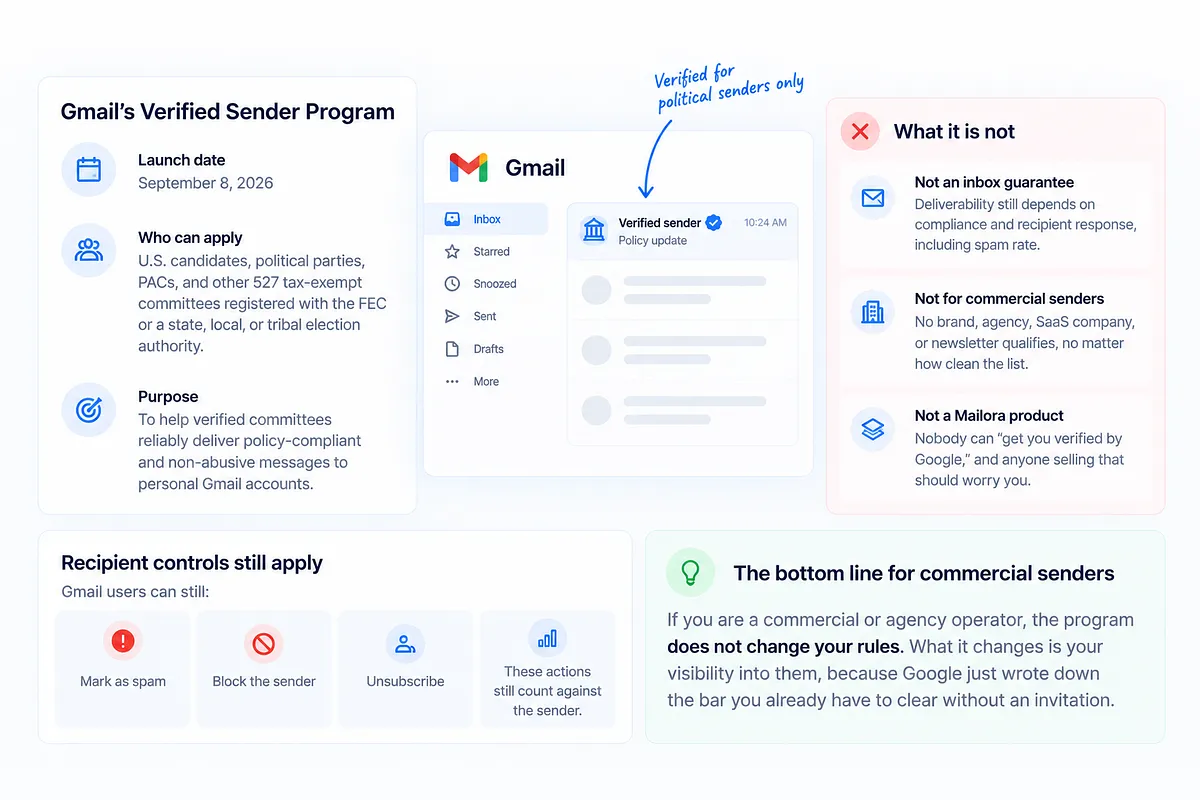
The program launches September 8, 2026. Eligibility is narrow: U.S. candidates, political parties, PACs, and other 527 tax-exempt committees registered with the FEC or a state, local, or tribal election authority. Google's stated purpose is to help verified committees reliably deliver policy-compliant and non-abusive messages to personal Gmail accounts.
It is not an inbox guarantee: Google's own FAQ says deliverability still depends on compliance and recipient response, including spam rate. It is not a commercial-sender program: no brand, agency, SaaS company, or newsletter qualifies, no matter how clean the list. And it is not a Mailora product: nobody can "get you verified by Google," and anyone selling that should worry you.
Recipient controls also survive intact. Gmail users can still mark verified political mail as spam, block the sender, and unsubscribe. Those actions still count against the sender.
So if you are a commercial or agency operator, the program does not change your rules. What it changes is your visibility into them, because Google just wrote down the bar you already have to clear without an invitation.
What Google documented vs. what headlines claimed
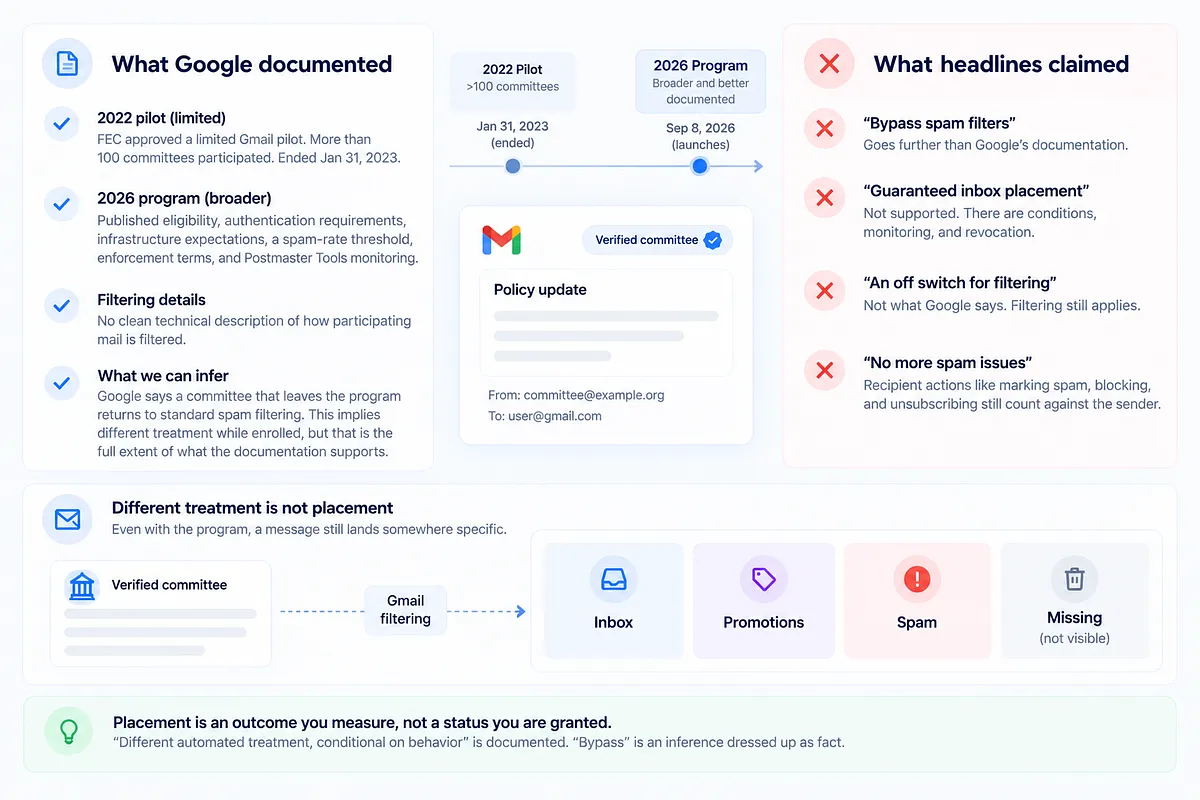
This is not Google's first attempt. In 2022, the FEC approved a limited Gmail pilot that gave enrolled committees different treatment with more weight on recipient choice. More than 100 committees participated, and the pilot ended on January 31, 2023. The 2026 program is broader and better documented: published eligibility, authentication requirements, infrastructure expectations, a spam-rate threshold, enforcement terms, and Postmaster Tools monitoring.
What Google does not publish is a clean technical description of how participating mail is filtered. The only documented inference available: Google says a committee that leaves the program returns to standard spam filtering. If exiting means returning to standard filtering, participating mail must get some different treatment while enrolled. That is the full extent of what the documentation supports.
Headlines saying verified committees "bypass spam filters" go further than the documentation does. Read the help center and you find conditions, monitoring, and revocation, not an off switch for filtering. "Different automated treatment, conditional on behavior" is documented; "bypass" is inference dressed up as fact.
Even different treatment is not placement. A message from a verified committee still lands somewhere specific: Inbox, Promotions, Spam, or nowhere visible at all. Placement is an outcome you measure, not a status you are granted. That was true before September 8 and it stays true after.
Identity is the enrollment gate, not the inbox
Enrollment runs through Campaign Verify, a nonpartisan 501(c)(3) that verifies U.S. political committees. The sequence: Campaign Verify confirms the committee itself, then verifies its sending domain. That domain must host the committee's public website or redirect to it. The committee also needs a verified Google Postmaster Tools account on that same domain. Once approved, enrollment becomes active within one to two business days and is visible in Postmaster's Compliance Status.
Every step of that answers who you are, not whether anyone wants your email.
This is the same shape commercial senders already know from SPF, DKIM, and DMARC. Authentication proves the message really came from your domain and was not altered in transit. Campaign Verify adds a stronger identity layer for a category where impersonation is a real abuse problem. But identity, at any strength, only opens the door.
Authentication is necessary but not sufficient. Reputation and recipient behavior decide whether the message stays in the inbox. Google built a whole enrollment pipeline around verified identity and still reserved the right to suspend anyone whose recipients hit the spam button too often. If a Google-run verification program cannot buy placement with identity alone, your DMARC policy certainly cannot either. It was never supposed to. It answers one question so the filtering can move on to the harder ones.
The operating rent: dedicated-enough infrastructure, predictable volume, 0.3%
Verification gets a committee in. Staying in costs ongoing operational discipline, and Google itemized the bill:
- SPF configured on the sending domain, and DKIM signatures from that same domain. Alignment, not just presence.
- Compliance with Gmail's general sender requirements and anti-abuse policies. The program sits on top of the bulk-sender rules, not beside them.
- Avoiding shared infrastructure. A shared IP does not block eligibility, but Google warns it can hurt classification, because co-tenants' behavior bleeds into yours.
- Reasonable, expected volume with gradual increases. Volume shape is a filtering input. Spikes read as anomalies.
- Content recipients are actually interested in, with one-click unsubscribe recommended and unsubscribe requests honored.
- A spam rate below 0.3% over a 14-day average. This is a condition of remaining in the program, not a best-practice suggestion.
Enforcement is specific: fall out of compliance and the committee faces a 7-day suspension or permanent termination. Fix the technical and spam-rate issues and re-enrollment happens automatically, per Google within 7 days. Otherwise the mail goes back through standard filtering.
Google also warns that what a sender considers solicited may not match what the recipient considers solicited, including people who opted in a long time ago and forgot. The spam button reflects the recipient's memory, not your consent records.
Now map each line item to something you can watch every week: SPF and DKIM alignment maps to authentication visibility. The 0.3% threshold maps to your complaint trend in Postmaster Tools. "Reasonable, expected volume" maps to your sending cadence and how sharply it moves. Shared infrastructure risk maps to IP and domain reputation monitoring. And all of it, together, maps to one output metric: where your mail actually lands in Gmail. Every one of those is measurable today, no enrollment required.
Wanted mail and legal mail are different questions
One more distinction the coverage blurred. U.S. law treats political email differently from commercial email: CAN-SPAM is built around commercial messages, and genuinely non-commercial political mail sits largely outside its unsubscribe mandates. That is a legal fact. It is not a deliverability fact, and it does not disable the spam button.
Recipients do not adjudicate statutes. They vote with the tools in front of them: open, ignore, delete, unsubscribe, or report. When unsubscribing is hard, the spam button becomes the emergency exit, and every press of it feeds the filtering models. That is why Google recommends one-click unsubscribe even for senders with thinner statutory obligations. Unsubscribe is not just compliance. It is a pressure-release valve that protects your complaint rate.
Gmail is a private inbox product, not a public utility. Google's obligation runs to the people who keep using the inbox, which is why every version of this program preserves recipient control. (None of this is legal advice on CAN-SPAM, FEC rules, or 527 status. Talk to counsel for that.)
For commercial senders, "allowed" and "wanted" are different questions with different referees. Legal review answers the first. The second is answered by complaint rates, engagement, and ISP-level placement, which is what email deliverability means in practice. You measure wanted-ness. You do not certify it.
What commercial senders should run this week (you will not be invited)
You cannot enroll, but you can extract the operating rules Google just published and apply them as your own. Four lessons transfer directly:
1. Identity is a prerequisite, not an entitlement. Google demanded verified identity from political committees and still tied their standing to recipient behavior. Run the same standard on yourself: SPF, DKIM, and DMARC aligned on every sending domain, checked continuously rather than at setup. Then treat that as the starting line.
2. Sender intent does not outrank recipient perception. Google warned committees that their definition of "unsolicited" may not match the recipient's. Your consent records are not the referee; the spam button is. Watch your complaint rate the way an enrolled committee has to watch 0.3%: as a standing condition, with old and cold segments under the most suspicion.
3. Predictable volume is a filtering input. Google asked committees for reasonable, expected volume and gradual increases, right before a fundraising season that rewards blasting. The commercial equivalent is Black Friday, a product launch, or a reactivation push. Test placement before you spike, then ramp in stages while watching what each stage does. Teams that treat this seriously build it into their calendar; the SaaS deliverability playbook shows what that looks like when transactional and marketing mail share a domain.
4. Easy unsubscribe protects reputation. One-click unsubscribe, honored promptly, converts silent resentment into a clean exit. A lost subscriber costs you a send. A complaint costs you standing with every future send.
No credential turns unwanted mail into wanted mail. Not DKIM, not a dedicated IP, not Campaign Verify, not a special Google program. Google built the strongest identity credential in email and still made recipient response the condition of keeping it.
The operating loop that follows: run a pre-send placement and authentication check, send, then read the post-send picture across Gmail, Outlook, and Yahoo alongside complaint movement and reputation trend, and pick one next step. Run that loop weekly, and before any deliberate volume change.
Measure the bar Gmail just published, then decide
Google can verify legitimacy, adjust automated treatment, and publish rules. What it cannot do is stop running an inbox people choose to keep using, which is why every requirement in this program points back at recipient behavior. For commercial senders, that makes the Verified Sender Program something better than news: a public spec of what Gmail already rewards, with the thresholds written down.
Campaign Verify can confirm who you are. It cannot confirm anyone wants the email. Mailora answers the second question: where your mail landed, why, and what to do next. Run a Gmail-inclusive placement test this week, and check your complaint rate and authentication alignment in the same pass.
---
FAQ
Can commercial brands or B2B senders join Gmail's Verified Sender Program?
No. Eligibility is limited to U.S. candidates, political parties, PACs, and other 527 tax-exempt committees registered with the FEC or a state, local, or tribal election authority, verified through Campaign Verify. Commercial senders reach the Gmail inbox the same way as before: authentication, low complaints, steady volume, and mail recipients want, all of which you can measure without enrolling in anything.
Does the Gmail Verified Sender Program mean political email skips the spam folder?
Not as documented. Google says enrolled committees can more reliably deliver policy-compliant, non-abusive messages, and that leaving the program returns mail to standard spam filtering, which implies some different treatment while enrolled. Google does not publish how that filtering works, and recipients can still mark verified mail as spam, block it, or unsubscribe. "Bypass" is headline language, not help-center language.
What spam complaint rate does Google require for verified political senders?
Below 0.3%, measured as a 14-day average, as a condition of staying in the program. Exceeding it can mean a 7-day suspension or permanent termination, with automatic re-enrollment once technical and spam-rate issues are resolved. Commercial bulk senders face the same 0.3% ceiling under Gmail's general sender requirements, which is why complaint trend belongs on every weekly dashboard.
Why does Google require Campaign Verify and Postmaster Tools if SPF and DKIM already exist?
SPF and DKIM prove a message came from a domain and was not altered. They do not prove who operates the domain. Campaign Verify adds that layer by confirming the committee itself and its registration with election authorities. Postmaster Tools is the monitoring half: it is where enrollment status appears under Compliance Status, and where spam rate is tracked against the 0.3% line. Identity plus monitoring, not identity alone.
What should non-political senders measure after reading Gmail's program rules?
The same four signals Google listed as conditions: authentication alignment (SPF, DKIM, DMARC on every sending domain), complaint rate trend in Postmaster Tools, volume shape (gradual ramps instead of spikes, especially before peak season), and unsubscribe friction. Then measure the outcome those inputs produce: actual placement in Gmail, Outlook, and Yahoo, per send. If you only pick one, run the placement test, because it tells you whether the other four are working.
Stay in the loop
Deliverability insights, product updates, and early access to new features. No spam, unsubscribe anytime.
By subscribing, you agree to our Privacy Policy. Unsubscribe anytime.