Deliverability Meaning: What Does "Deliverability" Actually Mean?
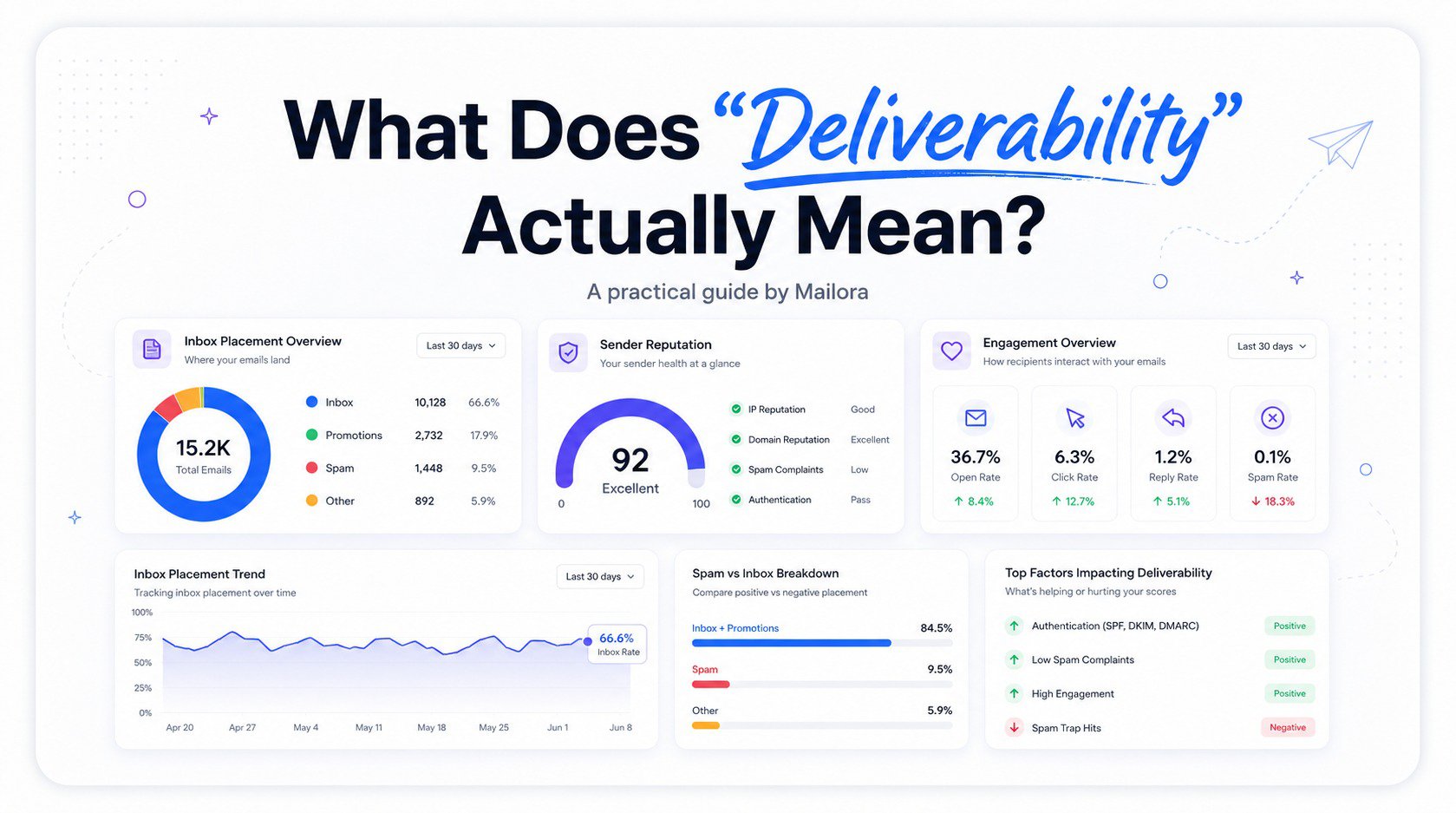
Ask five marketers to explain deliverability meaning and there's a good chance you'll get five slightly different answers. Some will point to delivery rate and email delivery. Others will mention spam folders. A few might mention sender reputation without quite explaining what that means either. This isn't because the term is inherently confusing. It's because deliverability sits at the intersection of several related but distinct concepts, and understanding the actual deliverability meaning, not just the vague sense of "getting emails through," makes a real difference in how a team approaches email marketing as an operational discipline.
A Simple Definition of Email Deliverability
At its core, the deliverability meaning that matters most is this: the ability of an email to actually reach a recipient's inbox and be seen, as opposed to being blocked, filtered to spam, or otherwise rendered invisible to the subscriber it was intended for. It's a measure of outcome, specifically whether a message achieves genuine visibility, not just whether it left the sender's system or was technically accepted somewhere along the way.
This definition matters because it centers on the recipient's actual experience rather than any single technical checkpoint. A message can clear every technical hurdle, get accepted by the receiving server, and still fail at deliverability if it ends up in a spam folder no one checks.
What Deliverability Is Not (Common Misconceptions)
The most common confusion around deliverability meaning is treating it as synonymous with delivery rate, the percentage of messages a receiving server accepts. Delivery rate is a narrower, purely technical metric. It confirms a server didn't reject a message outright. It says nothing about whether that message landed in an inbox, a promotions tab, or a spam folder.
| Misconception | What People Assume | What's Actually True |
|---|---|---|
| Deliverability = delivery rate | High delivery rate means success | Delivery rate only confirms server acceptance, not visibility |
| Deliverability = legal compliance | CAN-SPAM/GDPR compliance guarantees inbox placement | Compliance is necessary but doesn't influence reputation or engagement |
| Deliverability = a single score | A domain is either "good" or "bad" | Outcomes vary by provider and even by recipient |
The Factors That Make Up Deliverability Meaning
Deliverability emerges from the interaction of several distinct components, none of which is sufficient on its own to guarantee good outcomes:
- Authentication (SPF, DKIM, DMARC): establishes that a message genuinely originates from the domain it claims to represent. In particular, DMARC helps mailbox providers verify alignment and protect the domain from spoofing.
- Sender reputation: reflects a domain and IP's history, including complaint rates, bounce rates, spam trap hits, and sending consistency.
- Engagement: measures how recipients actually interact with messages, including opens, clicks, replies, and whether messages get moved out of spam.
- Infrastructure and sending behavior: covers DNS configuration, consistent sending volume, and clean list management practices, often managed through an ESP or email service provider.
Marketers can also use tools such as Litmus to preview emails across messaging environments and identify rendering issues before sending. None of these factors show up as a single, clean pass-or-fail signal, which is central to understanding deliverability meaning in practice rather than in theory.
Why Deliverability Is a Spectrum, Not a Score
One of the more counterintuitive aspects of deliverability meaning, once you understand its actual components, is that it doesn't resolve to a single pass or fail outcome. Two recipients on the same list, at the same mailbox provider, can receive the identical campaign with different results, one landing in the inbox and one in spam, based partly on their individual engagement history with the sender.
Different mailbox providers also evaluate the same sender differently, since Gmail, Outlook, and Yahoo each apply their own filtering logic and weighting. A domain can have excellent inbox placement at one provider and meaningfully worse placement at another, simultaneously.
How to Start Thinking About Deliverability Operationally
Once deliverability meaning is understood as an ongoing, multi-factor outcome rather than a one-time setup task, the practical implication is that it needs to be managed the way any other ongoing operational responsibility is managed, with continuous attention rather than a single project with a defined end date.
This means treating authentication configuration as something to verify periodically, not just set up once. It means watching reputation indicators like complaint rate and engagement trends over time, rather than only reacting after a visible drop in performance. It also means coordinating email collaboration, digital communications governance, and the use of automated agents so that sensitive data and risky behavior do not undermine email delivery.
Frequently Asked Questions
What is the simplest deliverability meaning to remember?
Deliverability is whether an email actually reaches and is seen in a recipient's inbox, not just whether a server accepted it. It's an outcome, not a technical checkpoint.
Is deliverability the same as spam score?
Not exactly. A spam score, where such tools exist, is typically a rough content-based estimate of how a message might be filtered. The deliverability meaning is broader, shaped by authentication, reputation, engagement, and infrastructure together.
Can a company have good deliverability with one email service provider and poor deliverability with another?
Yes, and this is fairly common, since deliverability is heavily tied to the sending domain and infrastructure's own history and reputation, which can differ across platforms. The same principle applies whether a company uses an all-in-one email marketing solution, a specialized ESP, or several platforms for different channels.
Why do marketers so often confuse deliverability with delivery rate?
Delivery rate is the metric most commonly surfaced by default in email service provider dashboards, and it's easy to interpret a high percentage as a sign of success. Understanding the true deliverability meaning starts with recognizing that delivery rate alone doesn't confirm inbox placement or conversions.
Learn how Mailora helps you see deliverability as it actually works, across authentication, reputation, and engagement, so you're managing the real picture instead of a single misleading metric—and creating measurable impact for your customers.
Stay in the loop
Deliverability insights, product updates, and early access to new features. No spam, unsubscribe anytime.
By subscribing, you agree to our Privacy Policy. Unsubscribe anytime.