What Is Spam Compliance? Why Checkbox Compliance Isn't Enough

Most businesses believe they're doing everything right when it comes to spam compliance.
They have an unsubscribe link in every campaign. Their privacy policy is up to date. Subscribers have opted in to receive emails, and authentication protocols like SPF, DKIM, and DMARC are correctly configured. From both a legal and technical perspective, their email program appears to follow every best practice.
Then the campaign is sent.
A few days later, the results tell a different story. Open rates are lower than expected, engagement declines, and customers begin mentioning that emails are landing in their spam folders. The immediate question is usually the same:
"If we're fully compliant, why aren't our emails reaching the inbox?"
The answer is that spam compliance and email deliverability are two very different concepts.
One helps businesses meet legal and regulatory requirements (including spam laws). The other determines whether mailbox providers trust your emails enough to place them in front of your audience.
Unfortunately, these concepts are often treated as if they were interchangeable. Many organizations assume that complying with regulations like the CAN-SPAM Act (or GDPR) automatically improves deliverability. While compliance is essential, it does not guarantee inbox placement. Mailbox providers evaluate a much broader set of signals that go far beyond legal requirements.
This misunderstanding leads to a false sense of security. Teams invest significant time ensuring every compliance box is checked, only to discover that technically correct emails can still be filtered into spam because mailbox providers are evaluating trust, reputation, and recipient engagement rather than legal documentation.
Understanding this distinction is becoming increasingly important as email providers continue refining their filtering algorithms. Today's inbox decisions are influenced by years of sender behavior, subscriber interactions, authentication, list quality, and consistency. Compliance is simply one piece of a much larger picture.
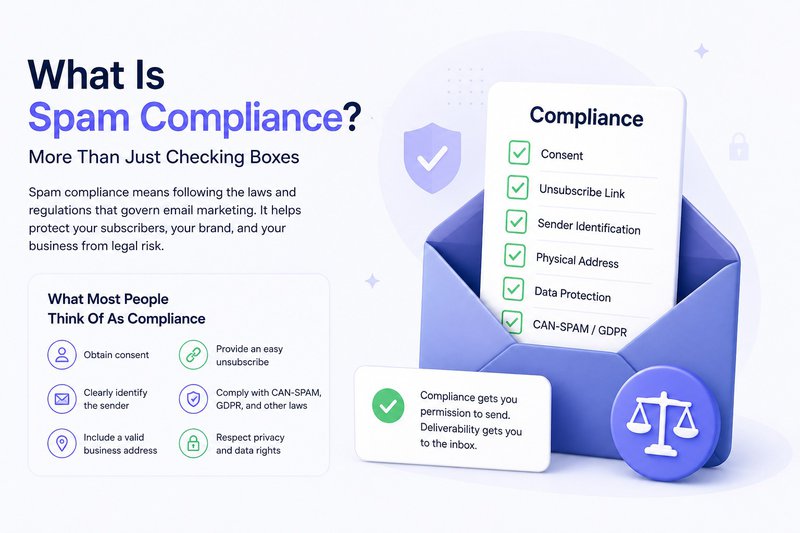
In this guide, we'll explain what spam compliance actually means, why it's only the starting point for successful email marketing, and what mailbox providers really evaluate before deciding whether your next campaign deserves a place in the inbox.
What Most People Mean by "Spam Compliance"
Ask someone in marketing what spam compliance means, and the answer will usually revolve around legal requirements.
They'll mention obtaining consent before sending marketing emails, including an unsubscribe link, identifying the sender clearly, displaying a valid business address, and complying with regulations such as the CAN-SPAM Act in the United States or GDPR in Europe. These requirements have become the standard checklist businesses work through before launching a campaign.
They're also extremely important.
Spam regulations exist to protect consumers from deceptive, misleading, or unwanted email practices across modern electronic communications. They establish clear expectations around transparency, consent, privacy, and user control. Without them, inboxes would quickly become overwhelmed with unsolicited and potentially harmful communications, including unwanted spam e-mail messages.
For organizations, complying with these regulations is not optional. It helps reduce legal risk, protects customer trust, and demonstrates responsible marketing practices.
The challenge is that many businesses stop there.
Once every legal requirement has been met, it's easy to assume the email program is fully optimized. The thinking often sounds something like this:
"We have permission from our subscribers."
"Our unsubscribe process works correctly."
"SPF, DKIM, and DMARC all pass."
"Our legal team approved the campaign."
From a compliance standpoint, those are all positive signs.
From a deliverability standpoint, however, you've only established the minimum requirements for sending email responsibly.
Think of it this way. Opening a restaurant requires permits, health inspections, and compliance with local regulations. Meeting those standards allows you to operate legally, but it doesn't guarantee customers will enjoy the food, recommend the restaurant to friends, or become loyal visitors.
Email marketing follows the same principle.
Compliance gives you permission to send emails.
Deliverability determines whether those emails are trusted enough to reach the inbox.
This distinction is often overlooked because compliance and deliverability appear closely related. Both involve email, both rely on technical configurations, and both influence the overall success of an email program. However, they exist for entirely different reasons.
Regulators want to ensure businesses communicate fairly and transparently.
Mailbox providers want to ensure their users receive emails they actually want to read.
Those objectives overlap, but they are not the same.
As a result, a company can be fully compliant with every applicable regulation and still experience poor inbox placement if recipients consistently ignore its emails or if its sender reputation begins to decline.
Understanding that difference is the first step toward improving long-term email performance.
Spam Compliance vs Deliverability
Although these terms are often used together, compliance and deliverability solve two completely different problems.
Compliance is concerned with legal responsibility (and avoiding certain fines and penalties).
Deliverability is concerned with trust.
When regulators evaluate your email program, they're asking questions such as:
- Have recipients given the appropriate level of consent? (In other words, is each recipient truly expecting the electronic mail message?)
- Can users unsubscribe easily (opt-out) using a clear internet-based reply mechanism, a valid return e-mail address, or an internet website preference center?
- Is the sender clearly identified (even when the message is a commercial advertisement, solicitation, or promotion for a commercial product)?
- Are personal data and privacy rights being respected?
Mailbox providers are asking a very different set of questions.
They want to understand whether recipients actually value your emails.
Every campaign generates behavioral signals that help providers make that decision. They observe whether recipients open your emails, click your links, reply to messages, delete campaigns immediately, report them as spam (reporting), or simply ignore them over long periods of time.
Notice what's missing from that evaluation.
Mailbox providers don't know whether your legal department approved the campaign. They aren't checking whether your privacy policy has been updated recently. Their primary objective is protecting the inbox experience for their users.
Every filtering decision is designed to answer one question:
"Is this an email our users are likely to find useful?"
That's why two businesses can send remarkably similar campaigns while achieving completely different results.
Imagine two software companies announcing a new product feature.
Both campaigns include proper consent, unsubscribe links, business information, and authenticated sending domains. Legally, they're almost identical.
The difference lies in how subscribers have interacted with previous campaigns.
One company has spent years sending relevant updates to engaged customers who regularly open, read, and click their emails. The other has continued sending promotional campaigns to subscribers who haven't engaged in months.
From the perspective of mailbox providers, these aren't equal senders.
One has demonstrated a history of positive engagement and responsible sending behavior.
The other has accumulated signals suggesting recipients are becoming less interested.
As a result, even though both companies meet the same legal requirements, one campaign is far more likely to reach the inbox than the other.
This is why businesses are often disappointed after investing time in technical improvements without seeing meaningful improvements in deliverability.
They configure authentication correctly.
They review consent records.
They update compliance documentation and internal practices.
Everything appears to be in order.
Yet inbox placement remains largely unchanged because the issue was never compliance in the first place.
Compliance reduces legal and regulatory risk.
Deliverability is earned through consistent trust, positive engagement, and responsible sending behavior over time.
Understanding this distinction changes how organizations approach email marketing. Instead of viewing compliance as the finish line, they begin treating it as the foundation upon which long-term deliverability is built.
In the next section, we'll look at the factors mailbox providers actually evaluate every time you send an email, and why those signals have a far greater influence on inbox placement than compliance alone.
What Inbox Providers Actually Evaluate
Once you've met the legal requirements for sending email, an entirely different evaluation begins.
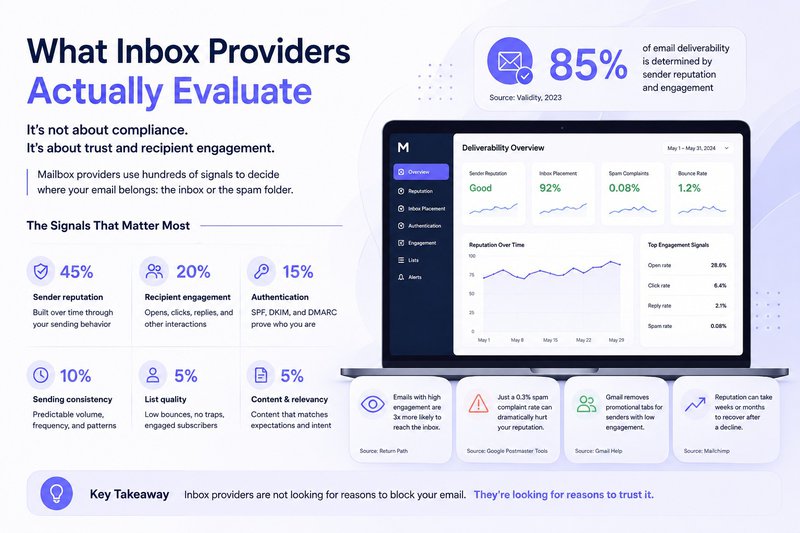
Every email you send passes through the filtering systems of mailbox providers like Gmail, Outlook, Yahoo, and Apple Mail. Their goal isn't to determine whether you're compliant with the CAN-SPAM Act, other CAN-SPAM legislation, or GDPR (which in the U.S. is enforced by regulators like the Federal Trade Commission). Instead, they're trying to answer a much simpler question:
Is this email likely to provide value to the recipient?
To make that decision, mailbox providers evaluate hundreds of signals that together form a picture of your credibility as a sender. No single metric determines whether an email reaches the inbox or the spam folder. Rather, it's the combination of your technical setup, historical sending behavior, recipient engagement, and overall reputation that influences the outcome.
This is why two companies can send nearly identical campaigns and experience completely different results. One consistently reaches the inbox, while the other struggles with spam placement despite following the same legal requirements. The difference usually isn't compliance, it's trust.
Sender Reputation Is Your Most Valuable Asset
If there is one factor that has the greatest influence on deliverability, it's sender reputation.
You can think of sender reputation as your business's credit score for email. It's built over time based on every campaign you send and every interaction recipients have with your messages. Mailbox providers continuously assess whether your domain and sending infrastructure have demonstrated responsible behavior or shown patterns commonly associated with spam.
This reputation isn't determined by a single campaign. Instead, it's influenced by dozens of signals working together, including complaint rates, bounce rates, spam trap hits, authentication status, engagement levels, sending consistency, and historical performance.
For example, imagine two SaaS companies launching a monthly product update. Both have valid consent from subscribers, include an unsubscribe link, and have properly configured SPF, DKIM, and DMARC. From a legal perspective, they're equally compliant.
However, Company A regularly removes inactive subscribers, sends highly relevant updates, and maintains strong engagement. Company B continues emailing contacts who haven't opened an email in over a year. Although the campaigns look similar, mailbox providers see two very different sender reputations, and that difference can significantly affect inbox placement.
Unlike compliance, reputation can't be achieved by checking a box. It has to be earned over time through consistent, responsible sending.
Recipient Engagement Matters More Than You Might Think
Mailbox providers have access to something regulators don't: recipient behavior.
Every time someone opens an email, replies, clicks a link, moves a message out of spam, or simply continues reading, it sends a positive signal. Likewise, when recipients delete emails without opening them, ignore campaign after campaign, or mark messages as spam, those actions gradually reduce the trust mailbox providers place in future emails from the same sender.
This is one of the reasons why email deliverability has become increasingly personalized. Providers aren't just evaluating whether an email is technically legitimate, they're observing how real people interact with it over time.
Imagine you subscribe to an electronic newsletter that consistently shares useful industry insights. You open it every week, occasionally click through to read an article, and sometimes even reply to the sender. Those interactions reinforce the idea that you value those emails.
Now compare that with a newsletter you subscribed to two years ago but haven't opened since. Even though you never marked it as spam, your lack of engagement still tells mailbox providers that the messages are becoming less relevant to you.
This shift towards engagement explains why sending fewer, more relevant emails often outperforms sending larger volumes to disengaged audiences. Deliverability isn't simply about reaching more inboxes, it's about reaching people who actually want to hear from you.
Authentication Builds Trust, But It Doesn't Guarantee the Inbox
Authentication is one of the most misunderstood aspects of email deliverability.
Many organizations assume that once SPF, DKIM, and DMARC are correctly configured, inbox placement should naturally improve. While authentication is essential, it solves a very specific problem: proving that your emails genuinely come from your domain and haven't been tampered with during delivery.
That's an important first step, but it doesn't tell mailbox providers whether recipients actually enjoy receiving your emails.
A useful analogy is airport security. Presenting a valid passport proves your identity, but it doesn't automatically grant access to every country. Additional checks still determine whether you're allowed to enter.
Email authentication works in much the same way. It establishes your identity, but your reputation, engagement, and historical behavior determine how much mailbox providers trust you once they've confirmed who you are.
This is why businesses are often surprised after fixing authentication issues only to discover that inbox placement barely changes. Authentication is a prerequisite for strong deliverability, not a complete deliverability strategy.
Consistency Is a Trust Signal
Mailbox providers don't just evaluate what you send. They also pay close attention to how you send.
A business that sends a weekly newsletter every Tuesday morning for several years creates predictable patterns that mailbox providers learn to trust. The audience is familiar with the cadence, engagement remains relatively stable, and the sending behavior appears consistent.
Problems often arise when that consistency disappears.
For example, a company that normally sends 5,000 emails per week suddenly launches a campaign to 250,000 contacts after several months of inactivity. Even if every address was collected legitimately, the dramatic change in volume and behavior can trigger additional scrutiny.
The same applies to sudden changes in audience, frequency, or sending infrastructure. Large spikes don't automatically send emails to spam, but they do encourage mailbox providers to examine your campaigns more closely.
Consistency helps build confidence because it demonstrates predictable, responsible sending habits over time.
Your Email List Is Always Changing
Many marketers treat list quality as something they solve once.
In reality, every email list begins changing the moment someone subscribes.
People change jobs. Companies shut down. Email addresses become inactive. Interests evolve. Some subscribers simply stop engaging over time.
This natural decay means that even a fully permission-based list requires ongoing maintenance.
Continuing to send campaigns to disengaged recipients doesn't just reduce your open rates, it can slowly damage your sender reputation. Mailbox providers notice when large portions of your audience consistently ignore your emails, and those patterns influence future inbox placement decisions.
Healthy email programs regularly remove invalid addresses, suppress long-term inactive subscribers, run re-engagement campaigns, and avoid the temptation to keep every contact forever simply because they once subscribed.
List hygiene isn't about making your database smaller. It's about ensuring the people on your list still want to receive what you're sending.
Content Still Matters, Just Not in the Way Many People Think
For years, marketers were told to avoid certain "spam words" like free, winner, or guaranteed.
Modern spam filtering is far more sophisticated than that.
Today's mailbox providers evaluate content within a much broader context. They look at how recipients have historically interacted with similar emails from your domain, whether your formatting appears trustworthy, whether links point to reputable destinations, and whether your campaigns consistently meet recipient expectations, including whether your subject line accurately reflects the content.
In other words, there isn't a single phrase that automatically sends your email to spam.
A promotional email can reach the primary inbox.
A plain-text email can land in spam.
The difference usually isn't one particular word, it's the level of trust you've built over time.
Deliverability Is the Result of Hundreds of Small Signals
One of the biggest misconceptions in email marketing is that deliverability can be fixed by solving one problem.
In reality, inbox placement is cumulative.
Every campaign contributes to your reputation. Every subscriber interaction provides another data point. Every technical improvement, every engagement trend, and every sending decision becomes part of the overall picture mailbox providers use to evaluate your emails.
That's why deliverability rarely improves overnight. Building trust takes time, and maintaining it requires continuous monitoring rather than occasional troubleshooting.
If your campaigns aren't performing as expected, the answer usually isn't to assume your emails are compliant. It's to understand which deliverability signals are working in your favor and which ones are quietly limiting your inbox placement.
Many deliverability problems remain invisible until campaign performance starts to decline. By the time open rates fall or replies disappear, the underlying issues have often been developing for weeks or even months.
Rather than guessing whether the problem is your content, authentication, reputation, or sending behavior, it's far more effective to monitor those signals continuously.
Mailora helps businesses understand how mailbox providers evaluate their email program by monitoring authentication, sender reputation, inbox placement, and other critical deliverability signals, so you can identify problems before they affect campaign performance.
One of the most common reasons businesses struggle with email performance is that they mistake compliance for success.
A campaign is reviewed by legal, every required element is included, authentication passes, and the email is sent with complete confidence. When engagement drops or messages begin landing in spam, the immediate reaction is often confusion.
"We've done everything right. Why isn't it working?"
The answer is that legal compliance and inbox placement measure two completely different things.
Compliance reduces legal risk. Deliverability measures trust.
When organisations stop at compliance, they often overlook the factors that have a much greater influence on inbox placement: declining engagement, inconsistent sending behaviour, list quality, or a damaged sender reputation. Those issues don't appear on compliance checklists, yet they're often the very reasons campaigns underperform.
The highest-performing email programs understand this distinction. They don't treat compliance as the finish line—they treat it as the foundation. Once the legal requirements are in place, the real work begins: building trust with mailbox providers and consistently earning a place in the inbox.
Building a Deliverability-First Compliance Strategy
If legal compliance is the foundation of responsible email marketing, what comes next?
The answer is building a strategy that focuses on earning and maintaining trust with both your subscribers and mailbox providers.
Many businesses approach email compliance as a project with a clear finish line. They update their privacy policy, configure an unsubscribe link, verify that SPF, DKIM, and DMARC are working correctly, and consider the job complete. Those steps are essential, but they don't create a high-performing email program on their own.
A deliverability-first strategy recognizes that compliance is simply the starting point. The real objective is to consistently send emails that recipients want to receive and that mailbox providers trust enough to place in the inbox.
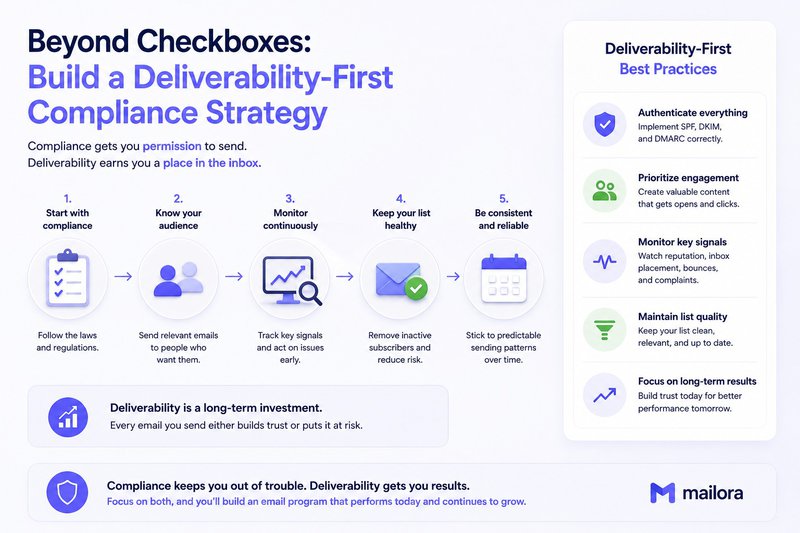
That requires shifting the conversation from "Are we compliant?" to "Are we sending emails that deserve to reach the inbox?"
Start With Compliance, But Don't Stop There
Every successful email program begins with legal compliance.
Your subscribers should know who is contacting them, why they're receiving emails, and how they can opt-out at any time. Consent should be collected appropriately, unsubscribe requests should be honored promptly, and your organization should comply with the regulations that apply to your audience.
These practices are not optional. They help protect both your business and your subscribers.
However, they should be viewed as the minimum standard rather than the ultimate goal.
Imagine opening a new retail store. Following building codes, obtaining permits, and passing inspections allows you to open the doors. It does not guarantee customers will visit, recommend your business, or return for future messages.
Email marketing works in much the same way.
Compliance gives you permission to communicate. Deliverability determines whether those communications are actually seen.
Focus on Building Trust Instead of Avoiding Penalties
Many compliance discussions revolve around avoiding fines or meeting legal requirements.
While those concerns are valid, they don't reflect how mailbox providers evaluate senders.
Providers like Gmail and Outlook are focused on protecting the inbox experience for their users. Every decision they make is based on trust.
That trust is built through consistent, positive interactions.
When recipients regularly open your emails, click through to your content, reply to your messages, or actively search for your newsletters, mailbox providers gain confidence that your emails belong in the inbox.
The opposite is also true.
If recipients repeatedly ignore your emails, delete them without reading, or report them as spam, that trust gradually declines.
This is why the most successful email marketers spend just as much time improving relevance and engagement as they do maintaining technical compliance.
Make List Quality an Ongoing Process
One of the biggest mistakes businesses make is treating list cleaning as a one-time activity.
An email list is constantly changing.
Subscribers change jobs, abandon old email addresses, lose interest, or simply stop engaging with your content. A list that was healthy six months ago may look very different today.
Instead of measuring success by the total number of subscribers, focus on the quality of your audience.
Regularly review engagement trends, identify inactive subscribers, and decide whether they should enter a re-engagement campaign or be removed from future mailings.
Although reducing the size of your mailing list may seem counterintuitive, sending relevant emails to engaged subscribers usually produces stronger long-term results than continuing to email people who stopped paying attention months ago.
Healthy lists contribute to healthy sender reputations.
Monitor Deliverability Instead of Waiting for Problems
Many organizations only investigate deliverability after they notice a significant decline in campaign performance.
By then, the underlying issues may have been developing for weeks.
A better approach is to monitor deliverability continuously.
Authentication failures, reputation changes, increasing bounce rates, declining engagement, and inbox placement issues often appear gradually rather than all at once. Detecting those trends early gives you an opportunity to address them before they begin affecting revenue or customer communication.
This is especially important for businesses that rely heavily on email for sales, onboarding, customer success, or transactional messaging (including a transactional message within an ongoing transactional relationship). For example, messages exempt from certain marketing requirements may still suffer deliverability problems if trust declines.
Waiting until open rates collapse is similar to servicing your car only after the engine fails.
Preventive monitoring is almost always less expensive than recovering from a damaged sender reputation.
Deliverability Is a Long-Term Investment
One of the reasons deliverability is often misunderstood is that it doesn't provide instant results.
There is rarely a single change that suddenly moves every campaign from the spam folder into the inbox.
Instead, strong deliverability is built through hundreds of consistent decisions made over time.
Every campaign contributes to your reputation.
Every subscriber interaction strengthens or weakens trust.
Every improvement to your list quality, authentication, segmentation, and content helps mailbox providers understand that your emails deserve to reach recipients.
Businesses that view deliverability as an ongoing process generally outperform those that only react when something goes wrong.
Rather than asking, "How do we fix this campaign?", they ask, "How do we build an email program that continues performing six months from now?"
That shift in mindset often makes the biggest difference.
The Bottom Line
Spam compliance is important.
Without it, businesses expose themselves to unnecessary legal and regulatory risk. Following regulations such as the CAN-SPAM Act and GDPR should always be part of a responsible email marketing strategy. For commercial purpose email, that includes being clear about the message’s primary purpose (for example, whether it’s a commercial advertisement versus a purely transactional message), and ensuring your disclosures, disclaimer language, and opt-out process are handled correctly.
However, compliance alone does not determine whether your emails reach the inbox.
Mailbox providers evaluate sender reputation, recipient engagement, authentication, sending consistency, list quality, and many other signals that have little to do with legal requirements. They are trying to determine whether your emails create a positive experience for their users, not whether every compliance checkbox has been completed.
The strongest email programs understand this distinction.
They build compliance into their processes from day one, but they also invest in monitoring, reputation management, audience engagement, and continuous optimization. Over time, those efforts create something far more valuable than legal compliance alone. They create trust.
And in email deliverability, trust is what earns inbox placement.
Understand Your Deliverability Beyond Compliance
If your campaigns aren't performing as expected, don't assume compliance is the problem or the solution. The most valuable insights often come from understanding how mailbox providers evaluate your emails after you press send.
Mailora helps businesses monitor the signals that matter most, including sender reputation, authentication, inbox placement, and deliverability trends. Instead of guessing why emails land in spam, you can identify the root cause and make decisions based on real data.
Whether you're managing a growing SaaS company, running campaigns for clients, or scaling outbound email, understanding your deliverability is the first step toward building an email program that consistently reaches the inbox.
(Practical note: many email platforms include a CAN-SPAM toggle or similar setting to classify a campaign as marketing vs. transactional, use it carefully, document the decision for regulatory affairs, and ensure your opt-out and contact details are correct. If you’re ever unsure, consult counsel or your internal teams, often marketing, human resources, and privacy, especially when emailing groups like prospective students or when coordinating with an external organization. If you need to reach a privacy office at a university, for example, you might be directed to an address like privacy@ua.edu in Alabama.)
Stay in the loop
Deliverability insights, product updates, and early access to new features. No spam, unsubscribe anytime.
By subscribing, you agree to our Privacy Policy. Unsubscribe anytime.