Key Takeaways
|
Google and Yahoo's bulk sender requirements apply once you send more than 5,000 messages in a day to their users, which is a useful benchmark for welcome programs because early lifecycle mail can ramp volume fast.
A welcome series is supposed to be your easiest win. The subscriber just signed up, intent is fresh, and engagement should be high. When deliverability slips here, it usually points to a deeper issue with source quality, identity setup, or pacing, not just subject lines.
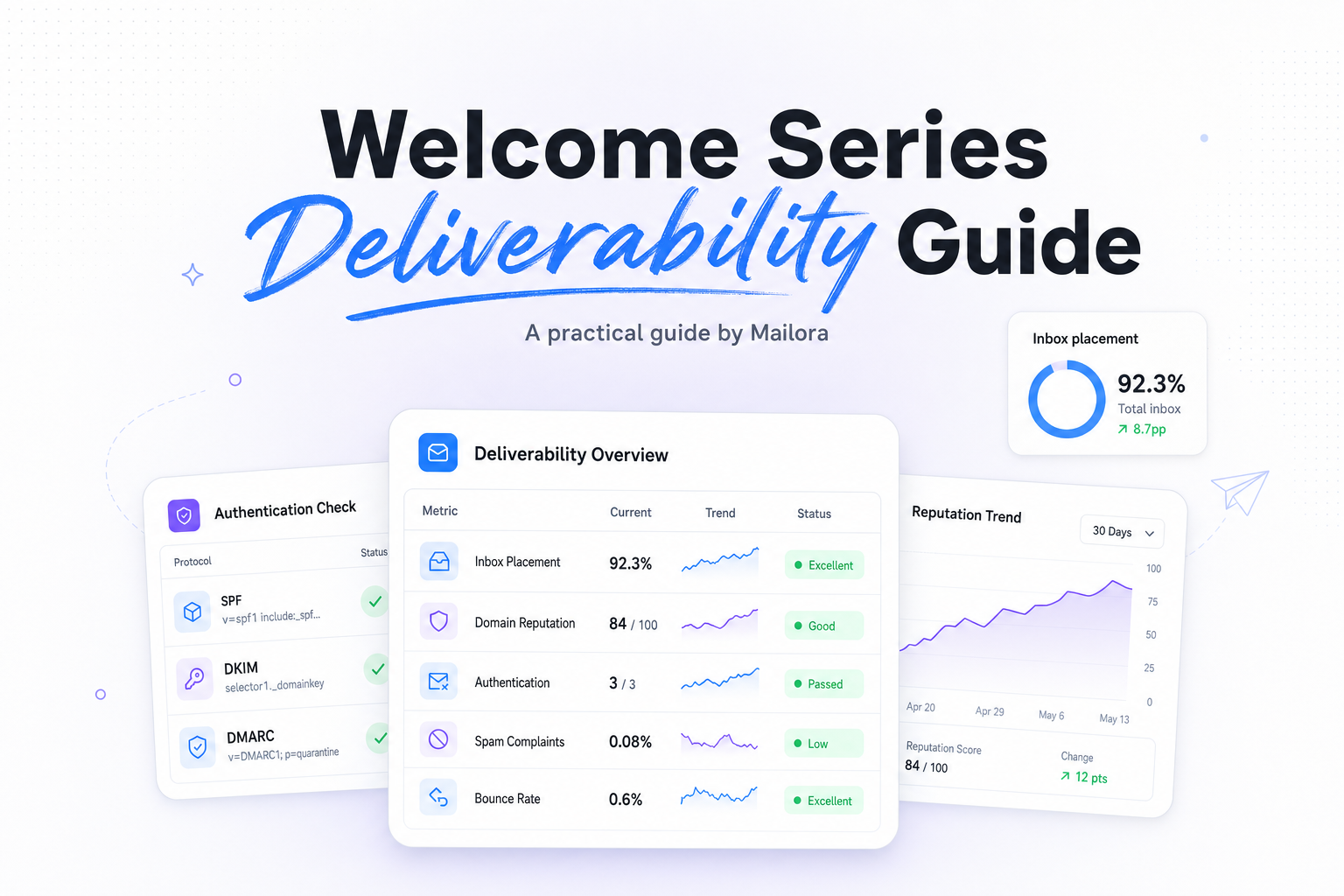
This guide focuses on the decisions that move inbox placement for welcome series mail, what to check before launch, how to structure sends by mailbox provider behavior, and which signals tell you to change course.
Why welcome series deliverability is different from regular campaigns
Welcome mail gets judged quickly because it generates a strong first-party signal set. Gmail, Outlook, Yahoo, and Apple Mail all observe some version of the same pattern, did the recipient expect this message, did they engage, did they ignore it, and did they mark it as spam. In a welcome flow, those answers show up faster than they do in a weekly newsletter.
That speed is useful when the program is clean. A high-intent signup source can produce strong opens and clicks, low complaint rates, and stable inbox placement within days. It is risky when forms are loosely gated, coupon-led, or fed by offline imports, because poor-fit addresses move into the flow immediately.
That is why a welcome series should be treated as a reputation-setting stream, not just a conversion stream. If your first message underperforms, the rest of the series usually gets dragged down with it.
Start with identity and alignment, before you tune content
Authenticate the exact sending path
Your welcome series should send from a fully authenticated domain and subdomain path, with SPF, DKIM, and DMARC aligned to the visible From domain where possible. This is table stakes, but it is still a common reason new flows underperform. If the brand signs up users on one domain and sends from another, mailbox providers see more ambiguity, especially during volume spikes.
Keep the From name stable, use a recognizable From address, and make sure links, tracking, and reply handling all match the brand identity the user saw at signup. If you are reviewing that setup, Mailora's deliverability test page is the natural place to validate the sending path, but because no related internal page list was provided here, I have not added body links beyond the required final CTA.
Align the signup promise with the first email
If the form offers a discount, early access, product education, or onboarding help, the first email should fulfill that promise immediately. The more mismatch between form language and email content, the more likely a user is to ignore, delete, or complain. Those are all negative signals, even when they do not show up as a formal spam complaint metric in your ESP.
A simple test is this, if a subscriber looked only at the form and the first email, would the connection feel obvious. If not, fix that before you optimize copy.
Control volume and cadence like a reputation decision
Do not let signup spikes flood your first touch
Welcome series volume is rarely linear. A promotion, product launch, paid social burst, influencer mention, or imported event leads can push one day of signups far above baseline. Mailbox providers notice sudden changes in volume, especially on streams with limited history.
If your normal welcome volume is 8,000 messages a day and a campaign pushes that to 40,000, do not assume the same inbox result. Sudden growth is not bad on its own, but it increases the importance of source quality and engagement consistency. If the extra signups are weaker, the first message absorbs the damage first.
Match timing to user intent
For most programs, the first welcome message should go out immediately or within a few minutes. That is when user expectation is highest. The second and third messages should follow the decision cycle of the product, not a fixed "one every day" rule.
Here is a practical way to think about cadence:
| Signup context | Recommended first 3 touches | Deliverability rationale |
|---|---|---|
| Coupon or retail signup | Immediate, 24 hours, 3 to 5 days | High short-term intent, fast action window, strong early engagement if the offer is clear |
| SaaS trial or product onboarding | Immediate, next key setup milestone, 2 to 4 days later | Behavior-based timing avoids unnecessary sends to inactive or blocked users |
| Content newsletter signup | Immediate, 2 to 3 days, then regular cadence | Too many early touches can create passive deletes before trust is established |
| Offline or event capture | Immediate confirmation, slower follow-up after engagement check | Higher risk of low recognition, so you want proof of interest before heavier sending |
If users are not engaging with message one, sending message two sooner usually makes placement worse, not better.
List source quality matters more than list size
Separate high-intent signups from low-certainty sources
Not all welcome series entrants are equal. A double opt-in website signup, a checkout opt-in, a webinar registration, and a badge scan from a trade show all create different levels of expectation. Blending them into one flow hides the real performance pattern.
At minimum, split your welcome entry sources by acquisition method and monitor each source's spam complaints, unsubscribes, and click-through rate separately. If one source is consistently weaker, slow it down, add confirmation, or remove it from the standard welcome stream.
Watch for hidden invalid and role-based addresses
Role accounts like info@, sales@, support@, and catch-all domains are common in B2B and partner signups. They are not always bad, but they often produce lower engagement and more routing variability. If your welcome audience includes a high share of these addresses, do not benchmark it against consumer web signups without adjustment.
Likewise, imported legacy leads should not enter the same welcome stream as brand-new subscribers. A contact who signed up 10 months ago at an event is not a welcome-series user anymore, even if your CRM says they are net new to email.
Design the first message for recognition, not maximum content
Front-load the reason for the email
The first screen should answer three questions instantly, who are you, why did I get this, and what should I do next. This is especially important in Apple Mail, where privacy protections reduce the value of opens, and in Outlook, where users may be quicker to triage mail based on sender recognition.
Put the signup context near the top when it helps. For example, "Thanks for signing up for product updates" or "Here is your 10% code from yesterday's checkout." Recognition reduces confusion, and less confusion means fewer deletes and complaints.
Keep the first send narrow
Trying to introduce the entire brand in one message usually hurts. One primary CTA, one clear value proposition, and one obvious reason to stay subscribed is enough. Long image-heavy emails can still work, but they are rarely the safest starting point for a new or newly scaled sending stream.
For warmups or after a deliverability dip, use simpler HTML, balanced text and image ratio, visible preheader text, and a working plain-text alternative. That does not guarantee inbox placement, but it removes avoidable technical friction.
Measure the signals that actually predict placement
Do not rely on opens alone
Open rate can still be directionally useful, but it is not a reliable single source of truth across Apple Mail and privacy-affected audiences. For welcome series deliverability, the stronger indicators are complaint rate, click rate, unsubscribe rate, bounce classification, reply rate where relevant, and seed-based or panel-based placement data if you have it.
A healthy welcome stream often shows better clicks and lower complaints than the rest of the lifecycle program. If that is not true, treat it as a sign to audit the signup source or message promise first.
Use source-level thresholds
Blended benchmarks create false confidence. A retail signup source might support a very different complaint and click profile than a B2B demo request flow. Set thresholds by source, domain family, and mailbox provider where volume allows.
For example, if Gmail placement drops while Yahoo remains stable, look first at engagement quality and send pacing to Gmail-dominant segments. If Outlook shows more deferrals, review authentication consistency and burst control. The fix is usually not the same across providers.
Common welcome series deliverability failures and what they usually mean
| Symptom | What it often indicates | First action |
|---|---|---|
| High opens, low clicks, weak downstream conversion | Apple Mail inflation or curiosity opens without message-match | Review CTA clarity and signup-to-email promise |
| Low opens and rising unsubscribes on message one | Poor recognition or weak source quality | Audit form language, source segmentation, and From identity |
| Spam complaints spike after a promotion | Volume jump from lower-intent traffic | Separate the source and slow follow-ups |
| Good Gmail results, weak Outlook results | Bursting, inconsistent reputation, or enterprise filtering issues | Reduce spikes and validate sending identity |
| Strong first email, steep drop in second and third | Cadence too aggressive or content too broad | Trigger later sends from behavior, not fixed time alone |
How RevOps and lifecycle teams should operationalize this
The best welcome series deliverability programs are owned across teams. Lifecycle owns timing and content logic. Deliverability owns sending identity, placement review, and domain-level monitoring. RevOps owns source tagging, CRM hygiene, and entry criteria. When those pieces are disconnected, the flow keeps sending but nobody can explain why performance changed.
A practical operating model is to review the welcome stream weekly by signup source and mailbox provider, then review monthly by domain reputation trend and conversion quality. That gives you enough granularity to catch damage early without overreacting to one soft day.
If you are launching a new brand, changing ESPs, or moving the welcome series to a new subdomain, treat the first 30 days as a controlled observation period. Limit variable changes, document source mix, and compare providers separately. The goal is not to chase every metric swing, it is to know which decision changed the result.
Related reading: email deliverability tools and spf and dkim deliverability.
Run your first deliverability test with Mailora, then use the results to confirm your welcome series is set up to earn the signals you want.
FAQs
How many emails should a welcome series have for good deliverability?
There is no fixed safe number. Most programs do well with 2 to 5 emails, but the right count depends on user intent, product complexity, and how quickly engagement drops after the first send.
Should welcome series emails be sent from the same domain as campaigns?
Usually yes, if that domain already has a strong reputation and clear brand recognition. If you split streams by subdomain, keep authentication and visible identity consistent so users and mailbox providers see the connection.
Is double opt-in necessary for welcome series deliverability?
Not always, but it is very effective for high-risk sources or brands with complaint issues. It improves certainty that the address is valid and that the user expects the first email.
Why does my first welcome email perform well but the second one tanks?
The most common causes are overly aggressive timing, weaker message relevance after the initial promise is fulfilled, or low-intent subscribers who were only interested in the first offer.
What is the most important metric to watch for welcome series deliverability?
If you must pick one operational signal, watch complaint rate on the first email by source. It is one of the clearest indicators of whether your acquisition promise and sending reality match.
Stay in the loop
Deliverability insights, product updates, and early access to new features. No spam, unsubscribe anytime.
By subscribing, you agree to our Privacy Policy. Unsubscribe anytime.