Why SPF and DKIM Don't Fix Email Deliverability Problems

Key Takeaways
- SPF and DKIM verify sender identity but do not guarantee inbox placement.
- SPF and DKIM deliverability depends on sender reputation as much as authentication.
- Recipient engagement, complaint rates, and sending consistency all influence deliverability.
- DMARC, or domain-based message authentication, reporting, strengthens authentication but cannot compensate for poor sending practices.
- Long-term inbox placement requires both technical configuration and trust.
- A hosting provider, mail administrator, and DNS server configuration can all affect email processes.
Email authentication is one of the first things people investigate when campaigns start missing the inbox. That is understandable because SPF, DKIM, and DMARC are essential technical controls that help mailbox providers verify the identity of a sender. However, many organizations assume that once authentication is configured correctly, their deliverability problems should disappear.
The reality is very different.
SPF and DKIM deliverability is a topic surrounded by misconceptions because authentication is only one component of a much larger evaluation process. Mailbox providers such as Gmail, Microsoft, and Yahoo do not make inbox placement decisions based solely on whether an email is authenticated. They also evaluate sender reputation, domain reputation, recipient engagement, sending consistency, complaint rates, bounce history, domain behavior, and dozens of additional trust signals.
This explains why two organizations can have identical authentication records while experiencing completely different inbox placement results. One consistently reaches the inbox while the other lands in spam, despite both passing every authentication check.
Understanding where SPF and DKIM fit into the overall deliverability ecosystem helps organizations stop chasing technical fixes that cannot solve strategic problems. Authentication is the foundation of trust, but it is never the complete picture.
Comparison: Authentication vs Deliverability
| Authentication (SPF & DKIM) | Deliverability |
|---|---|
| Verifies sender identity | Builds sender trust |
| Technical configuration | Sender reputation |
| Prevents spoofing | Recipient engagement |
| DNS records | Complaint & bounce rates |
| Message integrity | Sending consistency |
Why SPF and DKIM Deliverability Gets So Much Attention
Whenever someone reports that their emails are landing in spam, the first recommendation is usually to check SPF, DKIM, and DMARC.
There is a good reason for this. Authentication problems are relatively easy to identify and relatively easy to fix. Missing DNS records, invalid signatures, incorrect alignment, or configuration errors can all be detected using automated tools within minutes.
Compared to diagnosing sender reputation or engagement issues, authentication feels straightforward. It produces clear pass or fail results that give teams confidence they have identified the problem.
Unfortunately, this often creates a false sense of completion.
Many businesses successfully configure SPF and DKIM, see every technical check marked as "pass," and assume inbox placement will immediately improve. When nothing changes, frustration follows because the original assumption was incomplete.
Authentication confirms that an email is authorized to send on behalf of a domain. It does not guarantee that mailbox providers trust the sender behind that identity.
This distinction is critical because authentication establishes identity, while deliverability is ultimately built on trust earned over time.
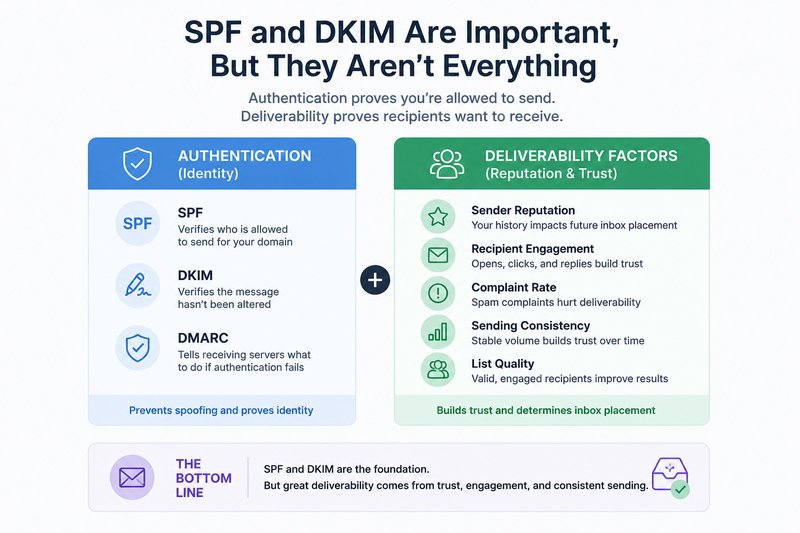
What SPF and DKIM Actually Do
To understand why authentication alone cannot solve deliverability problems, it helps to understand what these technologies were designed to accomplish.
SPF verifies who is allowed to send
Sender Policy Framework, commonly known as SPF, is an SPF protocol and sender policy framework that tells receiving mail servers which IP addresses or services are authorized to send email for a specific domain.
When an email arrives, the receiving server compares the sending IP address against the domain's published SPF record. If the sender is authorized, the SPF check passes, producing an SPF pass result. If not, the message may be flagged as suspicious or return an SPF fail. A softer policy can produce an SPF softfail when the sender is not authorized but the domain owner does not want the message immediately rejected.
SPF helps prevent unauthorized systems from pretending to send email from your domain, but it does not evaluate whether your sending practices are trustworthy.
A mail administrator may review the SPF record syntax, authorised servers, DNS lookups, and the domain's mail-related DNS records when troubleshooting failed emails. In some environments, these settings are managed through cPanel, WHM, or a hosting provider.
DKIM verifies message integrity
DomainKeys Identified Mail, or DKIM (also known as domainkeys identified mail and domain keys identified mail), works differently.
Instead of validating the sending server, DKIM digitally signs every outgoing message using a private cryptographic key. The receiving server uses the corresponding public key stored in DNS to verify that the email has not been modified during transmission. This DKIM signature supports DKIM authentication and confirms the message's integrity.
If the signature matches, the recipient knows the message remains intact and genuinely originated from the authenticated domain.
Again, DKIM confirms authenticity. It does not measure sender quality.
The digital signature is checked against the public key published in the DKIM record section of the DNS server. A valid signature helps confirm message content integrity, but it does not guarantee that recipient servers will accept or deliver the message to the inbox.
DMARC builds on both
DMARC, short for domain-based message authentication, reporting, and conformance, connects SPF and DKIM into a single policy that tells mailbox providers how to handle messages that fail authentication.
Organizations can choose to monitor failures, quarantine suspicious messages, or reject them entirely through a dmarc policy. A properly configured dmarc DNS record also generates dmarc reports, providing reporting and visibility into authentication activity across sending domains.
Although DMARC improves domain protection and reduces email spoofing, it still focuses on identity verification rather than inbox placement performance. A thoughtful dmarc deployment is important for email security, but it does not replace broader reputation management. DMARC checks can also help confirm alignment for a specified domain and identify unauthorized sources.
Authentication answers one question.
"Is this sender who they claim to be?"
Deliverability asks a much broader question.
"Do recipients actually want these emails?"
Those are entirely different evaluations.
Why SPF and DKIM Deliverability Depends on More Than Authentication
Authentication establishes technical legitimacy. Inbox placement depends on reputation.
Mailbox providers continuously evaluate whether recipients value messages from a sender. Every campaign contributes to an ongoing reputation profile that influences future delivery decisions.
Several factors often carry more weight than authentication itself.
Sender reputation
Sender reputation is one of the strongest predictors of inbox placement.
Every sending domain and IP address develops a history based on previous campaigns. Consistent engagement improves trust, while complaints, spam reports, hard bounces, and irregular sending patterns reduce it.
Even perfectly authenticated emails struggle when reputation deteriorates. A poor domain reputation can affect multiple email senders using the same domain, even when their individual authentication records are correct. This can weaken the overall email reputation associated with the domain name.
Recipient engagement
Modern mailbox providers monitor how recipients interact with incoming messages.
Opening emails, replying, forwarding, moving messages into folders, or marking emails as important all reinforce positive signals.
Ignoring emails, deleting them immediately, or marking them as spam sends the opposite message.
Mailbox providers interpret these behaviors as direct feedback about sender quality.
List quality
Poor mailing lists damage deliverability regardless of authentication.
Lists containing inactive subscribers, purchased contacts, invalid addresses, spam traps, or recipients who never requested communication create unnecessary risk.
Every bounce or complaint gradually weakens sender reputation.
Authentication cannot compensate for poor audience quality.
Sending consistency
Large fluctuations in email volume often trigger additional scrutiny.
Organizations that send ten thousand emails one week and two hundred thousand the next create unpredictable traffic patterns that mailbox providers may interpret as suspicious.
Steady, consistent sending behavior generally supports healthier reputation development.
Content relevance
Although modern spam filtering relies less on keyword detection than it once did, content still influences engagement.
Irrelevant messaging reduces opens and increases complaints. Poor personalization, misleading subject lines, and repetitive campaigns eventually affect sender reputation through recipient behavior.
The issue is rarely the wording itself.
The issue is whether recipients continue finding value in future emails.
Real Examples Where Authentication Was Perfect but Deliverability Failed
These situations occur every day across organizations of every size.
Scenario 1: The technically perfect cold outreach campaign
A B2B company launches a new outreach platform.
SPF passes.
DKIM passes.
DMARC enforcement is fully configured.
Every technical requirement appears correct.
However, the company immediately sends thousands of cold emails without warming the domain or establishing a sending reputation.
Open rates remain low.
Spam complaints increase.
Mailbox providers begin filtering campaigns into spam despite flawless authentication.
Nothing is technically broken.
The reputation simply never had an opportunity to develop.
Scenario 2: An ecommerce business with aging customer lists
An online retailer has authenticated every sending domain correctly.
Unfortunately, the business continues emailing customers who have not engaged for several years.
Bounce rates increase.
Inactive subscribers ignore campaigns.
Complaint rates slowly rise.
Inbox placement gradually declines.
Again, authentication remains perfect throughout the entire process.
The underlying problem is audience quality rather than technical configuration.
Scenario 3: Multiple marketing platforms
A growing company adopts several email platforms.
Marketing uses one provider.
Customer support uses another.
Sales introduces a separate outreach platform.
Each platform successfully implements SPF and DKIM.
However, one platform generates high complaint rates because of aggressive prospecting practices.
Mailbox providers evaluate the overall reputation associated with the domain rather than viewing each platform in complete isolation.
The actions of one sending source influence trust across the broader ecosystem.
Scenario 4: Seasonal volume spikes
A retailer sends relatively small volumes throughout the year.
During a major holiday promotion, email volume increases by several hundred percent within a few days.
Authentication works exactly as expected.
Even so, mailbox providers observe unusual sending behavior and temporarily limit inbox placement while evaluating the sudden change.
The problem is behavioral, not technical.
The Bigger Picture of SPF and DKIM Deliverability
Deliverability is an ongoing trust relationship between senders, recipients, and mailbox providers.
Authentication plays an essential role within that relationship because it establishes identity. Without it, mailbox providers cannot confidently determine who is sending the message.
However, identity alone is insufficient. Imagine applying for a business loan. Showing identification proves who you are. It does not automatically demonstrate financial responsibility, repayment history, or long-term credibility.
Email authentication works in much the same way.
SPF, DKIM, and DMARC verify identity.
Sender reputation demonstrates trustworthiness.
Recipient engagement demonstrates value.
Sending consistency demonstrates reliability.
List quality demonstrates responsible practices.
Together, these factors create the complete deliverability profile that mailbox providers evaluate every day.
Organizations that focus exclusively on authentication often overlook the operational decisions that truly influence inbox placement.
The most successful email programs continuously monitor authentication, reputation, DNS configuration, blacklist status, engagement trends, bounce patterns, complaint rates, and infrastructure changes as part of a unified deliverability strategy. They may also use email blacklist checks and platforms such as Valimail to support ongoing SPF implementation, SPF deployment, and DMARC status monitoring. Reviewing a dmarc overview or using a dmarc analyzer can help teams evaluate conformance across email systems.
Rather than treating authentication as the finish line, high-performing teams view it as the starting point.
Conclusion
SPF, DKIM, and DMARC remain fundamental components of modern email infrastructure. Every legitimate sender should configure them correctly because they protect domains from spoofing, establish sender identity, and support a trustworthy email ecosystem.
However, authentication should never be mistaken for a complete deliverability strategy.
If your emails continue landing in spam despite passing every authentication test, the answer is rarely another DNS adjustment. More often, the issue lies in sender reputation, engagement quality, list management, sending behavior, or long-term trust signals that mailbox providers evaluate continuously.
Improving inbox placement requires looking beyond individual technical checks and understanding how every aspect of your email program contributes to reputation over time. Reviewing the SPF record syntax, avoiding unnecessary DNS lookups counts, and understanding whether a policy uses ~all can help fix email deliverability, but these technical improvements must support a broader strategy. Teams should also review HELO configuration, PTR record settings, filtering behavior, and the requirements of each receiving domain.
Organizations that monitor the entire deliverability ecosystem instead of isolated authentication records are far more likely to achieve consistent inbox placement and maintain strong sender trust as their email programs grow.
Frequently Asked Questions
Does passing SPF and DKIM guarantee inbox placement?
No. Passing SPF and DKIM only confirms that your email is authenticated. Mailbox providers also evaluate sender reputation, recipient engagement, complaint rates, bounce rates, and sending behavior before deciding whether an email reaches the inbox.
Can emails go to spam even when SPF, DKIM, and DMARC all pass?
Yes. This is extremely common. Authentication verifies identity but does not guarantee trust. Poor sender reputation or weak engagement can still result in spam placement.
What is more important than email authentication?
Email authentication is essential, but sender reputation is often the stronger predictor of inbox placement. Reputation is influenced by recipient engagement, list quality, complaint rates, bounce rates, and consistent sending practices.
Should I use DMARC if SPF and DKIM are already configured?
Yes. DMARC builds on SPF and DKIM by defining how authentication failures should be handled and providing valuable reporting about who is sending on behalf of your domain. Reviewing dmarc reports can also reveal unauthorized or unauthenticated domains and help identify SPF alignment issues. A clear dmarc policy gives the receiving domain instructions for handling failed emails.
How can I improve deliverability beyond SPF and DKIM?
Focus on maintaining clean mailing lists, sending relevant content, warming new domains carefully, monitoring sender reputation, reducing complaint rates, and continuously tracking authentication and infrastructure changes. Deliverability improves when technical configuration and responsible sending practices work together, helping protect outgoing email legitimacy and provide email phishing protection. Testing with test emails can also confirm that email systems, authorized servers, and authentication records behave as expected.
Stay in the loop
Deliverability insights, product updates, and early access to new features. No spam, unsubscribe anytime.
By subscribing, you agree to our Privacy Policy. Unsubscribe anytime.