SPF Alignment: How It Works & Why It Fails (2026 Guide)
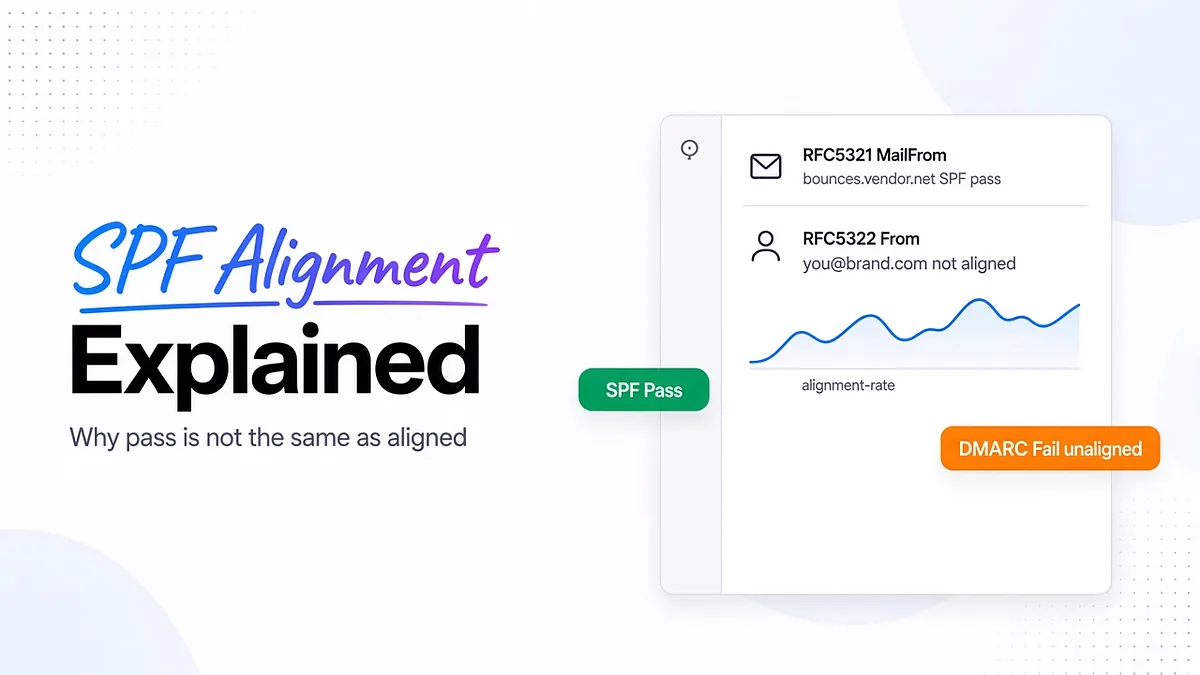
Your email can pass SPF and still fail DMARC.
That single fact explains most of the confused support tickets in email authentication. Passing and aligning are two different checks, and plenty of senders never discover the gap until inbox placement drops. The pattern is almost always the same: a new ESP, CRM, or outbound tool gets added to the stack, its bounce address doesn't match your From domain, and a slice of your sends quietly starts landing in spam with no obvious cause.
This guide explains exactly how SPF alignment works, why it breaks, how to choose the right alignment mode for each email stream, and how to catch failures before they cost you the inbox. We see this pattern constantly at Mailora because we treat alignment as a live deliverability signal, mapping misaligned sources back to the platforms and campaigns causing them, not a one-time DNS box to tick.
What SPF Alignment Actually Means
SPF authentication answers one question: is the server that delivered this message authorized to send for the domain in the bounce address? The receiving server looks up that domain's SPF record, checks whether the connecting IP is listed, and returns pass or fail.
SPF alignment asks a different question: does the domain that passed SPF match the domain your recipient actually sees in the From line?
A message can pass the first check and fail the second. If your campaign goes out through a sending platform whose bounce address lives on the platform's own domain, SPF passes for the platform's domain, not yours. The authentication is real. It just isn't attached to your identity.
This matters because DMARC, not SPF alone, decides how mailbox providers treat your identity. DMARC only credits an SPF pass when the passing domain aligns with your From domain. Unaligned SPF is a valid credential presented for the wrong name.
Getting the record itself right is the prerequisite, of course. If you're still building or auditing yours, start with these SPF record examples and come back; everything below assumes a syntactically valid record.
The Two Domains That Must Match: RFC5321.MailFrom vs. RFC5322.From
Every email carries two sender identities, and the entire concept of SPF alignment lives in the gap between them.
- RFC5321.MailFrom, also called the envelope sender or Return-Path: the address used during the server-to-server transaction, and where bounces go. Recipients never see it unless they open the raw headers.
- RFC5322.From: the From header displayed in the mail client. This is the identity your recipient trusts.
SPF is evaluated against the first. Your recipient judges the second. Here's where each lives in a real delivered message:
Return-Path: <bounces@em.vendormail.net>
From: Maya at Example <maya@example.com>
Subject: Your March report is ready
SPF was checked against em.vendormail.net, the vendor's bounce domain, and passed. But the From domain is example.com. Those two domains share nothing, so SPF is unaligned and contributes zero to DMARC for example.com.
This is the default configuration of many sending platforms. They route bounces through their own domain so they can process them for you, which is operationally convenient and breaks your alignment out of the box. The fix, covered below, is a custom Return-Path domain. First, the rules that govern what counts as a match.
Strict vs. Relaxed SPF Alignment (aspf=s vs. aspf=r)
Your DMARC record's aspf tag sets how strictly the Return-Path domain is compared to the From domain:
- Relaxed (aspf=r): the default when the tag is unspecified. The two domains align if they share the same organizational domain. So bounce.example.com in the Return-Path aligns with example.com in the From.
- Strict (aspf=s): the two domains must match exactly. bounce.example.com no longer aligns with example.com.
The same choice exists for DKIM via the adkim tag. Here's how common scenarios map to each mode:
Return-Path domain | From domain | Relaxed (aspf=r) | Strict (aspf=s) |
| example.com | example.com | Aligned | Aligned |
| bounce.example.com | example.com | Aligned | Not aligned |
| example.com | mail.example.com | Aligned | Not aligned |
| vendormail.net | example.com | Not aligned | Not aligned |
Two takeaways. Relaxed mode tolerates the subdomain structures real infrastructure uses, which is why it's the default and the right starting point for most senders. And no mode rescues a genuinely foreign domain: a vendor bounce domain never aligns, strict or relaxed.
How SPF Alignment Fits Inside DMARC
DMARC passes when at least one of two conditions holds: SPF passes and aligns with the From domain, or DKIM passes and aligns with the From domain. One aligned pass is enough.
That "or" is your safety margin, and it's worth engineering deliberately. SPF alignment is the more fragile of the two pillars, for a structural reason: SPF authorizes IP addresses, and the authorized IP changes the moment anyone forwards your mail. A DKIM signature travels inside the message; an IP authorization does not.
The data bears this out. In a study of 1.1 billion forwarded messages across 118 domains, roughly 73 percent of forwarding-induced DMARC failures came from SPF breaking down, versus about 21 percent from DKIM signatures damaged by content modification. If your DMARC pass depends on SPF alignment alone, every forwarded message is a coin flip.
So the practitioner posture is: fix SPF alignment because it's your first line and it's diagnosable, but always secure aligned DKIM as the durable fallback. Senders with both aligned survive conditions that break senders with either one.
Why SPF Alignment Fails: The Real Failure Modes
When aligned SPF breaks, it's nearly always one of six causes. Treat each as an operational signal pointing at a specific part of your stack, not just a config typo.
1. Third-party senders using their own Return-Path. The dominant cause. The platform routes bounces through its domain, SPF passes for the vendor, and alignment fails for you. Any newly added tool is suspect number one.
2. Forwarding. A recipient's mailbox forwards to another address, the forwarding server's IP isn't in your SPF record, and SPF fails outright. You can't fix this in your record; you survive it with aligned DKIM.
3. The 10 DNS lookup limit. SPF permits at most 10 DNS lookups per evaluation. Every include: in your record, and every include nested inside those, counts. Stack enough platforms and your record silently exceeds the cap, returning a permanent error that receivers treat as a failure. If your record has grown by accretion over years, this deserves an audit. Here's how to fix SPF permerror when you find one.
4. Syntax errors. A stray character, a duplicate SPF record on the same domain, or a malformed mechanism can invalidate the whole record. These often appear right after a DNS change made for an unrelated reason.
5. Subdomain mismatches under strict mode. If someone set aspf=s, every stream using a bounce subdomain like bounce.example.com fell out of alignment on the spot, even though nothing about the sending changed.
6. DNS propagation delays. After publishing or editing a record, receivers may see stale data for hours. Failures in the window right after a DNS change may resolve themselves; failures that persist past propagation are real.
Notice what these have in common: most are triggered by change. A new tool, a DNS edit, a policy tweak. Alignment doesn't decay on its own; your stack changes underneath it.
How to Check and Validate SPF Alignment
Validation is a two-domain comparison, and you can run it in minutes.
Check a real message. Send to a mailbox you control and open the full headers. Find the Return-Path line and the From line, and compare their domains. Then read the Authentication-Results header, where the receiving server records its SPF verdict and the domain it evaluated. If SPF shows pass but the evaluated domain isn't yours or a subdomain of yours, you've found unaligned SPF.
Check the record. Use an SPF record lookup to confirm the record on your Return-Path domain is valid, within the 10 lookup limit, and includes every platform that legitimately sends for you.
Check every stream, not just one. Marketing, transactional, outbound, and internal notifications often ride different infrastructure with different Return-Path configurations. One aligned stream tells you nothing about the other four. An email deliverability test that inspects authentication and alignment across providers gives you the per-stream picture in one pass.
One caution before you check the box and move on: a one-time check proves alignment at a point in time. Alignment silently breaks the moment someone adds a new sender, an ESP changes its bounce handling, or a DNS record gets edited. Validation tells you where you stand today; only monitoring tells you when that changes.
How to Fix SPF Alignment Failures
Remediation maps cleanly to the failure modes. Work through it in this order:
- Configure a custom Return-Path (bounce) domain at each sending platform. Nearly every serious ESP supports this: you point a subdomain like bounce.example.com at the platform via CNAME, and it starts using your subdomain as the envelope sender. SPF now passes for a domain that aligns with your From under relaxed mode. This one change fixes the majority of alignment failures.
- Set up custom DKIM signing at the same time. While you're in the platform's domain settings, complete DKIM authentication for your domain too. This gives you the aligned DKIM fallback that survives forwarding.
- Review your aspf mode. If your DMARC record carries aspf=s, confirm that was a deliberate decision and that every legitimate stream uses an exact-match Return-Path. If not, relaxed is almost certainly the right setting.
- Audit the SPF record itself. Count lookups, remove includes for platforms you no longer use, and fix syntax issues. A lean record is both safer and easier to reason about.
- Re-test after propagation. Give DNS changes time to propagate, then re-run your checks against a fresh send. Confirm the Authentication-Results header now shows an aligned pass.
Each fix ties to a specific failure mode: custom Return-Path solves vendor misalignment, DKIM solves forwarding, the mode review solves strict-mode surprises, and the record audit solves permerrors.
Choosing Your Alignment Mode: A Decision Framework
Most guides stop at defining strict and relaxed. The useful question is which mode each of your email streams should run under, because the trade-off is real: strict alignment is a tighter anti-spoofing posture, but it turns any misconfigured legitimate sender into blocked mail.
A stream-by-stream framework:
Email stream | Typical infrastructure | Recommended posture |
| Transactional (receipts, resets) | Dedicated subdomain, single platform | Relaxed; strict only if the Return-Path exactly matches the From domain and is verified |
| Marketing / lifecycle | ESP with custom bounce subdomain | Relaxed; subdomain bounce domains make strict impractical |
| Outbound / sales sequences | Separate sending domains, multiple tools | Relaxed, with aggressive monitoring; these stacks change too often for strict |
| Internal / corporate mail | Google Workspace or Microsoft 365 | Relaxed by default; strict feasible if all mail flows through one verified path |
The honest general rule: strict SPF alignment is rarely worth its operational cost, because relaxed mode already refuses to align foreign domains, which is the actual threat. Strict mode's marginal gain is protection against an attacker who controls a subdomain of your own organizational domain, a narrow scenario, while its cost is fragility across every legitimate subdomain-based bounce configuration you run. Tighten only when your DMARC reports show sustained exact-match alignment from every legitimate source, and treat the setting as reversible.
SPF Alignment Across a Modern SaaS Email Stack
A typical growth-stage company sends as one brand through five or more systems: an ESP for marketing, a CRM or marketing automation platform for lifecycle, transactional infrastructure for product email, an outbound sequencer for sales, and a workspace provider for corporate mail.
Picture the stack as a hub and spokes. Your domain sits in the middle; every platform is a spoke with its own Return-Path configuration, its own DKIM setup, and its own failure modes. Alignment is only as strong as the weakest spoke, because mailbox providers build reputation at the domain level. A misaligned outbound tool spraying unaligned mail doesn't just hurt the outbound stream; it degrades the domain reputation that your transactional and marketing mail depend on. The password-reset email pays for the sales sequencer's misconfiguration.
The common pitfalls in stack form: the marketing ESP got its custom bounce domain configured on day one because an expert set it up; the outbound tool added eight months later by the sales team didn't. The CRM was aligned until it migrated bounce infrastructure and nobody re-verified. The workspace provider is fine until someone adds a routing rule that relays mail through an unauthorized gateway.
The operational answer is an explicit sender inventory: for each From domain, list every platform authorized to send as it, each platform's Return-Path domain, and each platform's DKIM signing domain. Review it whenever a tool is added or changed. Most stack-level alignment incidents trace to a sender that never made it onto anyone's list.
The Deliverability Cost of Misalignment
Misalignment gets framed as a security concern, which lets revenue teams ignore it. The more accurate framing: it's a measurable inbox-placement risk with a delayed fuse.
While your DMARC policy is p=none, misaligned mail flows normally and the failures accumulate invisibly in reports. Under p=quarantine, misaligned mail goes to spam. Under p=reject, it's refused outright. The fuse burns down the day someone, your IT team, a security audit, a mailbox provider requirement, moves the policy to enforcement.
And the ecosystem is mid-transition on exactly this. In a study of 5.5 million domains, about 30.4 percent had DMARC records at all, and only around 12.8 percent of DMARC-enabled domains enforced quarantine or reject. Under-enforcement is still the norm, which means most senders' misalignment hasn't been punished yet. Meanwhile Google, Yahoo, and Microsoft now require authentication for bulk senders, with unauthenticated mail facing permanent 550 rejections. The direction of travel is one way.
There's also a resilience gap hiding in the adoption numbers: only about 48.5 percent of DMARC-enabled domains deploy both SPF and DKIM, while roughly 43 percent rely on SPF alone. That 43 percent is one forwarding hop away from a DMARC failure on any given message. Persistent misalignment plus enforcement equals lost campaigns; misalignment plus SPF-only dependence equals fragility even before enforcement.
Monitoring SPF Alignment as a Live Signal
Everything above describes alignment at a point in time. The operating discipline is treating it as a signal that moves.
Your DMARC aggregate reports are the raw feed: every mailbox provider that receives your mail sends periodic XML reports listing each source IP that sent as your domain, with per-source SPF and DKIM results and alignment outcomes. Buried in that XML is exactly what you need, which sources are misaligned, at what volume, since when.
Operationalizing it means three things:
- Per-source alignment rates over time, not a single blended percentage. A domain that's 95 percent aligned overall can be hiding one fully broken platform.
- Thresholds and alerts. A source dropping from 99 to 90 percent aligned inside a week is an incident in progress, and catching it in 24 hours instead of at month-end is the difference between one bad send and thirty.
- Attribution back to platforms and campaigns. An IP address in an XML file is a clue; "your outbound sequencer's new sending pool is unaligned as of Tuesday" is a decision. Mapping failures to the specific platform, IP range, and campaign is the step that turns reports into fixes.
This is the layer Mailora operates continuously as part of ongoing deliverability monitoring: alignment tracked per source, dips flagged as they happen, and failures traced to the platform responsible, so the fix lands before the reputation damage does.
A 48-Hour Runbook for Alignment Failures at Scale
When DMARC reports show an alignment failure spike, run this sequence.
Hours 0 to 4: Scope it. Pull the affected date range from your DMARC data. Which source IPs are failing? What volume? Is the failure SPF-only, or are DKIM failures rising too? SPF-only failures with intact DKIM usually mean a Return-Path or record change; both failing together often means a new, completely unconfigured source.
Hours 4 to 12: Identify the source. Match the failing IPs to a platform. Check platform documentation for their sending ranges, and correlate the failure start time against your change log: tools added, DNS edits, ESP settings changed, campaigns launched. If the IPs match nothing you recognize, treat it as potential spoofing and confirm your policy posture before panicking about deliverability.
Hours 12 to 24: Assign the owner. Vendor Return-Path misconfiguration belongs to whoever administers that platform, usually marketing ops or RevOps. DNS record problems belong to IT. A rogue tool someone connected without authentication setup belongs to that team's lead, with marketing ops guiding the fix. Naming an owner in hour 12 beats a three-way email thread in week two.
Hours 24 to 40: Apply the fix. Custom Return-Path, DKIM setup, record repair, or shutting off the unauthorized sender. Allow for DNS propagation.
Hours 40 to 48: Verify recovery. Send fresh test messages through the affected stream and confirm aligned passes in the Authentication-Results header. Then watch the next cycle of DMARC data to confirm the failing source's alignment rate recovers. The incident closes when the reports say so, not when the config screen does.
Frequently Asked Questions
What's the difference between SPF passing and SPF alignment?
SPF passing means the delivering server was authorized by the SPF record of the Return-Path domain. SPF alignment means that Return-Path domain also matches your visible From domain. A message sent through a vendor platform can pass SPF for the vendor's domain while remaining unaligned for yours, and only an aligned pass counts toward DMARC.
Should I use strict or relaxed SPF alignment for my sending domain?
Relaxed for almost everyone. Relaxed mode already refuses to align foreign domains while tolerating the bounce subdomains that legitimate platforms use. Strict adds protection only against subdomain-level spoofing of your own organizational domain, at the cost of breaking any stream whose Return-Path isn't an exact match. Consider strict only when your DMARC reports show sustained exact-match alignment from every source.
Why does SPF alignment fail when emails are forwarded?
Forwarding re-delivers your message from the forwarding server's IP, which isn't in your SPF record, so SPF fails before alignment is even evaluated. This is structural to SPF and can't be fixed in your record. The durable answer is aligned DKIM, which travels with the message and survives forwarding as long as content isn't modified.
Can I pass DMARC if SPF alignment fails?
Yes. DMARC needs only one aligned pass, so a message with failed SPF alignment still passes DMARC if its DKIM signature verifies and the signing domain aligns with the From domain. This is exactly why configuring custom DKIM at every platform matters: it's your fallback when SPF alignment breaks.
How do I check whether my SPF is aligned with my From domain?
Send a message to a mailbox you control, open the full headers, and compare the Return-Path domain to the From domain. Then confirm via the Authentication-Results header that SPF passed for a domain matching or subdomained under your From domain. For coverage across all your streams and providers at once, run a deliverability test that reports authentication and alignment per source.
Alignment Is a Signal, Not a Setting
The senders who keep their inbox placement stable share one habit: they stopped treating SPF alignment as DNS homework and started treating it as a live signal, validated before any new sender goes live, watched continuously after every send, and traced to a specific platform the moment it dips.
Your stack will change. Tools will be added, bounce domains will migrate, records will be edited. Alignment health is simply whether you find out before the mailbox providers do.
See where you stand today: run your first deliverability test and get a per-stream read on your SPF and DKIM alignment before your next campaign goes out. Send with confidence.
Stay in the loop
Deliverability insights, product updates, and early access to new features. No spam, unsubscribe anytime.
By subscribing, you agree to our Privacy Policy. Unsubscribe anytime.