Shared IP vs Dedicated IP: Deliverability Impact
Key Takeaways
|
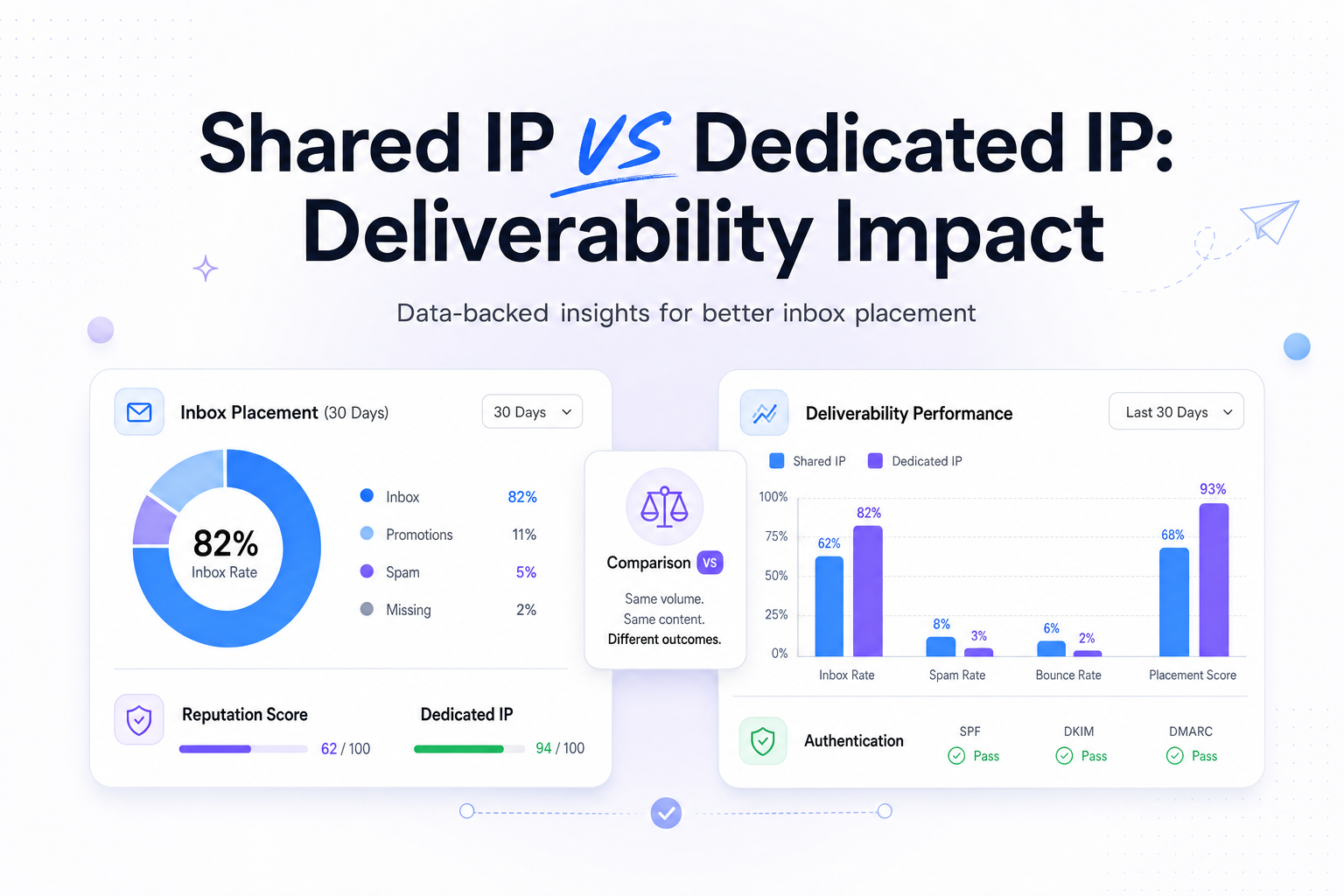
Google says bulk senders should keep spam complaints below 0.3%. That single number explains why the shared IP vs dedicated IP decision matters, because your infrastructure either gives you a stable reputation base or puts all reputation pressure on your own program from day one.
In practice, IP type rarely fixes a deliverability problem by itself. Gmail, Outlook, Yahoo, and Apple Mail look at domain reputation, authentication, user engagement, and complaint patterns, then use the IP as one more trust signal. The right decision depends on your sending volume, consistency, segmentation, and operational control.
If you send predictable lifecycle and transactional mail every day, a dedicated IP can make sense. If your volume swings hard between launches, newsletters, and quiet weeks, a well-managed shared IP often produces steadier inbox placement with less operational overhead.
How IP choice actually affects deliverability
The IP is part of the sender reputation stack, not the whole stack. ISPs use it to understand who is sending, how often they send, and what kinds of recipient reactions follow. When complaint rates rise, hard bounces spike, or volume jumps suddenly, the IP is often where throttling shows up first.
That matters most at Gmail and Outlook, where reputation is built from patterns over time. A shared IP spreads that pattern across multiple senders under a provider's governance. A dedicated IP concentrates that pattern around your own mail only. Neither model is inherently superior, but each creates different operational tradeoffs.
Think of it this way. A shared IP gives you pooled history and shared risk. A dedicated IP gives you isolated history and isolated accountability. For deliverability teams, that is the real decision.
When a shared IP helps
A shared IP is usually the safer choice when your volume is modest, your sends are inconsistent, or your program is still maturing. If you send 20,000 one week, 250,000 during a product launch, then 15,000 the next week, a dedicated IP will struggle to build stable reputation signals. A well-managed shared pool can smooth that volatility.
This is why shared infrastructure often performs well for SaaS lifecycle programs, early-stage B2B newsletters, and brands that send in bursts. Your ESP's deliverability team can absorb some of the operational complexity by shaping traffic, isolating bad actors, and maintaining healthier aggregate history.
The catch is obvious. Your outcome depends partly on your provider's standards. If the pool is tightly governed, shared IPs can be excellent. If pool hygiene is weak, another sender's complaints or spam traps can create collateral damage. That is why evaluating the provider matters as much as choosing the model.
Shared IP advantages
- Better fit for lower or inconsistent volume
- Less warm-up work for your team
- More resilience when campaigns create irregular spikes
- Often faster time to stable inboxing for newer programs
Shared IP risks
- Less direct control over neighboring senders
- Provider quality varies widely
- Harder to isolate your exact reputation contribution when performance changes
When a dedicated IP helps
A dedicated IP makes the most sense when you send enough mail, consistently enough, to create your own reputation signal. That usually means daily or near-daily volume, predictable patterns, and a team that can actively manage segmentation, suppression, and complaint monitoring.
This is often a strong fit for larger ecommerce brands, high-volume B2C lifecycle programs, and senders with substantial transactional traffic. If you are sending password resets, receipts, shipping updates, lifecycle automation, and campaigns every day, you may have enough stable volume to support a dedicated reputation.
The benefit is control. If performance drops at Gmail or Outlook, you know the signal is yours to investigate. You are not guessing whether a pool neighbor created noise. That cleaner attribution is valuable for RevOps and lifecycle teams who want tighter feedback loops between audience quality, message strategy, and inbox placement.
Dedicated IP advantages
- Full control over IP reputation
- Cleaner diagnostics when performance changes
- No exposure to another sender's poor practices
- Useful for separating transactional and marketing traffic
Dedicated IP risks
- You must warm it up correctly
- Low or erratic volume can weaken reputation signals
- Every complaint, bounce, and spike maps directly to your program
Warm-up and consistency matter more than the label
This is where teams often overestimate the value of a dedicated IP. A new dedicated IP starts with no trust history, so ISPs need to see measured growth, steady cadence, and good recipient reactions before they treat it as reliable. If you move too much volume too fast, especially to less engaged segments, Gmail and Outlook can throttle or spam-folder mail long before your program reaches normal scale.
Consistency matters just as much as warm-up. A sender putting 50,000 engaged messages a day through a dedicated IP will usually build stronger signals than a sender who alternates between 5,000 and 500,000 based on campaign calendar pressure. Dedicated IPs reward discipline. Shared IPs are often more forgiving when discipline is still a work in progress.
That is also why domain reputation usually deserves more attention than IP type. If your authentication is incomplete, your complaint rate is rising, or your audience selection is too broad, changing IP strategy will not solve the root cause.
Shared IP vs dedicated IP for common sending scenarios
| Scenario | Usually better fit | Why |
|---|---|---|
| Early-stage newsletter with irregular sends | Shared IP | Inconsistent volume is easier to absorb in a healthy pool |
| SaaS lifecycle program with moderate daily traffic | Shared IP | You benefit from established history unless your volume becomes highly predictable |
| Large ecommerce brand with daily campaigns and transactional mail | Dedicated IP | Consistent volume supports independent reputation and clearer diagnostics |
| High-volume transactional stream such as receipts or OTPs | Dedicated IP | Critical mail benefits from isolation and tight reputation control |
| Seasonal sender with sharp launch spikes | Shared IP | Dedicated reputation is harder to stabilize when volume fluctuates heavily |
How to make the decision without guessing
Use three filters. First, look at volume. If you do not have consistent daily or near-daily traffic, dedicated IPs are harder to justify. Second, look at control. If your team can monitor complaint rates, bounce trends, and engagement by segment every send, you are better positioned for dedicated infrastructure. Third, look at traffic type. If transactional and marketing mail have very different risk profiles, isolation can be worth it.
A good practical test is whether you can keep your best audience flowing steadily during a warm-up period of several weeks, not just during a launch window. If the answer is no, shared IP is often the more stable choice. If the answer is yes, and your program already has strong list hygiene and authentication, dedicated IP can give you better control.
For most teams, the best decision is the one that matches operational reality. A shared IP is not a compromise if it fits your volume pattern. A dedicated IP is not an upgrade if your sending behavior cannot support it.
Related reading: email deliverability tools and spf and dkim deliverability.
Run your first deliverability test with Mailora
FAQs
Is a dedicated IP always better for deliverability?
No. A dedicated IP is better only when your volume is consistent enough to build a healthy reputation and your team can actively manage warm-up, complaints, and segmentation.
Can a shared IP hurt my sender reputation?
It can if the pool is poorly managed, but strong shared pools often perform very well. The provider's standards and enforcement matter more than the shared model itself.
How much volume do I need for a dedicated IP?
There is no universal cutoff, but you generally want reliable daily or near-daily traffic. The less consistent your volume, the less value you usually get from a dedicated IP.
Does Gmail care more about domain reputation or IP reputation?
For most modern programs, domain reputation is usually the stronger signal. IP reputation still matters, especially during warm-up or when traffic patterns change sharply.
Should transactional and marketing mail use the same IP?
Not always. If your transactional stream is high value and time sensitive, separating it can protect critical mail from campaign-driven complaint or engagement swings.
Stay in the loop
Deliverability insights, product updates, and early access to new features. No spam, unsubscribe anytime.
By subscribing, you agree to our Privacy Policy. Unsubscribe anytime.