Key Takeaways
|
Google and Yahoo began enforcing stricter bulk sender requirements in 2024 for senders reaching 5,000 or more messages a day to their users. That changed the baseline for every ESP, including Moosend, because authentication, complaint control, and unsubscribe handling now affect deliverability much more directly.
If you use Moosend, the question is not whether the platform is “good” or “bad” for deliverability. The real question is whether your sending setup, audience management, and campaign behavior give Gmail, Outlook, Yahoo, and Apple Mail enough positive signals to trust your mail.
This guide breaks down how to evaluate moosend email deliverability in practical terms, what Moosend can help with, where you still need process discipline, and what to fix first when inbox placement starts to soften.
What moosend email deliverability actually depends on
Moosend provides the sending infrastructure, campaign builder, automation features, and standard reporting you would expect from a modern ESP. That matters, but inbox placement is still driven by a wider set of signals than the platform alone controls.
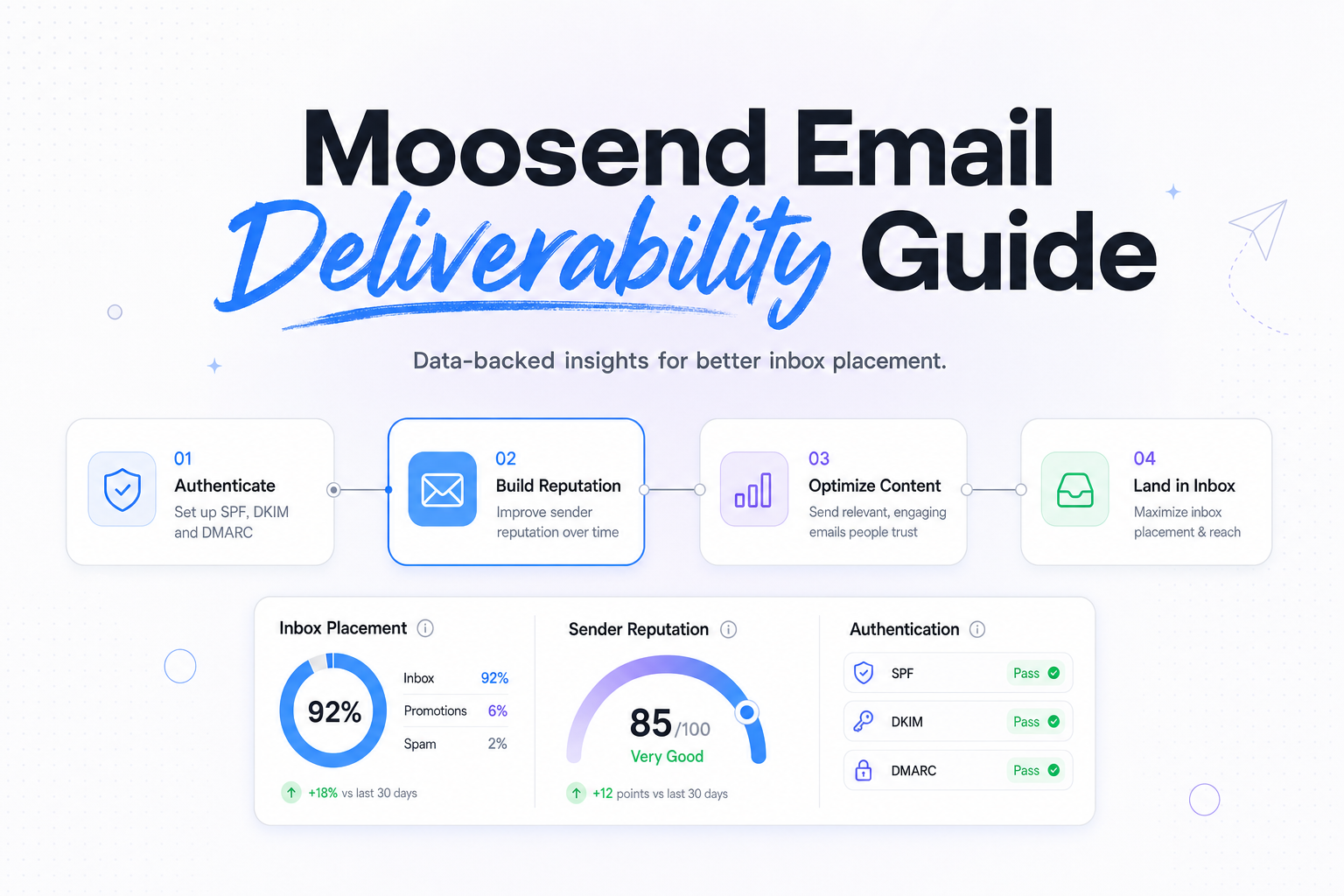
Mailbox providers typically weigh four areas together: domain authentication, sender reputation, recipient engagement, and message-level trust signals. If one of those weakens, a clean campaign inside Moosend can still land in spam or the promotions tab.
- Authentication, SPF, DKIM, and ideally DMARC aligned to your sending domain
- Reputation, complaints, unknown users, spam trap exposure, and recent sending behavior
- Engagement, opens, clicks, replies, deletions without reading, and list-level inactivity
- Content and consistency, template quality, link reputation, send cadence, and unsubscribe experience
A useful mental model is this: Moosend is the delivery vehicle, but your domain reputation is the driver's record. Mailbox providers care more about the driver than the car.
How Moosend fits into your deliverability stack
What Moosend can do well
Moosend can support strong deliverability when the fundamentals are in place. You can authenticate a branded sending domain, manage segmentation, build lifecycle automations, and monitor campaign-level engagement trends. Those are all meaningful inputs to sender reputation.
For many teams, especially mid-market SaaS, ecommerce, and B2B programs, Moosend gives enough operational control to run a disciplined sending program. If your acquisition sources are clean and your lifecycle logic is sound, Moosend is not inherently a blocker.
What Moosend does not solve by itself
No ESP can guarantee inbox placement across Gmail, Outlook, Yahoo, and Apple Mail. Moosend reporting may show a successful send and acceptable open rates, but it cannot fully explain where filtering happened, how a domain is trending before a campaign goes out, or whether a message is reaching the primary inbox versus spam.
| Area | What Moosend covers | What your team still owns |
|---|---|---|
| Authentication | Sending domain setup support | Correct SPF, DKIM, DMARC alignment and DNS governance |
| Campaign execution | Templates, lists, automations, scheduling | Segmentation logic, cadence, and suppression policy |
| Reporting | Sends, opens, clicks, bounces, unsubscribes | Cross-ISP diagnostics, inbox placement validation, reputation monitoring |
| List quality | Basic contact management | Acquisition hygiene, re-engagement rules, inactive pruning |
That is why teams often pair an ESP with external validation. You need to know what is happening before send, during delivery, and after filtering decisions are made by mailbox providers.
Set up the basics correctly before you judge performance
Authenticate your domain fully
If you are evaluating moosend email deliverability without SPF, DKIM, and DMARC in place, you are not really evaluating the platform. You are testing how tolerant mailbox providers are of an incomplete setup.
At minimum, your Moosend sending domain should publish valid SPF and DKIM records, and DMARC should be configured so recipient systems can evaluate alignment. For bulk senders, these are now standard requirements, not advanced optimizations.
Make sure the visible From domain, DKIM signing domain, and return-path strategy are aligned as closely as possible. That helps Gmail and Yahoo interpret mail as legitimately tied to your brand instead of a loosely associated third-party sender.
Use a branded tracking domain if available
Link tracking can become a quiet source of distrust when it points to a generic shared domain instead of your brand. A branded tracking domain reduces the mismatch between the message sender and the URLs inside the email, which can improve trust signals and help with user confidence too.
Confirm one-click unsubscribe behavior
For marketing mail, especially at volume, fast and visible unsubscribe handling matters. If users cannot leave easily, complaint rates go up, and that damages reputation faster than most content issues. A clean unsubscribe path protects both compliance posture and deliverability.
The biggest deliverability risk in Moosend is usually list quality, not templates
Most inboxing problems blamed on an ESP actually start upstream in acquisition and audience management. If you import old CRM contacts, sync broad webinar lists, or keep sending to six-month inactive users, Gmail and Outlook will notice the disengagement pattern long before you do.
Watch these four list signals closely
- Hard bounce rate, persistent unknown users suggest stale or risky acquisition sources
- Spam complaint rate, even low rates can hurt, especially at Gmail and Yahoo
- Unsubscribe rate, rising unsubscribes often warn that cadence or targeting is off
- Inactive share, a growing pool of non-readers drags down positive engagement signals
If your audience has not opened or clicked in 90 to 180 days, depending on your send frequency and sales cycle, that segment should not receive the same volume as recent engagers. Suppressing or tapering non-engaged users is often the fastest way to stabilize a weakening sender reputation.
Related reading: email deliverability tools and spf and dkim deliverability.
When you want to pressure-test whether a decline is list-driven or infrastructure-driven, a dedicated deliverability test workflow that checks placement and message signals helps separate audience problems from technical ones.
How Gmail, Outlook, Yahoo, and Apple Mail change the way you read Moosend metrics
Gmail rewards consistency and engagement depth
Gmail looks beyond the basic send outcome. Consistent volume, low complaints, strong recent engagement, and clean authentication all help. Large spikes, poorly targeted blasts, and reviving cold contacts too aggressively often show up as promotions tab pressure first, then spam placement if the pattern continues.
Outlook can be less transparent and more reputation-sensitive
Outlook and Microsoft-hosted mailboxes often frustrate teams because filtering behavior can change before campaign metrics clearly reflect it. That is one reason to avoid judging deliverability only by Moosend open and click reports. Message acceptance does not automatically mean inbox placement.
Yahoo still reacts strongly to complaints and list hygiene issues
Yahoo's 2024 requirements moved closer to Google's on bulk sender expectations. If complaint rates rise or authentication is incomplete, you have less margin for error than many teams assume.
Apple Mail can distort your engagement read
Apple Mail Privacy Protection makes opens less reliable as a pure engagement signal. Inside Moosend, that means you should evaluate clicks, site activity, conversions, replies, and downstream behavior alongside opens, not instead of them.
If your team is still relying on open rate as the main health check, it helps to review how deliverability testing complements campaign metrics so you are not making reputation decisions from inflated Apple Mail opens.
Moosend sending practices that usually improve inbox placement
Segment by recency first
If reputation is unstable, send first to users who opened, clicked, or converted recently. A simple 30-day engaged segment often performs better than a full-file campaign and sends stronger trust signals to Gmail and Outlook.
Ramp volume instead of jumping
Going from 20,000 emails one week to 200,000 the next is a classic cause of filtering pressure. If you are launching a new domain, new IP allocation, or a reactivated list in Moosend, increase volume in steps and keep your best-engaged users at the front of the curve.
Separate lifecycle from batch campaigns
Password resets, receipts, trial onboarding, and other high-intent lifecycle messages should be logically separated from lower-intent promotional traffic when possible. Different engagement profiles create different reputational outcomes, and mixing them too closely can blur what is actually working.
Control frequency with real thresholds
Frequency fatigue shows up before recipients complain. If your weekly sends per contact have doubled in the last 30 days, expect unsubscribes and complaints to rise unless segmentation got meaningfully tighter. More volume is not automatically more pipeline.
How to troubleshoot moosend email deliverability when results drop
Start with the change log
Ask what changed in the last 14 to 30 days. Common triggers include importing a dormant list, adding a new acquisition source, increasing send frequency, changing domains, or using a new template with more tracked links.
Compare by ISP, not just total performance
If Gmail dropped while Outlook stayed flat, the problem is rarely random. Gmail-specific filtering often points to engagement quality, domain trust, or list recency issues. If Outlook dropped harder, reputation and content-level trust issues may deserve a closer look.
Check suppression policy
If Moosend is still mailing contacts who have shown no signal for months, tighten your rules. A common fix is to pause broad sends to 90-day or 180-day inactives, then reintroduce only if re-engagement proves they still want the mail.
Review acquisition sources
Lead sources with weak intent often create the largest deliverability drag. Co-registration, old event lists, loosely verified demo forms, and purchased or rented contacts can all poison results inside an otherwise clean Moosend account.
When the source quality is uncertain, using a pre-send deliverability test to validate how mailbox providers are likely to treat the message can help you decide whether the issue is the audience, the message, or the domain setup.
What good looks like for a Moosend program
A healthy Moosend setup is not defined by a single open-rate benchmark. It looks more like this: authenticated branded domain, clear unsubscribe path, stable volume, recent-engagement segmentation, hard limits on inactive users, and monitoring that goes beyond campaign dashboards.
For RevOps and lifecycle teams, the goal is not perfection. The goal is a repeatable system where you can explain why Gmail improved, why Outlook softened, or why a larger send should be held back until the audience mix is safer. That is what lets you send with confidence instead of guessing from campaign summaries after the fact.
Run your first deliverability test with Mailora
FAQs
Is Moosend good for email deliverability?
Moosend can support good deliverability, but results depend more on your domain setup, list quality, segmentation, and complaint control than on the ESP alone.
Why are my Moosend campaigns delivered but not reaching the inbox?
Accepted delivery only means the receiving system took the message. Gmail, Outlook, and Yahoo may still place it in spam or secondary tabs based on reputation, engagement, and content signals.
What should I check first if Moosend open rates fall?
Check recent changes to volume, audience source, inactivity levels, authentication, and ISP-specific performance. Also account for Apple Mail open inflation before treating opens as the main diagnosis signal.
Does Moosend handle SPF, DKIM, and DMARC for me?
Moosend can support the sending setup, but your team still needs to publish and maintain the right DNS records and alignment on your domain.
How often should I remove inactive contacts in Moosend?
There is no universal threshold, but many teams start reducing sends to contacts with no engagement in 90 to 180 days, based on frequency, sales cycle, and mailbox-provider response.
Stay in the loop
Deliverability insights, product updates, and early access to new features. No spam, unsubscribe anytime.
By subscribing, you agree to our Privacy Policy. Unsubscribe anytime.