Valimail Pricing: A Practical Breakdown for Buyers Evaluating DMARC Vendors
Key Takeaways
|
Introduction
If you've searched "Valimail pricing," you've probably hit the wall most buyers hit: Valimail doesn't publish a simple price list you can forward to a manager. There's a free tier, a sales-assisted quote process for anything beyond it, and plan names that don't map cleanly onto "what do I need to get to p=reject."
That's a normal pattern for DMARC and authentication vendors. Valimail isn't unusual here. But it makes evaluation slower than it should be, especially if you're trying to figure out whether DMARC enforcement alone solves the deliverability problem you're actually worried about. It doesn't, and the "Does DMARC Enforcement Alone Improve Deliverability" section below explains why.
This piece covers what's publicly known about Valimail's pricing tiers, what the free plan gets you, how Valimail's pricing model works mechanically (domains versus volume versus seats), and what else to budget for once DMARC is handled. Pricing details are flagged as verified at a point in time, because vendor pricing pages in this category change faster than blog posts get updated.
One note on scope: this is not a full DMARC tutorial. If you need the complete mechanics of SPF and DKIM alignment, that's a different post. Here, DMARC gets explained just enough to make the pricing tiers make sense.
DMARC in 60 Seconds: Why This Line Item Exists at All
DMARC (Domain-based Message Authentication, Reporting and Conformance) is a DNS TXT record published at _dmarc.yourdomain.com. It tells receiving mail servers how to check that SPF and DKIM results align with the domain in the "From" header, and what to do if they don't.
A basic record looks like v=DMARC1; p=none; rua=mailto:reports@yourdomain.com. The p= tag is the policy: none means monitor only, quarantine sends failing mail to spam, reject blocks it outright.
Receivers send back aggregate reports (RUA) summarizing who's sending as your domain and whether those messages passed or failed alignment. That's the data Valimail's dashboard is built to parse.
Why this line item exists at all: without DMARC, anyone can spoof your domain in the "From" field, and receiving servers have no instruction on what to do about it. With DMARC at enforcement, spoofed mail gets blocked or quarantined before it reaches a recipient's inbox claiming to be you. That's the full job DMARC does. It's an identity and reporting layer. It doesn't touch content, engagement, or reputation scoring, which is why the enforcement section further down matters.
What Valimail Actually Does (and What It Doesn't)
Valimail is a DMARC management platform. Its core job is helping domain owners move from no visibility into who's sending as their domain, to an enforced authentication policy with monitoring and reporting.
Concretely, that means:
- Automating DMARC record generation and publishing guidance
- Aggregating DMARC aggregate (RUA) and forensic (RUF) reports into readable dashboards
- Identifying unauthorized senders using your domain (shadow IT, forgotten SaaS tools, spoofers)
- Guiding domains from p=none (monitor-only) through p=quarantine to p=reject (full enforcement)
- In some tiers, supporting BIMI readiness, which requires DMARC enforcement as a prerequisite
What Valimail does not do, and doesn't claim to do: it doesn't test where your authenticated mail lands across Gmail, Outlook, or Yahoo. It doesn't flag content issues pushing you to spam. It doesn't monitor domain or IP reputation trends, and it doesn't check blocklists. Those are separate problems that sit downstream of authentication, and they need different tooling.
This distinction matters for budgeting. Teams sometimes treat "we bought a DMARC tool" as equivalent to "we solved deliverability." Those are adjacent but separate line items, and conflating them leads to under-investment in the signals that actually explain spam placement once authentication is clean.
Valimail Pricing Tiers at a Glance
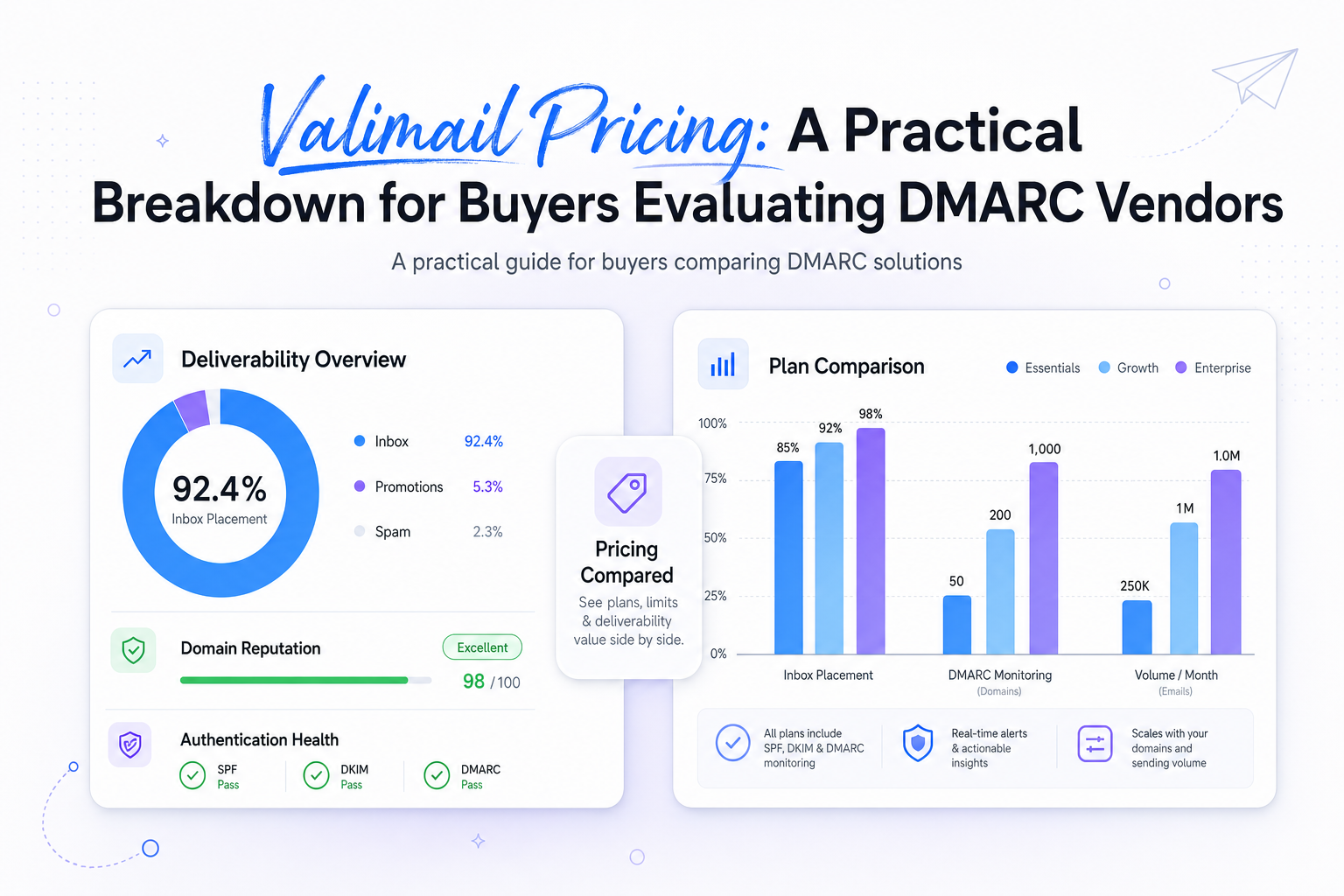
As of March 2025, Valimail's public pricing centers on a free entry tier (listed as "Valimail Starter" in its published materials at the time of writing) aimed at getting a domain to basic DMARC monitoring, with paid tiers unlocking enforcement support, multi-domain management, and automated sender discovery at scale. Exact tier names, included domain counts, and feature gates have shifted across past product cycles, and Valimail doesn't list enterprise pricing publicly. That part is quote-based, typically scoped around domain count and support level.
Tier | Who it's for | Core capability | DMARC policy level supported | Pricing model |
| Free / Starter | Single-domain teams getting initial visibility | Basic DMARC record setup and aggregate report visibility | Monitoring (p=none) | Free, self-serve |
| Growth / Pro (name varies) | Teams moving toward enforcement | Sender identification, guided policy progression | Up to p=quarantine and early p=reject | Paid, published starting price in some periods |
| Enterprise | Multi-domain orgs, agencies, regulated industries | Automated enforcement at scale, dedicated support, BIMI readiness | Full p=reject across domain portfolios | Custom quote, sales-assisted |
The practical takeaway: if your only requirement is getting a single domain from zero to monitored, the free tier is probably the starting point Valimail intends. If your requirement is enforcement across multiple domains and subdomains with ongoing automated discovery, you're in sales-conversation territory, and the number you get will depend on how many domains and parked domains you're protecting.
What the Free Valimail Plan Gets You, and Where It Stops
Valimail's free tier is built to get a single domain off zero. If you've never published a DMARC record and have no idea who's sending as your domain, the free tier is a reasonable place to start.
Typically, that includes:
- DMARC record generation help (the TXT record syntax itself)
- Aggregate report (RUA) ingestion into a dashboard, so you're not parsing raw XML by hand
- Basic sender visibility: which services are sending mail claiming to be your domain
What the free tier generally doesn't include:
- Guided progression to p=quarantine or p=reject with safety nets
- Multi-domain or subdomain management at scale
- Automated discovery of shadow senders across a large domain portfolio
- BIMI readiness support
- Priority support if something looks wrong in your reports
This gap matters most for buyers with a compliance trigger. If you're sending 5,000+ messages a day to Gmail or Yahoo personal accounts, the requirements in effect since February 2024 call for DMARC at minimum a published record, per Google and Yahoo's own sender guidelines, with spam complaint rates kept under 0.3%. The practical direction of these requirements pushes senders toward an active policy, not just a record sitting at p=none. Microsoft's 2025 requirements for high-volume Outlook.com senders move in a similar direction for SPF, DKIM, and DMARC enforcement.
A domain sitting at p=none for months isn't broken. It's informative: you're collecting reports, learning who sends on your behalf, and reducing the risk of jumping to enforcement blind. But p=none alone doesn't stop spoofing, and it's a lighter standard than what stricter bulk-sender requirements are gesturing toward. If your buying trigger is bulk-sender compliance specifically, confirm with Valimail whether the free tier supports a safe path to quarantine or reject, or whether that requires a paid plan.
How Valimail Prices: Domains, Sending Volume, or Seats?
Unlike an ESP, Valimail doesn't price around messages sent. That distinction trips up buyers coming from an email marketing background who are used to volume-tiered pricing.
Based on publicly available information, Valimail's pricing model centers on three variables.
Domain count. This is the primary driver. Valimail counts root domains, and in some tiers, parked and defensive domains separately. A company with one active sending domain and a dozen parked lookalike domains (bought defensively to prevent typosquatting) will price differently than a company with one domain total.
Policy enforcement level. Getting to monitoring (p=none) tends to be included at lower tiers or free. Getting to full enforcement (p=reject) across a domain portfolio, with guardrails against breaking legitimate mail flows, is typically gated to paid tiers.
Seats and support tier. Enterprise agreements commonly add dedicated support, SLA commitments, and sometimes BIMI add-ons, which affect price independent of domain count.
What Valimail does not appear to price around: your sending volume through your ESP, number of campaigns, or list size. That's a meaningful difference from Mailora's category, where usage (tests run, domains monitored, campaigns checked) is often the pricing axis. It's also why "Valimail pricing" and "email deliverability testing pricing" searches often lead to confusing comparisons. They're priced on different variables because they measure different things.
Before your Valimail sales call, have this ready:
- Total count of root domains you own and actively send from
- Count of parked or defensive domains registered under your organization
- Any subdomains used for separate business units, products, or regions
- A list of active ESPs and third-party tools currently sending on your domain's behalf (marketing ESP, transactional provider, CRM, support tool, survey tool)
Walking in with this list tends to produce a faster, more accurate quote. Sales-assisted pricing conversations move slower when the buyer doesn't know their own domain footprint.
Which Valimail Plan Do You Need for DMARC Enforcement?
The short answer: whichever tier unlocks guided policy progression for your domain count, not just reporting.
Getting to p=none is free or close to it with most DMARC vendors, Valimail included. Getting to p=reject safely is the harder, more expensive part of the job, and it's where paid tiers earn their price.
Here's why enforcement costs more than monitoring. Moving from p=none to p=quarantine to p=reject means telling receiving servers to actively block or junk mail that fails alignment. If you haven't identified every legitimate sender first (your ESP, your support tool, your CRM, a forgotten survey platform), enforcement will silently break mail you actually wanted delivered. Vendors that charge more at enforcement tiers are generally charging for the tooling and support that prevents that outcome: better shadow-IT discovery, staged rollout guidance, and someone to call if a legitimate stream suddenly stops flowing after you tighten policy.
If you manage one domain and no subdomains, you may be able to self-manage the climb to p=reject on a lower tier, especially if your sending stack is simple and well-documented. If you're managing a domain portfolio across parked domains, regional subdomains, and multiple business units each with their own ESP, the paid tiers that include automated sender discovery across that portfolio are worth evaluating closely, since manual tracking at that scale gets error-prone fast.
For a practical walkthrough of the policy progression itself, including how to sequence the move from monitoring to enforcement without breaking mail flow, see our guide on how to implement a DMARC reject policy.
One thing to state plainly: getting to p=reject is an identity milestone, not a deliverability milestone. It stops spoofed mail sent as your domain. It does not, by itself, change where your legitimate mail lands.
Does DMARC Enforcement Alone Improve Deliverability?
No, and this is the point worth sitting with before treating a Valimail invoice as a deliverability line item.
DMARC at p=reject proves that mail claiming to be from your domain is actually from your domain. That's an identity and authentication outcome. Gmail, Outlook, and Yahoo all use authentication as a baseline filtering input. If your DMARC fails, that's one more signal pushing mail toward spam or outright rejection. So enforcement removes a negative signal.
Removing a negative signal isn't the same as earning a positive one. Inbox placement decisions at Gmail, Outlook, and Yahoo weigh engagement history, complaint rates, content patterns, sending consistency, and list quality alongside authentication. A domain can sit cleanly at p=reject, fully authenticated, with no spoofing and no alignment failures, and still see a meaningful share of its legitimate marketing mail routed to spam or the Promotions tab because of unrelated reputation or engagement issues. Valimail's own annual security report has tracked a related gap, between domains that publish DMARC at all and domains that actually reach enforcement, which reflects how much work the enforcement step takes beyond simply publishing a record.
This is the gap buyers researching "valimail pricing" often miss. DMARC spend addresses one input into filtering decisions, not the whole filtering decision. If your actual symptom is declining opens, a Gmail-specific drop, or mail you know is sent correctly still landing in spam, DMARC enforcement isn't going to diagnose that. You need visibility into where mail is actually landing, ISP by ISP, which is a different kind of test than anything Valimail's dashboard reports on.
Running an email deliverability test alongside your authentication setup shows you the placement outcome directly: inbox, spam, or missing, broken out by provider, instead of inferring it from authentication status alone.
Valimail Pricing vs. Email Deliverability Testing Costs
Budget conversations about "DMARC pricing" and "deliverability tool pricing" often collide because buyers assume they're shopping in one category. They're usually shopping in at least three.
Category | Example vendors | Pricing axis | What it answers |
| Authentication and DMARC management | Valimail, EasyDMARC, PowerDMARC, dmarcian | Domain count, enforcement level | Who is sending as my domain, and is that sending authorized? |
| Inbox placement testing and content diagnostics | Mailora, GlockApps, Inbox Monster | Tests run, domains monitored, campaigns checked | Where did my mail actually land, and what pushed it there? |
| List validation and hygiene | ZeroBounce, NeverBounce | List size, verification volume | Are these addresses real and safe to send to? (Doesn't touch placement; a clean list and a spam-folder outcome can coexist.) |
| Enterprise deliverability suites | Everest by Validity | Bundled, sales-assisted contract | All of the above, bundled into one enterprise motion |
None of these categories replace each other. A buyer with a bulk-sender compliance trigger needs the authentication layer. A buyer with a placement or engagement problem needs the testing layer. Most growth-stage senders eventually need both, budgeted as separate line items rather than one tool expected to cover the other's job.
Within the testing layer, tools differ in what they hand back. GlockApps and similar seed-list tools report raw placement results per seed account, which still requires someone to interpret what to change. Mailora's category aims at the same placement visibility but attaches a clearer next action to the signal, rather than leaving raw data for a deliverability analyst to translate. MxToolbox-style lookups are useful for a one-off DNS or blocklist check, but they're point-in-time snapshots rather than ongoing, campaign-level monitoring.
Mailora's category sits in the testing and monitoring layer specifically: inbox placement across ISPs, reputation and blocklist monitoring, and content-level diagnostics, priced around usage rather than domain count. You can review Mailora's straightforward pricing to see how that compares against a domain-based DMARC quote.
What to Look for Beyond Valimail Pricing
Before finalizing a DMARC budget, map what Valimail's pricing does and doesn't cover against your actual deliverability questions.
Valimail pricing typically covers:
- DMARC record generation and policy management
- Aggregate (RUA) and sometimes forensic (RUF) report parsing
- Sender discovery across your domain's authorized and unauthorized senders
- Guided (on paid tiers) progression to enforcement
- BIMI readiness, on some tiers
Valimail pricing does not typically cover:
- Where your mail lands across Gmail, Outlook, Yahoo, or Apple Mail
- Which specific content element (subject line, image ratio, link structure) is pushing placement toward spam
- Ongoing domain and IP reputation trends over time
- Blocklist status across the lists that matter for inbox placement
- List hygiene or email validation
If your buying trigger is purely "we got a compliance notice and need DMARC published," Valimail or a comparable authentication vendor is the right starting spend. If your buying trigger is "we're authenticated correctly but still seeing placement problems," that's a different budget line. Review email deliverability monitoring features to see what a dedicated placement and reputation layer tracks that an authentication dashboard doesn't.
Most mature email programs end up running both categories side by side rather than picking one.
Valimail Alternatives Worth Pricing Against
Valimail isn't the only DMARC vendor, and it's worth getting a second quote before committing, especially if your domain portfolio is large or your enforcement timeline is tight.
dmarcian is one of the longer-standing independent DMARC vendors, often compared on report parsing depth and nonprofit or education pricing accommodations.
EasyDMARC is generally positioned as a lower-cost entry point for smaller domain counts, with a comparable free-to-paid structure.
PowerDMARC bundles DMARC with some adjacent authentication tooling (BIMI, MTA-STS) at what buyers commonly describe as a competitive per-domain rate.
Everest by Validity is an enterprise suite that bundles authentication alongside reputation and deliverability reporting, generally sold through a sales-assisted motion with a longer procurement cycle than a self-serve DMARC tool. If your organization already has budget and appetite for an enterprise contract, this collapses two categories into one vendor relationship. If you want similar clarity without that procurement cycle, pairing a lighter authentication vendor with a focused placement tool is often the faster path.
GlockApps focuses on seed-list testing and raw placement data per inbox provider. It's useful for a snapshot, but interpreting what to fix from that data generally falls on your team or a deliverability consultant.
MxToolbox is a solid utility for one-off DNS, blocklist, and record lookups. It isn't built for ongoing or campaign-level monitoring, so it answers "is this record correct right now" rather than "how is my sending program trending over time."
When comparing quotes, ask each vendor the same three questions you'd ask Valimail: how is pricing structured (domain count, seats, volume), what's included at the enforcement tier specifically (not just monitoring), and what does support look like if enforcement breaks a legitimate sending stream.
None of these vendors, Valimail included, test inbox placement or diagnose content-driven spam filtering. That's a separate evaluation, and conflating the two during a DMARC vendor search is one of the more common budgeting mistakes growth-stage teams make.
Validate Your Email Setup Beyond DMARC
Valimail pricing answers a specific question: what does it cost to prove your domain's mail is actually yours. That's worth paying for if you're facing a compliance deadline, a spoofing incident, or a BIMI rollout.
It doesn't answer a different question that most teams researching "valimail pricing" are actually trying to solve: why is authenticated, legitimate mail still landing in spam or Promotions for some recipients. Put simply, Valimail tells you who's sending as you. A placement and monitoring layer tells you what happened when you sent, and what to change next.
Those are two separate budget lines, evaluated against two separate vendor categories. Getting clear on which problem you're actually funding before signing a DMARC contract saves a renewal conversation later where someone asks why placement didn't improve after the authentication spend went through.
If your domain is already at p=reject, or you're partway through getting there, it's worth checking what that authentication work has actually bought you in terms of inbox placement. Run your first deliverability test to see where your mail lands across Gmail, Outlook, and Yahoo right now, and use that as the baseline for whatever you budget next.
Run your first test → https://app.usemailora.com/users/sign_up
FAQs
Does Valimail have a free plan, and what are its limits?
Yes, Valimail has offered a free tier aimed at getting a domain to basic DMARC monitoring (p=none) with limited sender visibility. It typically stops short of the automated discovery and guided enforcement support needed to move safely to p=quarantine or p=reject. Confirm current limits directly with Valimail, as free-tier scope changes.
How much does Valimail cost per domain?
Pricing is generally structured around domain count, sending volume, or a combination, with cost increasing as you add domains, subdomains, or move toward enforcement tiers. As of March 2025, exact published figures should be verified directly with Valimail, since vendors in this category update pricing periodically.
Is Valimail worth it if I only send from one domain?
For a single domain with a simple sending stack, a free or entry-level DMARC tier, Valimail or a comparable vendor, is often enough to reach monitoring and even enforcement without heavy spend. The value of paid tiers grows with domain count and sending complexity, not with having just one domain.
What's the difference between DMARC monitoring and DMARC enforcement?
Monitoring (p=none) collects reports on who's sending as your domain without blocking anything. Enforcement (p=quarantine or p=reject) actively junks or blocks unauthenticated mail claiming to be from you, which requires confirming every legitimate sender first to avoid breaking real mail flow.
Do I still need deliverability testing if my domain is at p=reject?
Yes. p=reject confirms your domain's identity is protected from spoofing, but it says nothing about whether your legitimate mail is landing in the inbox, Promotions, or spam. Those outcomes are driven by separate factors like engagement, reputation, and content, which require placement testing to see directly.
Stay in the loop
Deliverability insights, product updates, and early access to new features. No spam, unsubscribe anytime.
By subscribing, you agree to our Privacy Policy. Unsubscribe anytime.