What to Do When Your Spam Score Looks "Good" but Results Don't
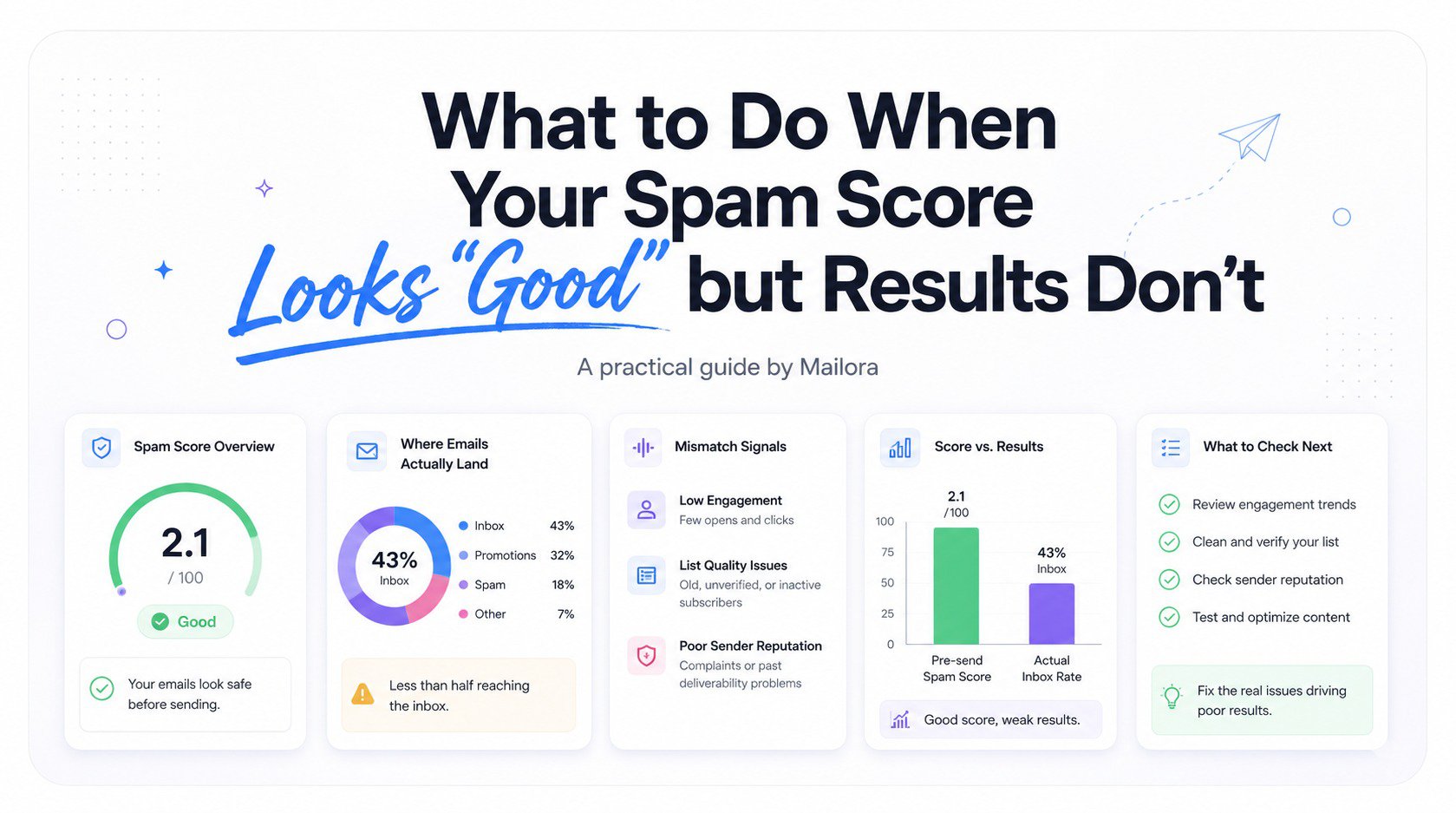
A campaign goes through a spam checker before it ships. The tool comes back with a 9 out of 10, a green "low risk" label, maybe a checklist of passed items. It feels like a clean bill of health. Then the campaign goes out and performs the same as it always has, or worse. This gap, where your spam score looks good but results don't follow, is one of the more common sources of confusion in email marketing, and it usually comes down to a simple mismatch: spam checkers and inbox placement are measuring two different things.
What a Spam Score Actually Measures
Most spam checking tools evaluate a message against a narrow set of signals: whether the content contains patterns historically associated with spam, whether basic authentication (SPF, DKIM) is configured, and whether the sending IP or domain appears on a small number of public blacklists. Some tools weigh subject line phrasing, link count, or image-to-text ratio. All of this produces a score, but the score is a static, point-in-time estimate based on rules the tool's vendor chose to check, not a live evaluation from Gmail, Outlook, or Yahoo.
This is precisely why a spam score looks good far more often than it should, given how campaigns actually perform. The tools are honest about what they check. The problem is that what they check is a small subset of what actually determines inbox placement.
Why Spam Score Looks Good but Real Results Don't Match
| Spam Checker Signal | What It Captures | What It Misses |
|---|---|---|
| Content and formatting | Obvious spam patterns, link ratios, and spammy phrasing | Recipient engagement history and contextual relevance |
| Basic authentication | Whether SPF/DKIM records exist and pass | Alignment issues, DMARC enforcement, and ongoing reputation trends |
| Blacklist status | Presence on a handful of public block lists | Provider-specific reputation, which isn't publicly available |
| Static snapshot | A single point-in-time check before sending | How reputation and engagement evolve over weeks of sending |
The core issue is that mailbox providers make placement decisions using signals no third-party spam checker has access to: your domain's actual complaint rate with that specific provider, engagement trends across your real recipient base, and behavioral history built from months of sending, not one message. A spam score looks good because it's checking for the absence of obvious red flags. It has no visibility into whether your last five campaigns saw rising complaints, or whether your list has quietly accumulated a large share of disengaged addresses.
This is the same gap that shows up whenever a team relies on authentication passing, or a clean bounce rate, as proof that everything is fine. A spam score looks good, SPF and DKIM pass, and the message still lands in spam, because none of those checks evaluate reputation or engagement, the two factors that carry the most weight in an actual placement decision.
A Real-World Example
Consider a SaaS company running a re-engagement campaign to a list that hadn't been emailed in several months. Every pre-send check came back clean: authentication passed, the spam score was excellent, no blacklist hits. Open rates still came in far below the company's historical average, and a meaningful share of the campaign landed in spam at Outlook specifically, while Gmail placement looked comparatively fine.
The cause had nothing to do with anything a spam checker could see. The list had aged, engagement had quietly declined over the months of inactivity, and Outlook's filtering treated the sudden reactivation send with more caution than Gmail did. A spam score looks good in a scenario like this because the tool has no way to know the list has gone stale. Only reputation and engagement monitoring, tracked over time, would have flagged the risk before the send.
What to Check Instead When the Score Doesn't Match Reality
When a spam score looks good but results don't improve, the investigation needs to move to signals the score never captured in the first place.
- Review inbox placement by provider, not just delivery rate. A message can be accepted and still routed to spam, and placement often varies meaningfully between Gmail, Outlook, and Yahoo.
- Check complaint rate and engagement trends across recent sends, not just the campaign in question. A single clean score says nothing about whether reputation has been declining over the past several weeks.
- Look at list health specifically. High bounce rates or a large inactive segment can quietly erode reputation even when every technical check passes.
- Confirm DMARC alignment, not just SPF and DKIM presence. A record can exist and still fail to align with the domain in the From header, something most basic spam checkers don't evaluate.
Common Mistakes
Treating a spam score as a pass-or-fail gate is the most common mistake, since it encourages teams to stop investigating the moment the number looks acceptable. Relying on a single tool's snapshot instead of watching trends over multiple sends is a close second, since reputation and engagement change gradually and a single good score can't reflect that. Confusing a good spam score with strong deliverability outright is the underlying error behind both: the two are related, but one doesn't guarantee the other.
Best Practices
Use a spam score as an early, narrow check, not a final verdict. Pair it with ongoing monitoring of reputation, engagement, and inbox placement, since these are the signals that actually explain why results diverge from what the score suggested. When a spam score looks good but a campaign still underperforms, resist the urge to rewrite the content first. Check reputation and list health before touching anything the score already confirmed was fine.
The same principle applies to SEO: teams should track top competitive SEO metrics, top pages, traffic-driving keywords, organic search competitors, and SERP tracking trends rather than relying on a single score. Enterprise SEO experts and a trusted SEO company use a broader SEO strategy to improve authority, local SEO visibility, and competitive edge, just as deliverability teams monitor reputation instead of one spam-check result.
Conclusion
A spam score looks good because it's answering a narrow question well: does this message contain obvious red flags a basic filter would catch? It was never designed to answer the harder question of whether a specific recipient, at a specific provider, with a specific engagement history, will see this message in their inbox. Closing that gap requires monitoring the signals spam checkers can't see: reputation trends, engagement quality, and placement by provider, tracked continuously rather than checked once before a send.
Frequently Asked Questions
Why does my spam score look good if my campaign still underperforms?
Because spam checkers evaluate a narrow set of content and basic authentication signals, not the reputation and engagement data mailbox providers actually use to decide placement. A spam score looks good without accounting for either.
Is a spam checker tool worth using at all?
Yes, as an early sanity check for obvious content or authentication issues before a send. It just shouldn't be treated as confirmation that a campaign will land well, since it can't see reputation or engagement trends.
What should I monitor instead of relying on a spam score?
Inbox placement by mailbox provider, complaint rate trends, engagement quality, and DMARC alignment all provide a more accurate picture than a single content-based score.
Can a good spam score coexist with a real deliverability problem?
Yes, and this is common. A spam score looks good precisely in situations where the underlying issue is reputation or engagement decline, since those factors sit entirely outside what most spam checkers evaluate.
Learn how Mailora helps you monitor the reputation and engagement signals a spam score can't see, so you know what's actually driving your results.
Stay in the loop
Deliverability insights, product updates, and early access to new features. No spam, unsubscribe anytime.
By subscribing, you agree to our Privacy Policy. Unsubscribe anytime.