The Myth of Safe Sending in Email Marketing: Email Sending Best Practices Are Not Enough
Many marketers believe that following email sending best practices is enough to protect their campaigns from spam folders. If SPF, DKIM, and DMARC are configured correctly, the mailing list is clean, and every message includes an unsubscribe link, the campaign should perform well, or at least avoid major deliverability problems.
That assumption is understandable, but it no longer reflects how mailbox providers evaluate email.
Modern inbox providers look beyond technical compliance. They assess sender reputation, historical sending behavior, recipient engagement, complaint patterns, authentication alignment, and dozens of other signals that change over time. A campaign can satisfy every traditional email sending best practice and still experience poor inbox placement because the real issue lies elsewhere.
This creates a dangerous misconception. Teams often spend weeks perfecting technical setup while overlooking the factors that inbox providers actually use to determine trust. When campaign performance drops, they continue checking the same compliance boxes instead of investigating reputation, audience quality, content relevance, or changes in recipient behavior.
Email sending best practices are still essential. They establish the foundation for responsible email marketing and reduce unnecessary risk. However, they should be viewed as the starting point—not the finish line. Strong deliverability requires continuous monitoring, ongoing optimisation, and an understanding that every campaign contributes new signals to your sender reputation.
In this guide, we'll explain why safe sending does not automatically mean successful sending, where traditional best practices fall short, and what marketers should monitor instead if they want consistent inbox placement over the long term.
What Email Sending Best Practices Usually Mean
Most teams treat email sending best practices as a safety checklist. That usually includes SPF, DKIM, DMARC, clean lists and verified contacts, conservative volume, compliant unsubscribe, low complaint risk, and content that avoids obvious spam patterns. These controls are required, but they are not proof of inbox placement.
The safe sending myth begins when teams treat best practice compliance as a guarantee. Mailbox providers judge sender identity, domain reputation, recipient behavior, bounce patterns, complaint signals, and recent engagement. A campaign can be technically correct and still fail.
Read Mailora resources on email deliverability, authentication, and email risk management.
Why Safe Does Not Mean Effective
Safe is a risk floor, not a performance strategy. Effective sending adapts to audience response, message relevance, and the effectiveness of your content and design choices (including subject lines).
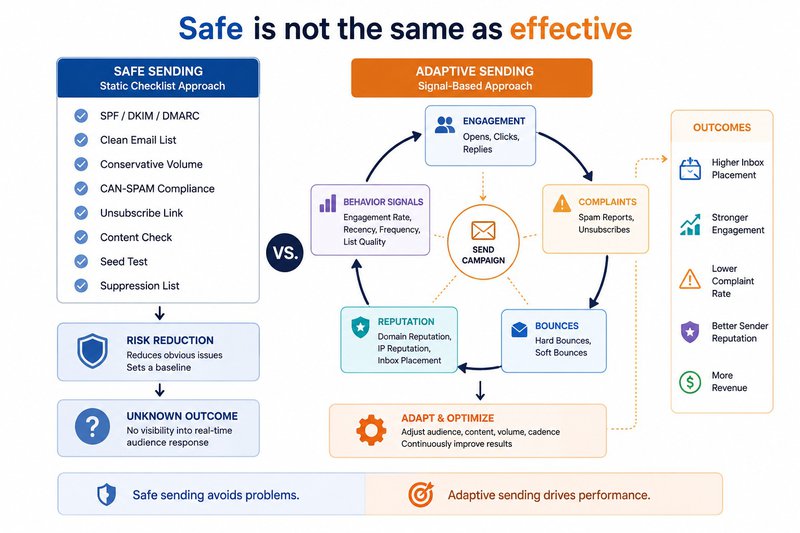
Most email deliverability mistakes are contextual. The sender may pass authentication, but the audience may not engage. The list may be clean, but recipients may ignore, delete, complain, or stop opening. The offer may be legitimate, but it may reach the wrong segment or arrive at the wrong cadence.
Diagnose these first:
- DMARC alignment passes but engagement is weak
- Complaint risk rises after colder segment expansion
- Volume looks modest but cadence is too frequent
- Content is compliant but repetitive, with weak subject lines, or mismatched messages
- Unsubscribe exists but suppression is slow
The Risk of Playing Too Safe
Playing too safe can hide demand. Very small sends reduce risk, but slow learning. Over filtering can remove valid prospects. Excessive caution shifts teams from improving relevance and effective content to avoiding all risk.
No verified revenue benchmark was provided, so no numeric ROI lift should be claimed. The ROI logic is directional: fewer wasted sends, earlier risk detection, less reputation repair, and more budget focused on responsive segments (often improving engagement rates and conversion rates over time).
Email Sending Best Practices Are Not Enough
Use email risk management as an operating system, not a checklist.
- Authenticate every stream with SPF, DKIM, and DMARC alignment (ideally on a branded domain).
- Separate marketing, sales, product, and transactional streams.
- Segment by consent source, explicit marketing consent status, engagement depth, recency, and domain.
- Start with engaged cohorts, then expand when signals support it.
- Track bounces, spam complaints, unsubscribes, open rates, clicks, replies, blocks, and placement tests (including shifts caused by Apple Mail behavior and privacy features).
- Treat GlockApps as one diagnostic input for inbox placement testing, not the full decision system.
- Use Mailora to review campaign risk before volume increases and connect sending behavior with deliverability outcomes. If you automate sending decisions, ensure automation (including ai agents) follows the same risk controls and suppression rules.
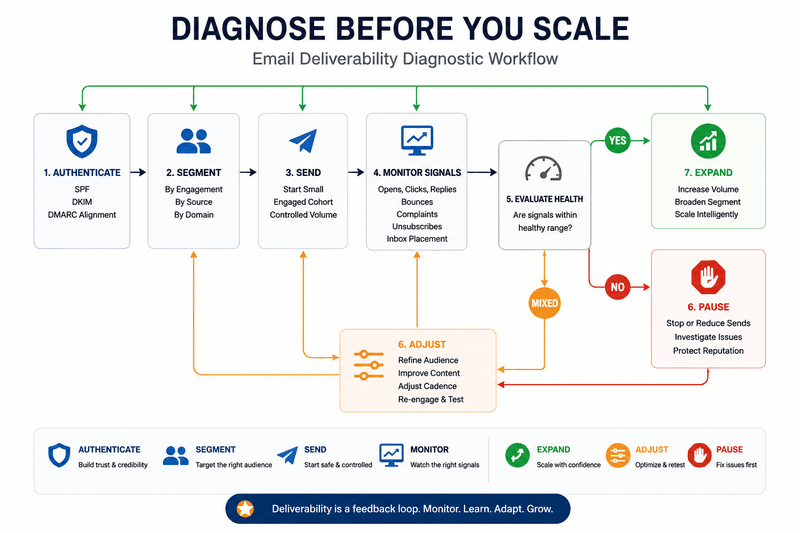
Before blaming content, verify authentication alignment, domain history, engagement by segment, complaint risk, bounce source, suppression timing, unsubscribe function, list origin, cadence, and mailbox provider patterns (including folder categorisation).
Compliance Considerations
Cover consent, explicit marketing consent where required, accurate sender identity, physical address, clear unsubscribe, prompt suppression, data privacy, privacy rules, GDPR, can-spam (CAN SPAM), CASL, consumer concerns, and data retention. Compliance does not guarantee inbox placement, but weak compliance increases deliverability risk and can damage brand reputation.
FAQ
What is the safe sending myth?
It is the belief that following email sending best practices guarantees inbox placement.
Are email sending best practices still necessary?
Yes. They reduce baseline risk, but do not prove relevance or engagement.
Why do safe emails go to spam?
Spam placement can result from reputation, complaints, weak engagement, bounces, cadence, or mailbox filtering.
Does email authentication improve deliverability?
It supports trust and alignment, but does not guarantee inbox placement.
Is GlockApps enough for deliverability testing?
No. GlockApps helps with placement diagnostics, but live recipient signals still matter.
What should advanced marketers monitor?
Monitor complaints, bounces, unsubscribes, engagement, blocks, domain reputation, segment response, and placement tests. Many teams also review subject lines, messages, and design changes as part of ongoing effectiveness measurement across important marketing channels.
How should SMB and enterprise teams differ?
SMB teams should control volume and learn fast. Enterprise teams need domain governance, regional compliance, and reporting.
When should a campaign be paused?
Pause when complaints, bounces, blocks, or negative engagement rise above normal campaign patterns.
Stay in the loop
Deliverability insights, product updates, and early access to new features. No spam, unsubscribe anytime.
By subscribing, you agree to our Privacy Policy. Unsubscribe anytime.