Key Takeaways
|
Google asks bulk senders to keep spam complaint rates below 0.3%, and that number matters a lot during IP warmup. A cold dedicated IP can cross that threshold quickly if you introduce too much volume before mailbox providers have enough positive engagement data.
An IP warmup schedule works when it reflects your actual list quality, cadence, and complaint risk. It fails when teams treat it like a generic spreadsheet, keep doubling volume despite soft blocks, or mix their best subscribers with old, unproven contacts too early.
For lifecycle, deliverability, and RevOps teams, the goal is simple: create a predictable reputation curve. That means steady volume, strong audience selection, and clear rules for when to accelerate, hold, or roll back.
Why an IP warmup schedule matters
Mailbox providers do not just look at whether mail is authenticated and technically valid. Gmail, Outlook, and Yahoo also watch how a new or lightly used IP behaves over time. They care about complaint rate, unknown user rate, engagement signals, deferrals, and whether volume growth looks consistent or risky.
A warmup schedule reduces uncertainty because it gives those providers a cleaner data set. If you send 5,000 highly engaged messages on Monday, 80,000 mixed-quality messages on Tuesday, and nothing on Wednesday, the reputation picture is noisy. If you send gradually increasing daily volume to your strongest segments, the signal is easier to trust.
This is why warmup is usually more about discipline than speed. The fastest successful warmups tend to come from senders who protect audience quality early, not from teams who try to hit full production volume in week one.
What a good IP warmup schedule includes
1. A clear starting volume
There is no universal opening number, but most teams should start far below their eventual daily target. If your steady-state goal is 200,000 messages per day per IP, opening with 2,000 to 10,000 can be reasonable when list quality is strong. If your audience is less proven, start lower.
2. Engaged recipients first
Your first sends should go to the people most likely to open, click, and not complain. That usually means recent purchasers, recently active users, trial signups from the last 30 days, or subscribers who opened within the last 14 to 30 days. Do not start warmup with reactivation, win-back, or old newsletter segments.
3. Daily consistency
Consistent daily volume is easier for providers to evaluate than bursty sending. If you only send twice a week, the schedule should still ramp predictably, but a daily pattern usually warms reputation faster and with fewer surprises.
4. Exit criteria for each phase
Each ramp step needs operating rules. Move up only when hard bounces stay low, soft bounces are not climbing, complaint rates remain controlled, and inbox placement does not materially worsen at Gmail or Outlook. A schedule without these checkpoints is just a calendar.
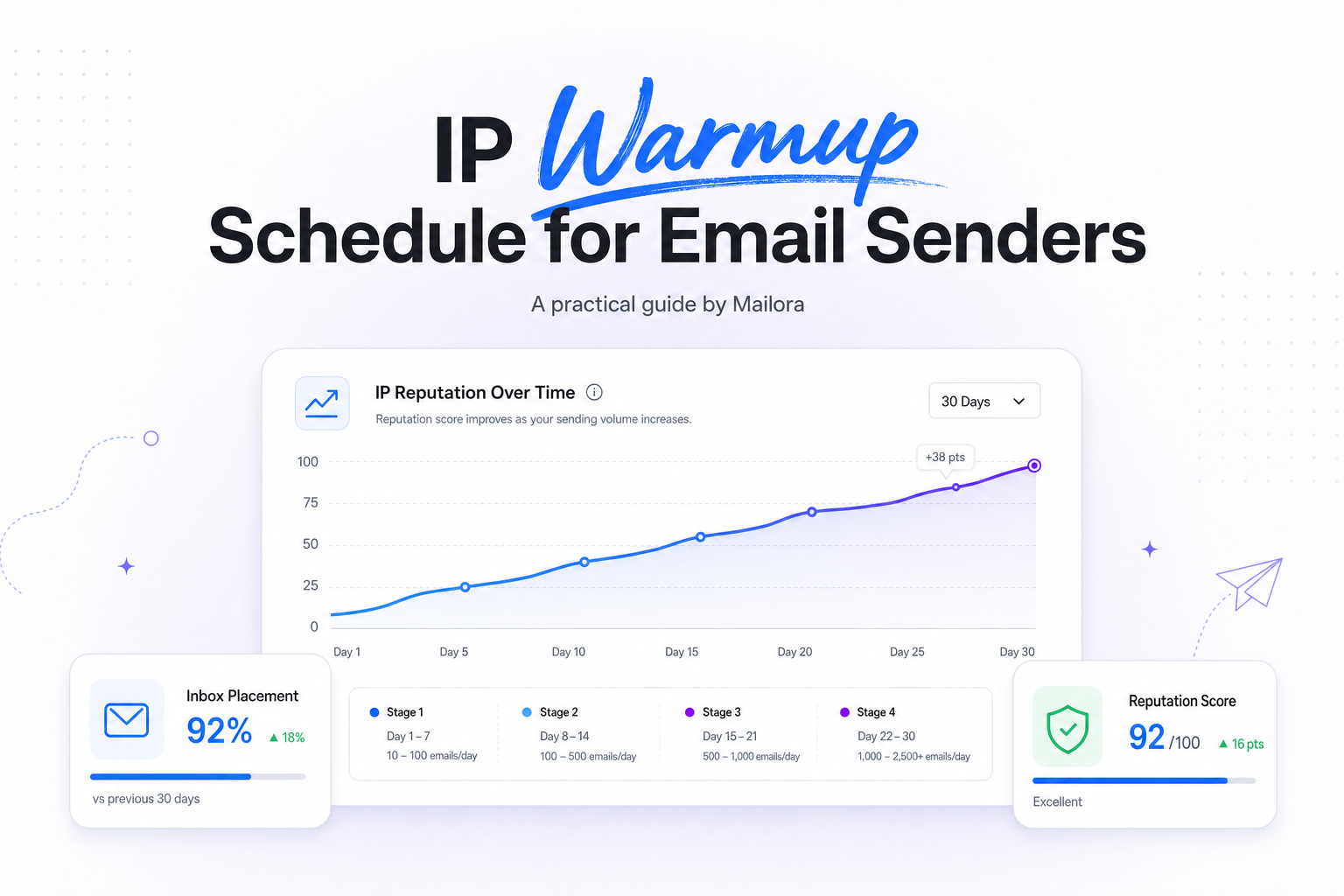
A practical 30-day IP warmup schedule
The right numbers depend on your domain reputation, authentication, and audience quality, but this framework is a useful starting point for a dedicated IP with a healthy list and a daily send pattern.
| Phase | Days | Daily volume per IP | Audience | Move forward when |
|---|---|---|---|---|
| Phase 1 | 1 to 5 | 2,000 to 5,000 | Most engaged, recent openers and buyers | Complaints stay well below 0.3%, bounces are stable, no meaningful throttling |
| Phase 2 | 6 to 10 | 5,000 to 12,000 | Add recent clickers and active users | Inbox placement is steady at Gmail and Yahoo, soft bounces are not rising |
| Phase 3 | 11 to 17 | 12,000 to 25,000 | Expand to 30-day engaged segments | Deferrals normalize within acceptable windows, complaint rate remains controlled |
| Phase 4 | 18 to 24 | 25,000 to 50,000 | Broader active lifecycle audience | Outlook blocks do not increase, unsubscribe rate stays normal |
| Phase 5 | 25 to 30 | 50,000 and up | Production mix, still excluding risky dormant segments | All major providers show stable acceptance and engagement |
If you need to reach much higher daily volume, keep ramping after day 30 using the same logic. As the base gets larger, percentage increases usually need to get smaller. Going from 2,000 to 4,000 is often fine. Going from 100,000 to 200,000 overnight is usually not.
How to choose the first audiences for warmup
The first audiences define your reputation baseline. If they perform well, providers are more likely to trust later volume from the same IP. If they perform poorly, every later send becomes harder.
- Best starting group: subscribers with recent opens, clicks, purchases, or product activity.
- Okay after the first phase: 30-day engaged users, active free-trial users, and recent form fills.
- Delay until reputation is stable: dormant users, imported lists, older leads, and re-permission campaigns.
For B2B senders, be extra careful with CRM-held contacts that have not engaged in months. Outlook in particular can be unforgiving when old corporate addresses generate low engagement and higher unknown-user rates. For B2C senders, Yahoo and Gmail often react quickly when promotional volume expands faster than audience quality supports.
When to slow down, pause, or roll back
A strong IP warmup schedule includes decision rules for bad days. The point is not to panic at every deferral. The point is to know which signals mean, slow down now.
Hold volume when
- Spam complaints are rising but still below your internal stop threshold.
- Soft bounces or temporary deferrals increase at one provider for one or two sends.
- Open rates dip slightly as you widen the audience, but remain directionally healthy.
Roll back volume when
- Gmail complaint rate approaches 0.3%.
- Outlook begins rate limiting or blocking after a volume jump.
- Yahoo acceptance drops sharply as soon as you add lower-engagement segments.
- Hard bounces increase because list hygiene is weaker than expected.
In practice, a rollback often means returning to the last stable daily volume for two to four sends, tightening audience selection, and only then testing growth again. That can feel slow, but it is faster than burning the IP and spending the next month recovering.
Shared IPs, dedicated IPs, and domain reputation
An IP warmup schedule is most important when you are moving to a dedicated IP or reviving an IP that has been mostly idle. On a shared IP, the platform usually manages the IP-level ramp, but your own domain reputation still shapes results. If your domain is new, mailbox providers may still be cautious even if the shared IP itself is established.
That is why smart teams watch both IP and domain signals together. A warm IP cannot fully protect a weak domain, and a respected domain can still be dragged down by reckless volume on a new dedicated IP. The schedule has to support both reputations at the same time.
Common mistakes that break a warmup schedule
Doubling volume too aggressively
Percentage growth looks harmless when the base is small. It becomes risky once daily volume gets meaningful. Early phases can grow faster, later phases usually need smaller increases and more observation time.
Mixing transactional and promotional assumptions
Transactional mail often gets more tolerance because engagement is naturally high. Promotional mail does not. If your future production mix is mostly marketing, build the schedule around marketing behavior, not around your password resets and order confirmations.
Including old lists too early
Teams often widen eligibility because revenue targets are waiting. That is exactly when complaint and bounce risk rises. Keep the first two to three weeks focused on people who are very likely to recognize and want your mail.
Changing too many variables at once
If you switch IP, change the From name, redesign templates, and move to a new domain in the same week, you make diagnosis much harder. Warmup works best when the main changing variable is volume.
How to operationalize the schedule across teams
The best IP warmup schedules are owned jointly. Deliverability sets thresholds, lifecycle marketing controls segmentation, and RevOps aligns reporting so everyone sees the same decision points. A simple daily review can prevent most warmup mistakes.
- Before send: confirm segment size, expected volume, and provider mix.
- After send: review acceptance, soft bounce rate, hard bounce rate, complaint rate, and engagement by Gmail, Outlook, and Yahoo.
- Decision: increase, hold, or roll back the next send based on those signals.
If you do that every day for the first few weeks, the schedule becomes a control system instead of a hope-based plan. That is the difference between simply sending and sending with confidence.
Related reading: usemailora.com.
Run your first deliverability test
FAQs
How long should an IP warmup schedule last?
For many senders, 2 to 6 weeks is realistic. Higher target volume, weaker list quality, or inconsistent cadence usually means a longer warmup.
Can I warm up an IP with weekly campaigns only?
You can, but it is slower and less stable than daily sending. Providers get fewer data points, so each volume jump carries more risk.
What complaint rate is too high during warmup?
Treat anything moving toward 0.3% at Gmail as a serious warning. Many teams use even tighter internal thresholds during early warmup phases.
Should I warm up multiple dedicated IPs at the same time?
Only if you truly need the capacity and can feed each IP consistent, high-quality volume. Underfeeding several IPs is usually worse than warming one well.
Does Apple Mail change an IP warmup plan?
Apple Mail is a client, not a mailbox provider, so inbox decisions still depend on the underlying provider. Warmup decisions should be based on provider-level signals such as Gmail, Yahoo, and Outlook behavior.
Stay in the loop
Deliverability insights, product updates, and early access to new features. No spam, unsubscribe anytime.
By subscribing, you agree to our Privacy Policy. Unsubscribe anytime.