How to Safely Scale Sending Without Killing Reputation
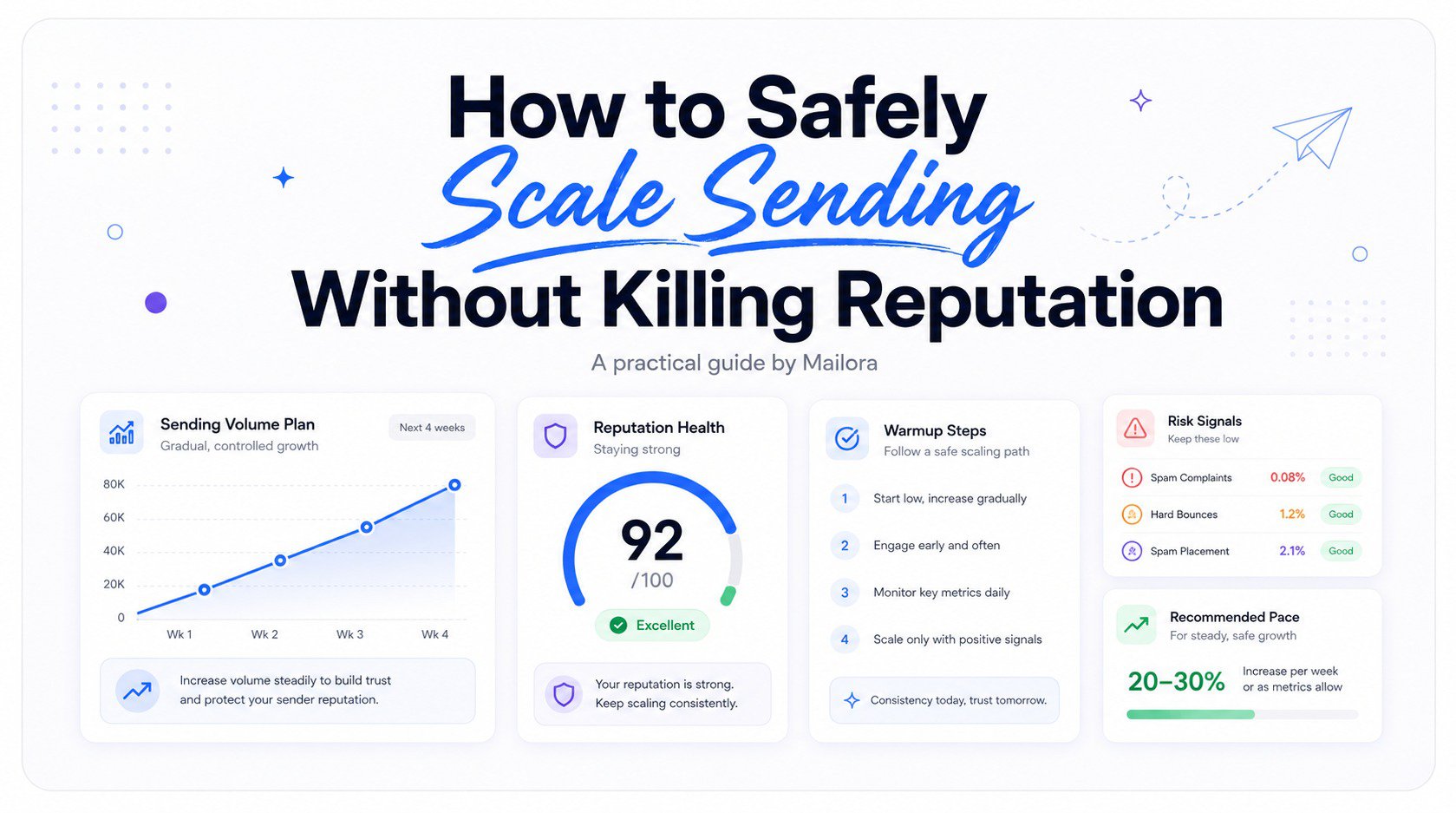
A growing list, a new product launch, or a shift to more frequent email campaigns all create real pressure to send more email, faster. The instinct is to just increase volume and see what happens. That instinct is exactly how senders end up damaging reputation they spent months building. Learning to scale sending without killing reputation isn't about sending less. It's about sending more in a way mailbox providers can recognize as consistent and trustworthy rather than sudden and risky, protecting email deliverability as sending volume grows.
Why Sudden Volume Increases Damage Reputation
Mailbox providers use sending consistency as a genuine trust signal. A domain that sends a stable, predictable volume over time builds a reputation baseline, including a sender score and trust score, that filtering systems come to recognize. A sudden, sharp increase in volume looks statistically similar to patterns associated with compromised accounts or spam campaigns, even when the sender is entirely legitimate. This is the core tension behind trying to scale sending without killing reputation: the growth itself, not the content or the audience, can be what triggers more cautious filtering from major providers.
The risk compounds when volume growth outpaces list quality. Rapid scaling often means reaching further into a list, including older, less engaged contacts and invalid addresses, which increases bounce and complaint rates at exactly the moment a domain can least afford it. A domain trying to scale sending without killing reputation has to manage both dimensions, how fast volume grows and who that volume is going to, at the same time. This is especially important for teams scaling outreach through a cold email operation or other high-volume outbound teams.
What Scaling Safely Actually Requires
| Volume increase | Doubling or tripling send volume in a single campaign | Gradual, staged increases over multiple sends |
|---|---|---|
| Audience selection | Sending new volume to the entire list at once | Prioritizing the most engaged segments first |
| Monitoring | Checking results only after the campaign completes | Monitoring engagement and complaint signals in real time during the ramp-up |
| Consistency | Irregular spikes tied to launches or promotions | Predictable, steady growth in sending cadence and volume |
The pattern across every row is the same: mailbox providers reward predictability and penalize sudden change, regardless of whether that change comes from good intentions like a product launch or a genuine surge in demand. The goal is not simply sending more emails, but sending relevant email while maintaining positive engagement signals.
A Practical Framework to Scale Sending Without Killing Reputation
- Start with your most engaged segment. Before increasing volume broadly, direct the additional sends to recipients with a strong recent history of opens and clicks, since their positive engagement helps offset the reputation risk of unfamiliar volume. This gives the domain time to build trust before placing more emails into the active rotation.
- Increase volume in stages, not all at once. A common approach is raising send volume by roughly 20 to 30 percent per send over several campaigns, rather than jumping to full target volume immediately. Increasing volume gradually is safer than trying to send 10,000 emails before the infrastructure is ready.
- Monitor engagement and complaint rate after every stage before increasing further. If complaint rate rises or engagement drops noticeably at any stage, pause the ramp rather than pushing ahead on schedule. Real time monitoring can reveal early complaint spikes before they create lasting reputational damage.
- Segment monitoring by mailbox provider throughout the ramp. Gmail, Outlook, and Yahoo can respond differently to the same volume increase, and aggregate metrics can hide a problem developing at one specific provider. Track reply rates, spam reports, and inbox placement as key signals across each provider.
- Keep list hygiene tight throughout the process. Removing hard bounces and long-term unengaged addresses before scaling reduces the chance that added volume includes recipients who will drag down reputation right when it's most exposed. Deliverability testing tools can also help identify issues before they affect a larger sending volume.
- Review the technical foundation before increasing volume. Confirm that authentication records are configured correctly, domain warming is complete, and the sending IP address and specific IP address configuration are consistent. A cold domain, new domains, or poorly managed cold email infrastructure can make scaling a high-risk environment.
A Real-World Example
A subscription company preparing for a major product launch needed to increase weekly send volume by roughly four times within a month. Rather than jumping straight to the new volume, the team ramped in five stages over three weeks, prioritizing the most engaged third of the list in the earliest stages and expanding to the broader list only once engagement and complaint metrics stayed stable at each step. The company used the same discipline for its email campaigns and transactional email, keeping each stream predictable.
Placement remained steady throughout the ramp, and by launch day the domain had already demonstrated to mailbox providers that the higher volume was a consistent pattern rather than an anomaly. A team that tried to scale sending without killing reputation by simply flipping a switch to the full new volume would have presented exactly the kind of sudden change filtering systems are built to treat with suspicion. Replacing burned inboxes and a burned inbox with new domains would also risk further reputational damage rather than solving the underlying problem.
Common Mistakes
Increasing volume and audience size at the same time is one of the most common mistakes, since it compounds two risk factors instead of managing them separately. Skipping monitoring between stages, and only checking results after the full ramp is complete, is another, since it removes the chance to catch a problem while it's still small. Assuming a strong existing reputation provides unlimited headroom is a third, since even well-established domains can trigger more cautious filtering when volume changes too abruptly.
Relying on mass-mailing infrastructure without monitoring the sending IP address is another problem. Some teams turn to IP rotation or move messages across new domains after burned inboxes appear, but this can create more inconsistent patterns instead of improving email deliverability. Most cold email senders should focus first on audience quality, authentication, and stable sending behavior.
Best Practices
Treat scaling as a monitored process with checkpoints, not a single decision made once and executed all at once. Prioritize engaged recipients early in any ramp, since their behavior does more to protect reputation during a volume increase than any technical configuration can. Build in pauses. If a stage shows early signs of strain, whether rising complaints or softening engagement, it's far cheaper to slow down mid-ramp than to recover reputation after a spike has already done damage.
Use active rotation only when it supports a consistent, controlled cold email operation, not as a way to hide sudden sending volume. Maintain a small complaint rate, watch reply rates, and continue sending relevant email to audiences most likely to engage. A successful mass mailing depends on maintaining trust with mailbox providers, not simply on deploying a powerful marketing tool.
Conclusion
Learning to scale sending without killing reputation comes down to treating growth as a gradual, monitored process rather than a single jump in volume. Mailbox providers read sudden change as risk, regardless of intent, which means the safest path to more volume is almost always the slower one: staged increases, engaged-audience-first sequencing, and close monitoring at every step. Reputation built over months can erode in days if scaling ignores that pattern, and prevention through a careful ramp is far less costly than recovering from a reputation hit after the fact. This approach supports scaling outreach while preserving sender score, email deliverability, and inbox placement.
Frequently Asked Questions
How fast can I safely scale my sending volume?
There's no universal number, but staged increases of roughly 20 to 30 percent per send, with monitoring between each stage, are a common and safer approach than jumping to a target volume all at once. The right pace depends on list quality, domain history, authentication, and the current sending volume.
Should I prioritize certain recipients when scaling sending?
Yes. Directing early volume increases to your most engaged segment helps offset the reputation risk that comes with unfamiliar volume, since positive engagement signals build trust faster than an untested general audience. This is especially important when introducing more emails into an active rotation or expanding to new domains.
What signs indicate I'm scaling too fast?
Rising complaint rates, declining engagement, falling reply rates, or inconsistent inbox placement at any point during a ramp are all signs to pause and stabilize before increasing volume further. Early complaint spikes, more spam reports, and unusual bounce patterns can also indicate that sending volume is growing faster than the audience or infrastructure can support.
Does a strong existing reputation protect me from the risks of scaling quickly?
It helps, but it isn't unlimited protection. Even well-established domains can trigger more cautious filtering when volume increases abruptly, since mailbox providers evaluate consistency continuously, not just historical reputation. A strong sender score cannot fully protect a sender from reputational damage caused by sudden changes, burned inboxes, or poor list hygiene.
Learn how Mailora helps you monitor reputation and engagement in real time while you scale, so growth in volume doesn't come at the cost of inbox placement.
Stay in the loop
Deliverability insights, product updates, and early access to new features. No spam, unsubscribe anytime.
By subscribing, you agree to our Privacy Policy. Unsubscribe anytime.