Key Takeaways
|
Google asks bulk senders to keep spam complaint rates below 0.3%, according to its Email Sender Guidelines, and Yahoo enforces similar requirements. That number matters because a deliverability tool is only useful if it helps you change the next decision, not just admire the last result.
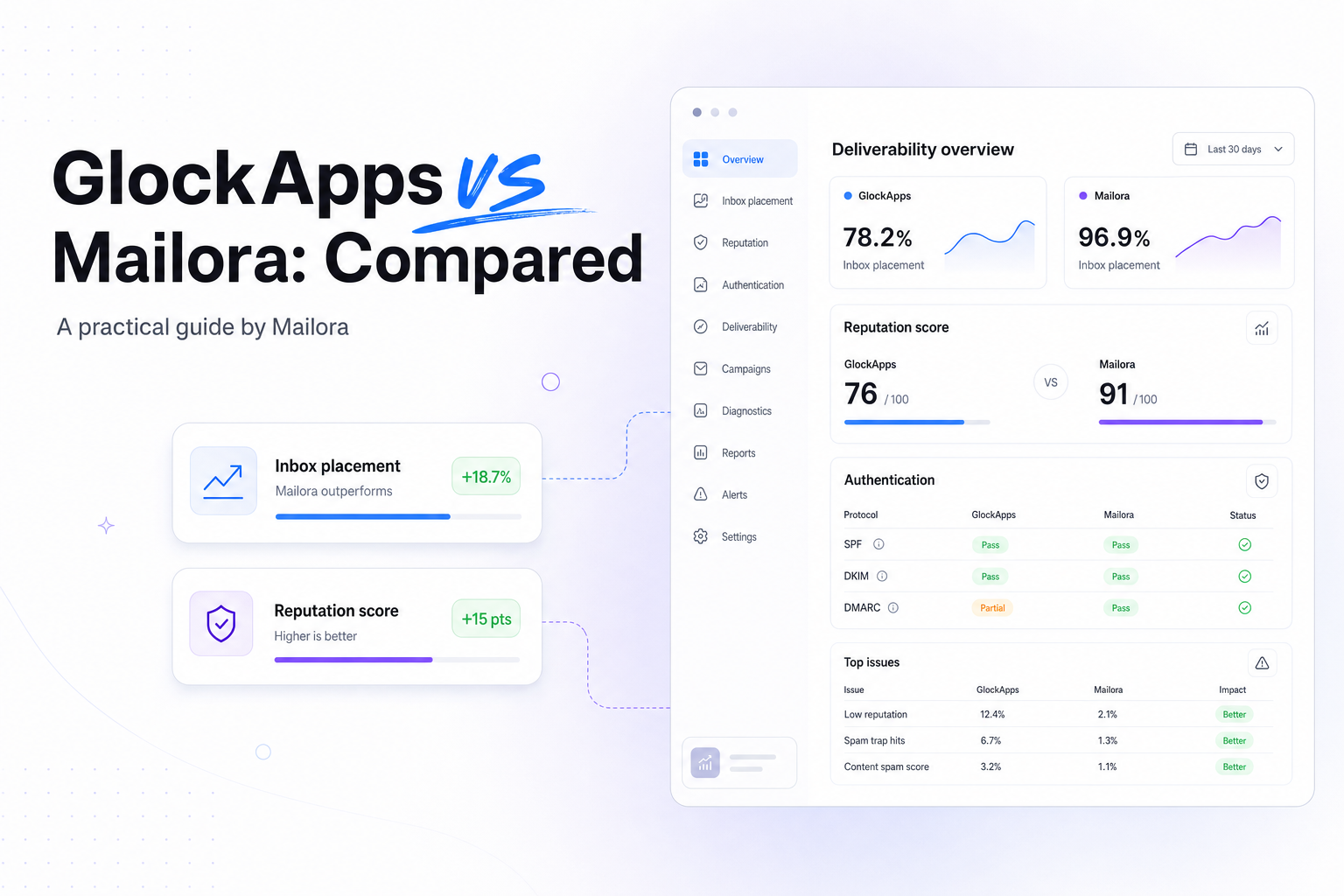
That is the practical difference in a GlockApps vs Mailora evaluation. Both sit in the deliverability workflow, but they solve different parts of the problem.
If your team mostly asks, where did this campaign land?, GlockApps is the familiar comparison point. If your team asks, what changed, why did it change, and what do we do next?, Mailora is the more relevant lens.
What each platform is trying to help you decide
Most teams do not buy a deliverability tool because they want another dashboard. They buy one because Gmail placement dipped, Outlook started clipping engagement, Yahoo complaint pressure rose, or Apple Mail open data became less trustworthy for diagnosis.
In that context, GlockApps and Mailora are not interchangeable.
GlockApps is generally evaluated as a pre-send and test-oriented platform. The value is straightforward, send to seeds, inspect placement, check content and infrastructure signals, and get a read before a broader launch.
Mailora is built around decision clarity. The value is not only seeing a signal, but understanding whether it points to authentication drift, reputation pressure, audience quality, frequency issues, or message-level changes that should alter the next send.
GlockApps vs Mailora at a glance
| Category | GlockApps | Mailora | Why it matters |
|---|---|---|---|
| Primary job | Test inbox placement before or around a send | Turn pre-send and post-send signals into actions | Choose based on whether you need validation, diagnosis, or both |
| Best-fit user | Deliverability specialist, agency, QA-heavy team | Lifecycle, deliverability, and RevOps operators | The buyer is often the best clue to the right platform |
| Workflow style | Run tests, review results, investigate manually | Review signals, prioritize causes, act faster | Speed matters when a campaign calendar is crowded |
| Best use case | Campaign checks, seed placement snapshots, launch confidence | Ongoing monitoring, trend interpretation, operational decisions | One is more episodic, the other is more continuous |
| Decision output | Where seeds landed | What changed and what to do next | Teams under pressure usually need the second output |
Where GlockApps tends to fit better
1. You need seed-based inbox placement tests
If your standard operating rhythm includes running seed tests before a launch, GlockApps is an easy fit for that workflow. This is especially useful when your team wants a structured way to spot whether Gmail, Outlook, or Yahoo is showing inbox, promotions, or spam placement before you scale volume.
2. You want a simple pre-send checkpoint
Some teams do not need a broad interpretation layer. They just need a recurring gate before newsletters, nurture launches, or client sends. In that scenario, a test-centric tool can be enough, especially if you already have strong internal expertise to interpret the result and decide the response.
3. You operate like an agency or a specialist QA function
Agencies and consultant-led deliverability programs often prefer tools that make campaign-by-campaign validation easy. If your process is built around proving placement snapshots across many clients, GlockApps aligns well with that operating model.
Where Mailora tends to fit better
1. You need actionability, not just visibility
Mailora is the better choice when the real bottleneck is not data collection, but interpretation. Many teams already have signals from seed tests, ESP dashboards, Google Postmaster Tools, and Microsoft data, but still struggle to answer a basic question, what should we change before the next send?
That matters most when a drop in Gmail performance is tied to multiple moving parts, for example a list source change, a frequency jump, a promo-heavy creative shift, or a subtle authentication issue. In those cases, a tool that translates signals into decisions saves more time than another raw metric view.
2. Your team spans lifecycle, deliverability, and RevOps
In-house teams rarely work in clean silos. The person watching complaints may not own segmentation. The person owning audience logic may not control domain setup. RevOps may be the group trying to connect platform changes to pipeline impact. Mailora fits better when those handoffs matter and the team needs shared clarity.
3. You care about before-and-after send context
Pre-send checks are useful, but many real deliverability failures appear only after the campaign goes out. If Outlook engagement softens, if Yahoo complaints spike on a single segment, or if Gmail promotions placement becomes spam for one stream but not another, you need context across the full send cycle. That is where Mailora has the stronger value story.
What matters more than the feature checklist
Seed data is directional, not exhaustive
A seed test can show whether controlled inboxes landed in inbox or spam. It cannot perfectly represent how Gmail will score every recipient in a live audience, because real filtering depends on recipient history, domain reputation, message consistency, and engagement patterns at scale.
That is why a seed-first tool can be necessary without being sufficient. It tells you something important, but not everything important.
Apple Mail makes weak diagnostics look stronger than they are
Apple Mail Privacy Protection means open-rate data is far less reliable as a deliverability diagnostic. If a platform leans too heavily on opens without grounding the analysis in placement, complaints, authentication, and audience quality, you can get false confidence. Any serious evaluation should account for that.
Complaint risk is now an operating constraint
For bulk senders, Google and Yahoo have moved complaint discipline from a best practice to a practical requirement. Staying below 0.3% is not the whole game, but it is a hard operational boundary. The better platform for your team is the one that helps you see complaint pressure early and change audience or frequency decisions before the damage spreads.
How to choose between GlockApps and Mailora
Choose GlockApps if your main need is pre-send testing, seed-based placement visibility, and a campaign QA workflow that your team already knows how to interpret.
Choose Mailora if your main need is decision support across the full deliverability workflow, especially when different teams need one clear explanation of what changed and what to do next.
A simple way to pressure-test the choice is to ask your team one question: when deliverability slips, do you usually lack test results, or do you lack clarity on the next move? If it is the first, GlockApps is likely closer to the mark. If it is the second, Mailora is.
Related reading: glockapps alternatives and usemailora.com.
Run your first deliverability test with Mailora
FAQs
Is GlockApps or Mailora better for seed testing?
GlockApps is usually the more natural fit if seed testing is your primary requirement and your workflow revolves around campaign checks before launch.
Which tool is better for lifecycle marketing teams?
Mailora is typically the better fit for lifecycle teams because the problem is often cross-functional, not just technical. You need decisions that connect audience, frequency, content, and reputation.
Can either tool tell me exactly why Gmail sent a message to spam?
No tool can give a perfect recipient-by-recipient explanation of Gmail filtering. The best tools combine directional testing with reputation and behavioral signals so you can make the next best decision quickly.
Do seed tests still matter in 2025-era deliverability?
Yes, they still matter. They are useful for spotting placement patterns and launch risk, but they should not be treated as a complete substitute for live performance and complaint monitoring.
Does Apple Mail affect this comparison?
Yes. Because Apple Mail opens are less reliable for diagnosis, teams need stronger placement and complaint analysis. That increases the value of tools that help interpret signals, not just report them.
Stay in the loop
Deliverability insights, product updates, and early access to new features. No spam, unsubscribe anytime.
By subscribing, you agree to our Privacy Policy. Unsubscribe anytime.