Top 10 Email Verification Tools in 2026: Compared & Evaluated
Key Takeaways
|
The average email list loses roughly 23% of its valid addresses every year. People change jobs, abandon personal accounts, and let domain registrations lapse. A 100,000-address list that was clean at acquisition holds approximately 78,000 deliverable addresses twelve months later, and that degradation is accelerating as role-based and disposable email adoption rises.
A hard bounce rate above 2% signals to ISPs that a sender is working from a stale or poorly sourced list. The response is throttling, filtering, and in persistent cases, blacklisting that affects every send from that domain or IP, including to subscribers who opted in and want the mail.
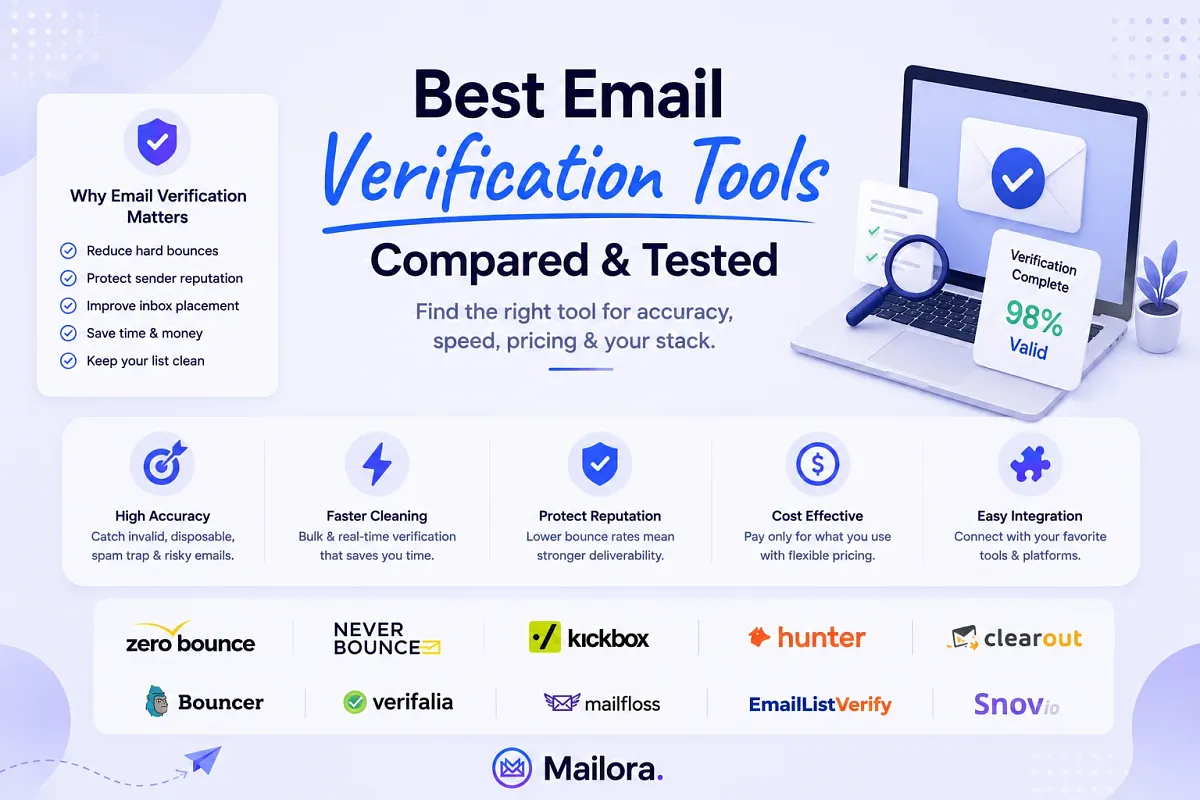
Email verification tools help you identify which addresses on a list can receive mail before a campaign goes out. Done right, they reduce hard bounces, protect sender reputation, and prevent wasted sends to addresses that will never deliver.
This guide covers 10 email verification tools evaluated, what verification does and does not when it comes to inbox placement.
How We Evaluated This Email Verification Tools List?
Each tool was assessed against the same criteria in the same order. The goal was to evaluate what each tool actually does and to surface the differences that matter for different use cases rather than producing a generic ranked list.
Verification depth
We looked at how many layers each tool runs, including syntax, MX records, SMTP handshake, catch-all detection, disposable email identification, and role-based address flagging. A tool that only runs syntax and MX checks is a different product from one that runs all six, and the difference is significant on a real-world list.
Bulk and real-time capability
Both were assessed independently. Bulk handling covers file upload support, processing speed, output format, and list size limits. Real-time API covers response latency, documentation quality, SDK availability, and rate limit transparency. Some tools are strong on one and weak on the other.
Pricing and credit model
We looked at pay-as-you-go rates, free tier limits, credit rollover policies, and whether subscription plans represent genuine value over pay-as-you-go at stated volumes.
Integration ecosystem
Native connectors to major ESPs and CRMs, Zapier and Make availability, and webhook support for async bulk jobs. Integrations were weighted below verification depth, a tool that connects to everything but verifies poorly is the wrong trade-off.
Deliverability intelligence beyond validity
Whether the tool surfaces signals beyond binary valid/invalid: engagement scoring, domain reputation signals, spam trap databases, or inbox placement context. Most tools stop at validity; a few go further, and those differences are relevant for how the tool fits a broader deliverability stack.
Email Verification Tools Compared at a Glance
Before the deep-dives, here's how each tool stacks up on the criteria that matter most
Tool | Verification Depth | Bulk | Real-Time API | Catch-all Detection | Starting Price | Best For |
| ZeroBounce | Full (6 checks + AI scoring) | Yes | Yes | Yes | Free / $99/mo | Accuracy + feature breadth |
| NeverBounce | Full (5 checks) | Yes | Yes | Yes | $8 per 1k (PAYG) | Speed + API reliability |
| Kickbox | Full (5 checks + Sendex score) | Yes | Yes | Yes | Free / PAYG | Marketer-friendly UX |
| Hunter.io | Standard (4 checks) | Yes | Yes | Limited | $34/mo | Prospecting + verification |
| Clearout | Full (20+ checks) | Yes | Yes | Yes | $16/mo | Mid-market value |
| Bouncer | Full (5 checks) | Yes | Yes | Yes | $25/mo | GDPR-first / EU teams |
| Verifalia | Full (6 checks + SLA tiers) | Yes | Yes | Yes | Free / PAYG | API depth + SLA requirements |
| Mailfloss | Standard (4 checks) | Auto | Limited | Limited | $29/mo | Set-and-forget hygiene |
| EmailListVerify | Standard (4 checks) | Yes | Yes | Limited | $16/mo | Budget bulk cleaning |
| Snov.io | Standard (4 checks) | Yes | Yes | Limited | $39/mo | SDR outbound all-in-one |
Detailed Overview
1. ZeroBounce
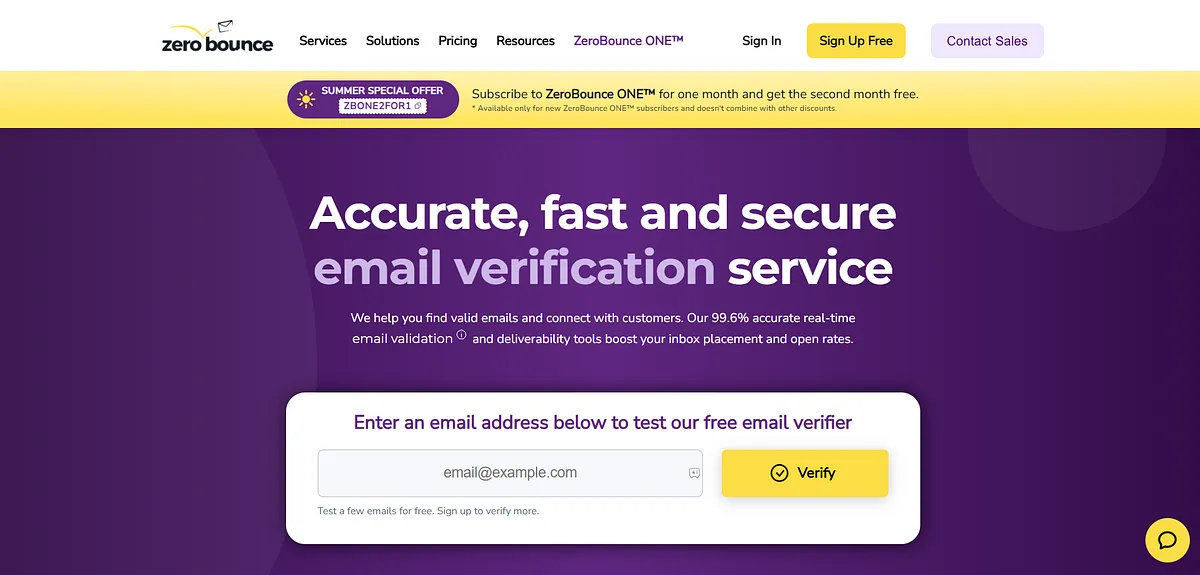
ZeroBounce is the most feature-complete verification platform on this list. It runs six verification checks, including syntax, MX records, SMTP, catch-all detection, disposable email filtering, and role-based detection, and layers an AI-driven email scoring system on top that predicts whether an address is likely to engage based on activity signals.
Key features:
- Abuse and spam trap detection: Flags addresses known to submit spam complaints or identified recycled spam traps
- Activity data: Estimates how recently an address was active, independent of SMTP response
- Email finder: Locate business addresses by domain and name (adds prospecting capability to a verification platform)
- Verification depth: Full six-layer check including catch-all, disposable, and role-based detection. Abuse and spam trap databases are maintained in-house.
Pricing: ZeroBounce offers a Freemium plan and ZeroBounce ONE ($99/month), combining email validation, inbox placement testing, blacklist monitoring, DMARC monitoring, email finding, deliverability insights, and warmup capabilities
Cons:
- Pricing becomes significant at high volumes relative to budget-focused alternatives
- The scoring layer adds complexity; teams that want simple valid/invalid segmentation may not use it
Best for: Teams that want verification + engagement scoring + basic deliverability signals in a single tool, particularly at mid-to-enterprise volume.
If you've decided ZeroBounce isn't the right fit for your budget, workflow, or feature requirements, it's worth comparing the leading ZeroBounce alternatives before choosing a verification platform, as each tool makes different trade-offs around accuracy, integrations, pricing, and deliverability features.
2. NeverBounce
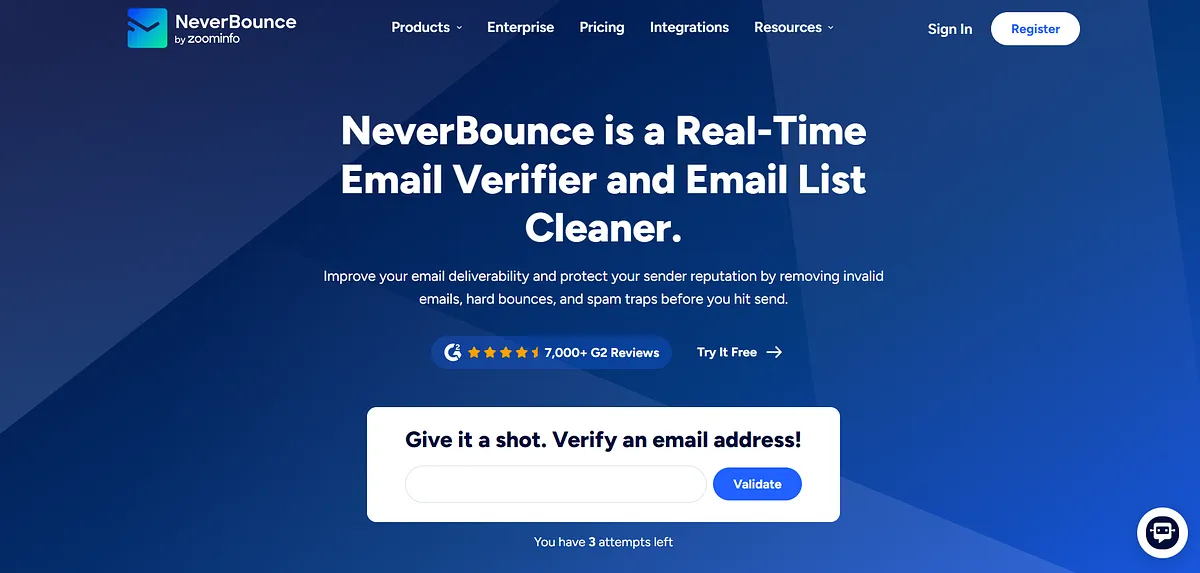
NeverBounce is built around speed and API reliability. Bulk jobs on large lists complete faster than most competitors, and the real-time API is one of the most widely used in the category.
Key features:
- Bulk processing: Large list jobs finish quickly with progress tracking and partial result access
- Native integrations: Connects directly to Mailchimp, HubSpot, ActiveCampaign, Marketo, and others
- Duplicate detection: Automatically flags and removes duplicate entries before verification runs
- Dashboard reporting: Breakdown of verification results by status, domain, and risk category
Pricing: NeverBounce offers pay-as-you-go verification ($8 per 1,000 emails), Growth ($49/month), and Enterprise plans, focusing on email validation, list cleaning, CRM syncing, AI lead scoring, and workflow automation.
Best for: Development and RevOps teams that need a reliable, well-documented API for real-time verification at scale, or marketing teams with large lists who prioritize processing speed.
Cons:
- Less feature breadth than ZeroBounce with no scoring, no spam trap database of similar depth
- Free tier is a one-time allotment, not recurring monthly credits
3. Kickbox
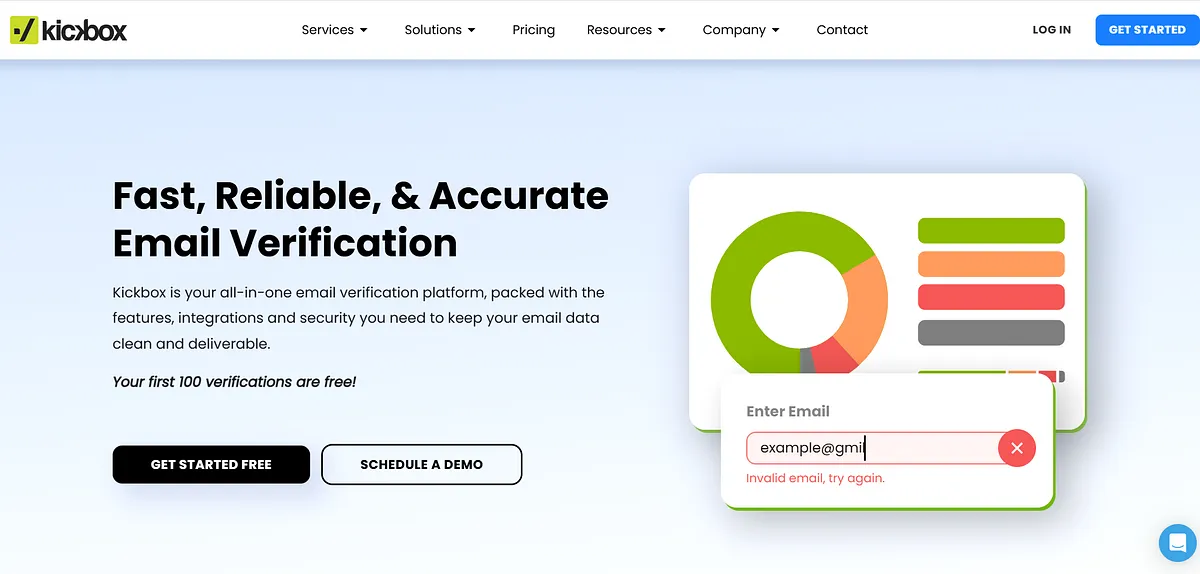
Kickbox is an email verification and deliverability platform that helps businesses validate email addresses before sending. It identifies invalid, disposable, risky, and role-based emails through bulk verification and real-time API checks, helping reduce bounce rates, protect sender reputation, and improve inbox placement
Key features:
- Sendex quality score: Proprietary 0–1 score combining mailbox responsiveness, domain quality, and engagement probability signals
- Acceptall / catch-all flag: Clear classification of catch-all domains with risk context
- Disposable and free provider detection: Flags throwaway addresses and major consumer domains separately
- Sandbox testing environment: Test API calls without consuming credits during development
- Zapier and Make integration: Available for teams using automation platforms rather than direct API
Pricing: Kickbox uses pay-as-you-go pricing from free to enterprise volumes, focusing on email verification, list cleaning, deliverability improvement, verification APIs, compliance, volume discounts, and dedicated support
Cons:
- No built-in spam trap detection database comparable to ZeroBounce
- Higher per-credit price at low volume than budget alternatives
Best for: Email marketers who want address quality scoring beyond binary validation, particularly for acquisition lists where engagement signals matter as much as deliverability.
4. Hunter.io

Hunter.io is primarily a prospecting and lead-finding platform that includes email verification as a core feature, instead of as a standalone verifier that added prospecting later. The combination makes it uniquely useful for outbound operators who need to find, verify, and store contacts in a single workflow without switching tools.
Key features:
- Email finder: Locate professional email addresses by domain, company, or full name
- Bulk verification: Upload a CSV or verify a full domain's known contacts in one job
- Domain search: Surface all publicly findable emails associated with a domain
- Campaign module: Send cold email sequences directly from Hunter. Turns it into a light outbound tool
- Google Sheets add-on: Find and verify addresses directly in spreadsheets, relevant for manual prospecting workflows
Pricing: Hunter offers Free, Starter ($34), Growth ($104), Scale ($209), and Enterprise plans, combining email finding, verification, lead enrichment, outreach automation, AI assistance, and team collaboration tools
Cons:
- Verification depth is lighter than ZeroBounce, NeverBounce, or Bouncer, not ideal for high-stakes bulk scrubs
- Verification credits are bundled with prospecting credits, making cost comparison with pure verifiers non-linear
Best for: Outbound operators and SDR teams that need prospecting and verification in a single platform, and do not require maximum verification depth.
5. Clearout

Clearout Email Verifier is an email verification and validation platform that checks email addresses individually, in bulk, or through APIs. It performs 20+ validation checks, including mailbox, MX, disposable-email, spam-trap, catch-all, and role-account detection, to identify valid and risky addresses, reduce bounce rates, protect sender reputation, and improve email deliverability.
Key features:
- Risk-scored results: Segments results into Safe, Risky, Invalid, and Unknown categories, instead of simple binary valid/invalid
- Catch-all identification: Clear flagging with domain-level context, not just an "unknown" label
- Real-time API: Available with documentation suitable for production integrations
- ESP and CRM integrations: Native connections to Mailchimp, HubSpot, Salesforce, Klaviyo, and others
- LinkedIn email finder: Enrichment capability for outbound teams who want to extend beyond verification
Pricing: Clearout offers Freemium, Starter ($16/month), Pro ($32/month), and Enterprise plans, combining email verification, email finding, CRM monitoring, prospecting, form validation, APIs, and deliverability-focused automation
Cons:
- Less brand recognition than ZeroBounce or NeverBounce
- Integration depth is narrower than enterprise-focused competitors
Best for: Mid-market email marketing teams and agencies that need full verification depth at a price point below the market leaders.
6. Bouncer
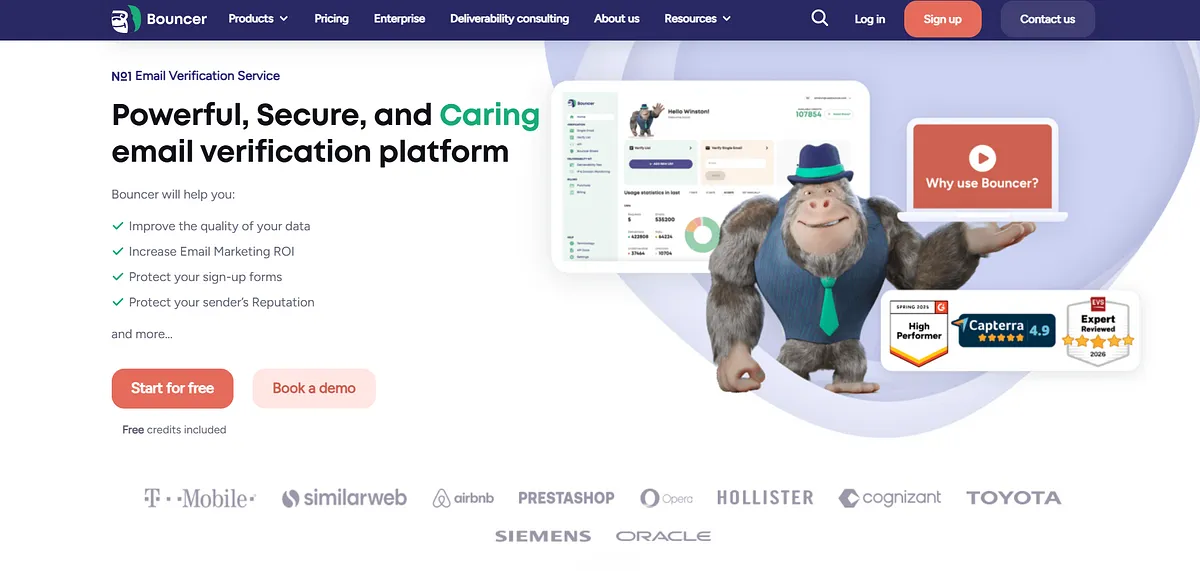
Bouncer is an email verification and deliverability platform that validates email addresses through bulk uploads, API integrations, and real-time checks. It identifies invalid, disposable, role-based, and risky email addresses while providing deliverability insights to help reduce bounce rates, maintain sender reputation, and improve inbox placement.
Key features:
- GDPR-compliant by design: EU data residency, published DPA, no data resale, explicit data retention policies
- Toxicity check: Flags addresses associated with known complaint generators or spam traps
- Email deliverability checker: Supplementary tool that checks domain reputation, DNS configuration, and blacklist status alongside verification
- API with EU endpoint: Requests can be routed through EU servers explicitly, critical for GDPR-strict implementations
Pricing: Bouncer offers pay-as-you-go email verification, Deliverability Kit plans from $25/month, and custom enterprise options, combining email validation, inbox placement testing, authentication checks, blocklist monitoring, and form protection
Cons:
- Smaller integration ecosystem than ZeroBounce or NeverBounce
- Less name recognition means fewer independent benchmarks to validate accuracy claims
Best for: Teams operating under GDPR or other EU data regulations, and any organization where data residency and compliance documentation are procurement requirements.
7. Verifalia
Verifalia is an email verification platform that validates email addresses through bulk processing, APIs, and real-time checks. It analyzes syntax, domain configuration, mailbox existence, disposable addresses, catch-all domains, and other deliverability factors to identify invalid or risky email addresses, helping organizations reduce bounce rates, improve list quality, and protect sender reputation.
Key features:
- Quality tiers: Choose between speed-optimized and thoroughness-optimized verification depending on the use case and latency tolerance
- 40+ result classification codes: Far more granular than the 4–6 status categories most tools provide, useful for building nuanced suppression logic
- Non-ASCII and internationalized address support: Handles addresses with Unicode characters, relevant for international sending programs
- Webhook support: Asynchronous job completion notification for large bulk jobs
Pricing: Verifalia offers pay-as-you-go credit packs and subscription plans from Free to Ultimate ($499/month), providing email verification, bulk list cleaning, API access, integrations, advanced validation levels, and team management.
Cons:
- Steeper learning curve than marketer-oriented tools
- Oriented toward technical integration
- Dashboard UX is functional but not optimized for non-technical users
Best for: RevOps leads and engineering teams building verification into a product, CRM pipeline, or data processing workflow where granular result codes and SLA guarantees matter.
8. Mailfloss
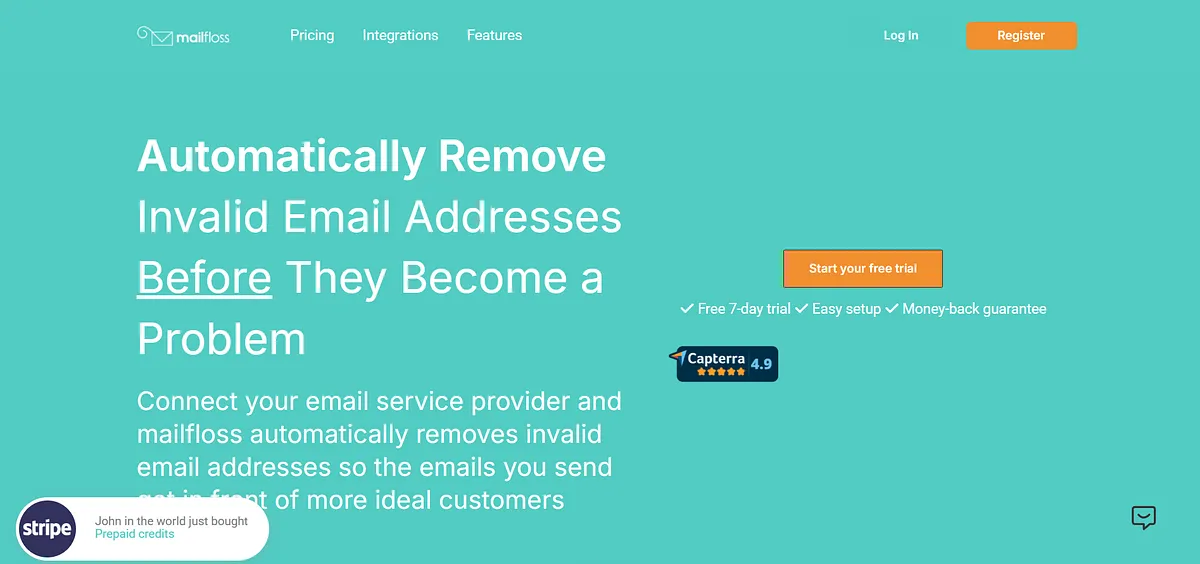
Mailfloss is an email verification and list-cleaning platform that automatically validates email addresses within connected email marketing platforms. It detects invalid, disposable, role-based, spam-trap, and catch-all addresses, removes hard bounces, fixes common typos, and continuously cleans subscriber lists through automated daily verification and real-time API checks.
Key features:
- Automated continuous cleaning: Connects directly to major ESPs and runs ongoing verification without manual triggers
- Decay settings: Configure how aggressively stale addresses are handled, immediate removal vs. flagging for review
- Typo correction: Identifies and offers corrections for common domain typos (gmial.com, yahooo.com) before suppression
- Instafloss on-demand: Manual verification job option alongside the automated cleaning
Pricing: Mailfloss offers Lite ($29), Business ($59), and Pro ($209) plans, automating email list cleaning, verification, typo correction, ESP syncing, real-time validation, and ongoing deliverability maintenance.
Cons:
- Not a substitute for a pre-send verification audit on a large legacy list, catches ongoing decay, not historical accumulation
- Verification depth is lighter than ZeroBounce or Bouncer for complex catch-all and risk scenarios
- Requires full access to an ESP account, a procurement or security consideration for some teams
Best for: Email marketers who want automated background list hygiene without manual scrub workflows, particularly those already on Mailchimp, ActiveCampaign, or HubSpot.
9. EmailListVerify
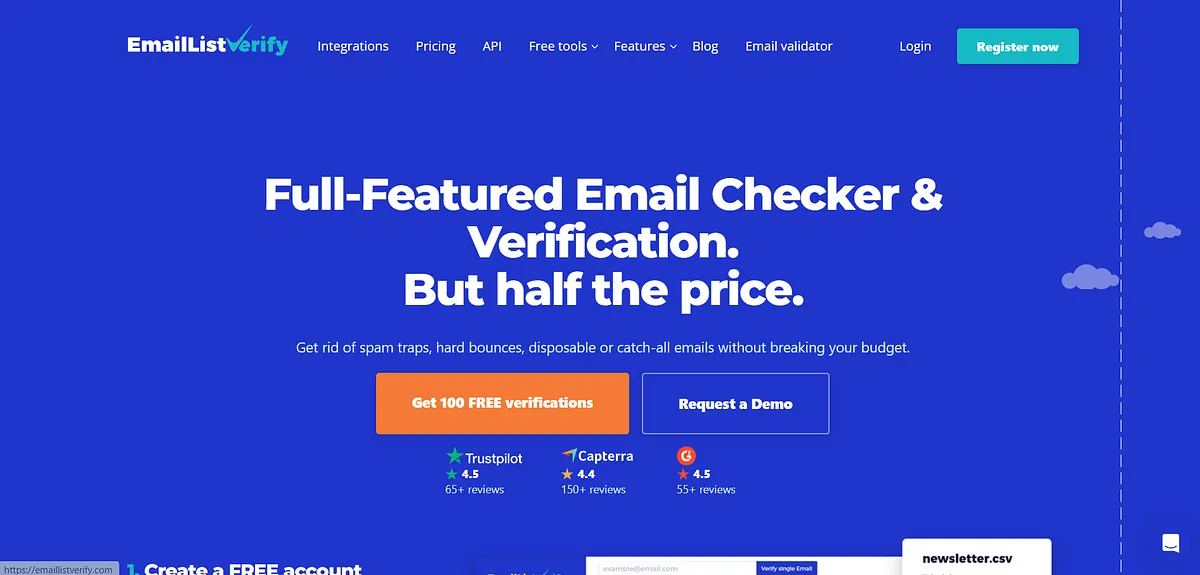
EmailListVerify is an email verification platform that validates email addresses through bulk uploads and API-based checks. It identifies invalid, disposable, role-based, spam-trap, catch-all, and duplicate email addresses while verifying domains, MX records, and mailbox status to help reduce bounce rates, improve list quality, and protect sender reputation
Key features:
- Bulk verification at scale: Handles large lists with no artificial volume ceiling on standard plans
- Multiple output formats: Results available in CSV, TXT, and Excel, flexible for different downstream workflows
- Spam trap detection: Included in the standard verification run
- Real-time API: Available for integration, though documentation depth is thinner than NeverBounce or Verifalia
- Online dashboard: Job management and results review without requiring technical setup
Pricing: EmailListVerify offers pay-as-you-go and subscription plans starting at $16/month, focusing on bulk email verification, spam trap detection, bounce prevention, email finding, API access, and list hygiene automation
Cons:
- Accuracy and depth benchmarks are less independently documented than category leaders
- API documentation and integration support are thinner than purpose-built API platforms
Best for: High-volume, budget-conscious teams running bulk scrubs where verification depth requirements are standard (not precision-critical) and cost per verification is the primary decision factor.
10. Snov.io
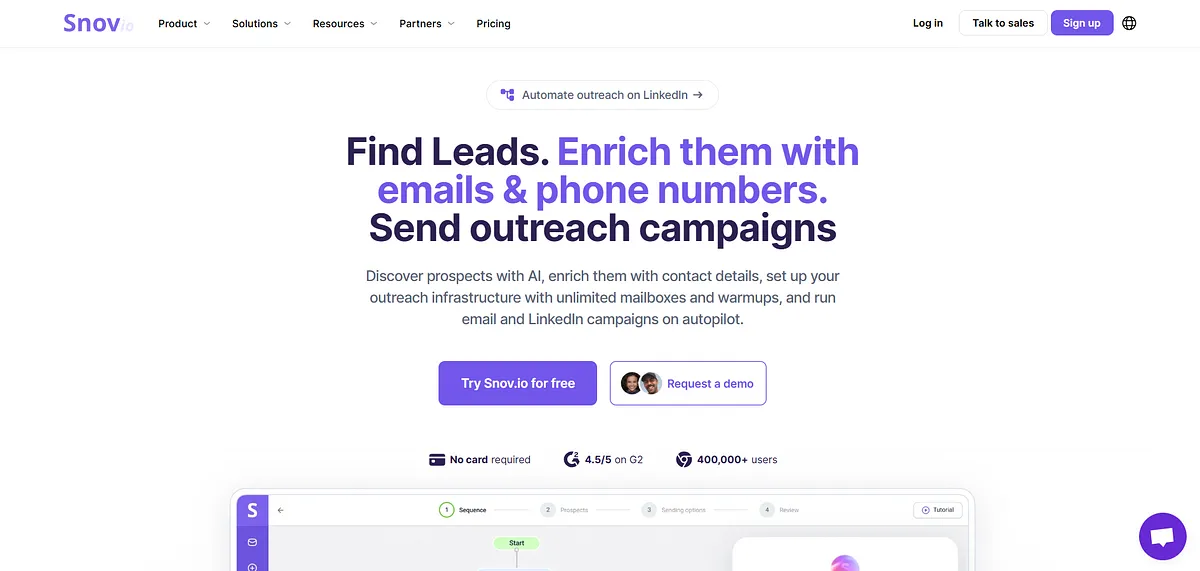
Snov.io is a sales prospecting and email outreach platform that includes email verification, lead generation, and cold email automation tools. Its Email Verifier uses a multi-step validation process, including syntax, domain, MX, SMTP, mailbox existence, and catch-all checks, to identify invalid and risky email addresses, helping reduce bounce rates and protect sender reputation
Key features:
- Email finder and prospector: Find and extract verified business emails by company, LinkedIn profile, or domain
- Bulk email verification: Upload and verify contact lists inside the same platform used for outreach
- Cold email sequencing: Build and send multi-step cold email sequences with reply detection and CRM sync
- Technology checker: Identify technologies a company uses, useful for ICP filtering in outbound programs
- CRM integrations: Native connections to Salesforce, HubSpot, Pipedrive, and others
Pricing: Snov.io offers Starter ($39/month), Pro ($99/month), and Custom plans, combining lead generation, email verification, cold outreach, deliverability testing, email warm-up, CRM features, and LinkedIn automation.
Cons:
- Verification depth and accuracy are secondary to the outbound workflow value proposition
- Credit pools are shared between prospecting and verification, making cost modeling for high-volume verification non-linear
Best for: SDR teams and outbound-led growth functions that need prospecting, verification, and cold email automation in a single platform, and do not require maximum verification precision.
Beyond Verification: The Gap Between a Clean List and the Inbox
A list can come back 97% verified and still produce poor campaign results because inbox placement is determined by an entirely different set of signals. Mailbox providers evaluate authentication, sender reputation, engagement history, complaint rates, and sending behavior long after verification has done its job.
A verified address can still receive your email in the spam folder.
The Catch-All Problem
Catch-all domains are one of the biggest limitations of email verification.
These domains are configured to accept mail for virtually any address, which means a verification tool may receive a positive response even when the specific mailbox doesn't actually exist.
Most verification platforms flag these addresses as Catch-All or Unknown because the mailbox cannot be validated with confidence. For cold outreach and high-risk campaigns, large volumes of catch-all addresses can introduce unnecessary deliverability risk.
What Email Verification Doesn't Measure
Even the best verification tool cannot tell you:
- Whether emails are reaching the inbox or spam folder
- How Gmail, Outlook, or Yahoo view your sender reputation
- Whether your domain or IP has developed deliverability issues
- Whether authentication problems are affecting inbox placement
- Whether engagement patterns are helping or hurting future sends
That's why teams that only verify lists often end up troubleshooting a deliverability problem that started somewhere else entirely.
How to Choose the Right Email Verification Tool for Your Use Case
After comparing features, pricing, and capabilities, the more useful question becomes: what problem are you actually trying to solve? Some tools are built to clean lists. Others help test inbox placement. A smaller group focuses on ongoing deliverability monitoring and authentication health. The matrix below helps connect each tool to the operational need it serves best.
Use Case | Recommended Tool(s) | Why |
| Cold email list scrub | ZeroBounce, Bouncer | Spam trap detection + catch-all flagging critical for cold |
| Newsletter / campaign hygiene | NeverBounce, Kickbox | Full verification + engagement scoring for list quality |
| SaaS signup form validation | NeverBounce, ZeroBounce | Real-time API with low latency; drops bad addresses at entry |
| E-commerce / DTC promo sends | ZeroBounce, Clearout | Bulk efficiency + catch-all detection for acquisition lists |
| Agency managing multiple clients | ZeroBounce, NeverBounce | White-label options, volume flexibility, integration breadth |
| EU-regulated / GDPR environment | Bouncer | Data residency, DPA, no resale, built for compliance |
| SDR outbound stack | Hunter.io, Snov.io | Find + verify + sequence in one platform |
| High-volume budget scrub | EmailListVerify | Lowest cost per verification at scale for standard-depth needs |
A Clean List Is the Starting Point, Not the Finish Line
Most teams discover email verification when bounce rates become a problem. That's a reasonable place to start because sending to invalid addresses damages reputation quickly and creates avoidable risk.
But once the list is clean, a different set of questions emerges.
- Are mailbox providers trusting your domain?
- Are authentication records configured correctly?
- Is Gmail treating your mail the same way Outlook is?
- Are engagement signals helping future campaigns or quietly working against them?
Those questions sit outside the scope of email verification, yet they have a far greater influence on whether your emails reach the inbox consistently.
The most effective sending programs treat verification as one layer of a broader deliverability strategy. List quality protects sender reputation. Authentication establishes trust. Deliverability monitoring reveals what mailbox providers are actually doing with your mail.
A clean list removes addresses that will bounce. Whether your mail actually reaches the inbox after that depends on authentication alignment, sender reputation, and how mailbox providers are treating your domain, signals that no verification tool surfaces.
Run your first deliverability test with Mailora to see what's happening after the list is clean.
FAQs
What is email verification?
Email verification confirms that an address is real, correctly formatted, and capable of receiving mail. Unlike syntax validation, full verification runs through MX records, an SMTP handshake, catch-all detection, and disposable email filtering, determining whether an address will accept a message before anything is sent.
How often should I verify my email list?
Email databases decay at roughly 22% per year, so quarterly verification is the floor for static lists, and any segment dormant for 90 days or more should be verified before reactivation. For ongoing programs, real-time verification at point of acquisition stops decay from accumulating in the first place.
What's the difference between email validation and email verification?
Validation checks whether an address is syntactically formatted correctly. Verification confirms the domain can receive mail, performs an SMTP handshake to probe whether the specific mailbox exists, and runs additional checks for catch-all domains, disposable addresses, and role-based accounts.
What is a catch-all email address?
A catch-all domain returns a positive SMTP response for any address, whether or not the mailbox exists, making individual address validity unconfirmable through standard verification.
Do email verifiers work on Gmail and Yahoo addresses?
Yes. SMTP handshake verification works on consumer domains. Consumer domains are rarely catch-all, and role-based detection is less relevant for personal addresses.
Stay in the loop
Deliverability insights, product updates, and early access to new features. No spam, unsubscribe anytime.
By subscribing, you agree to our Privacy Policy. Unsubscribe anytime.