Key Takeaways
|
According to Google, bulk senders that send more than 5,000 messages per day to Gmail accounts should keep spam complaint rates below 0.3%. Yahoo aligned to the same 2024 sender requirements. That changed the standard for any SendForensics alternative, a useful tool now has to help you before the campaign goes out and after Gmail, Outlook, Yahoo, and Apple Mail react to it.
SendForensics is still relevant if your main need is pre-send content analysis and risk scoring. But most lifecycle, deliverability, and RevOps teams need wider signal coverage now, including authentication, inbox placement, complaint trends, and domain-level reputation context.
If you are comparing the best SendForensics alternatives, the real decision is simple. Do you need a better pre-send check, better post-send diagnosis, or one system that connects both?
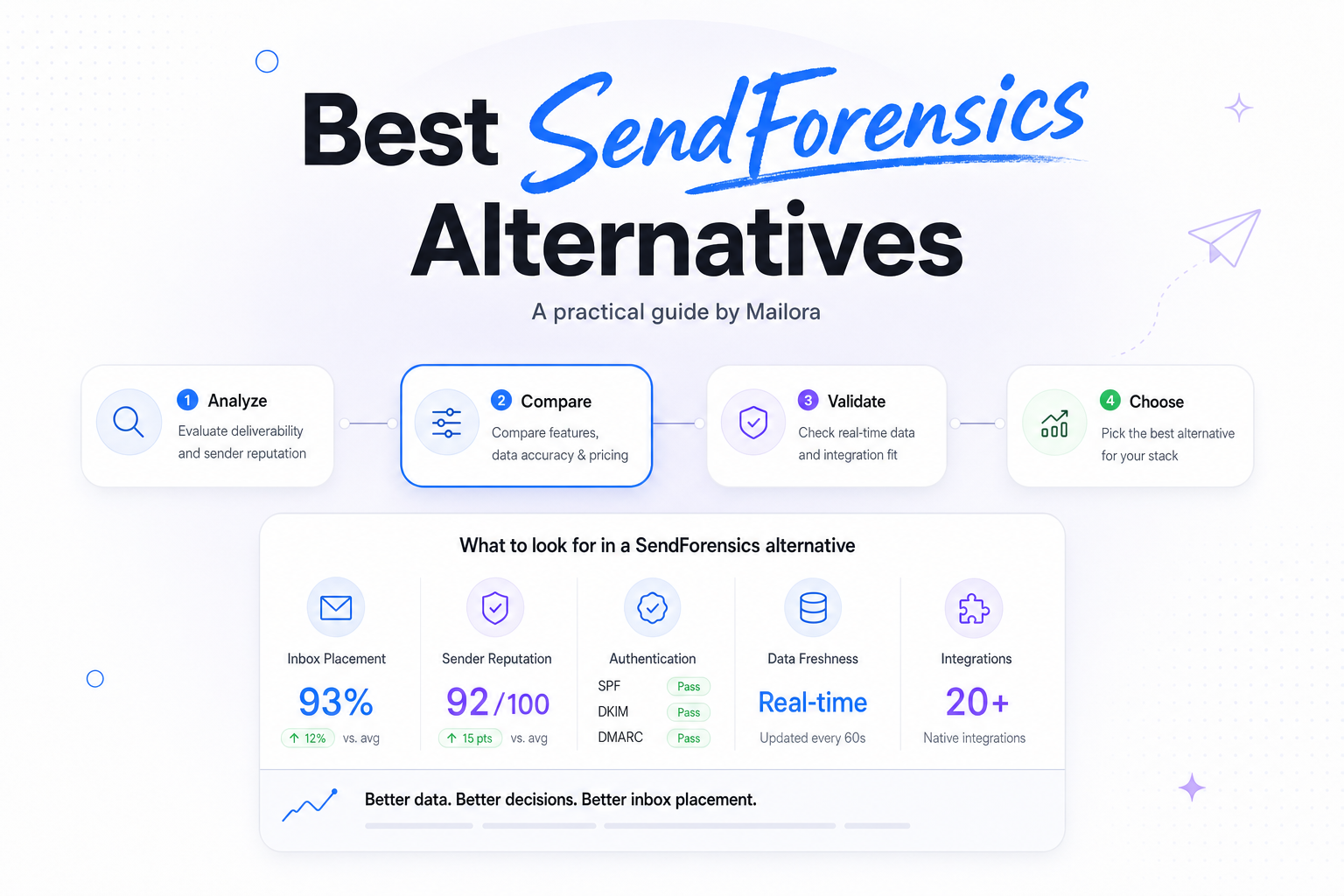
What to look for in a SendForensics alternative
Pre-send scoring versus live mailbox signals
SendForensics is known for predicting likely deliverability risk before send. That is useful, but it is only one layer. A campaign can score well before launch and still underperform if Gmail sees weak recent engagement, if Outlook distrusts the sending IP, or if Yahoo sees inconsistent list hygiene. The best alternatives show you both the forecast and the outcome.
Coverage across real mailbox providers
Not all inbox placement data is equal. Gmail, Outlook, Yahoo, and Apple Mail do not behave the same way, and Apple Mail Privacy Protection makes open-rate-based interpretation even less reliable. If a platform groups all mailbox providers into one high-level score, you will struggle to make the right operational call.
Actionability for operators
Deliverability teams do not need another vague score. They need to know whether the problem points to authentication, content, domain reputation, bounce quality, seed placement, or audience mix. The strongest SendForensics alternatives turn those signals into next actions that a lifecycle manager or RevOps lead can actually execute this week.
Workflow fit
A lean SaaS team sending two newsletters and three lifecycle streams each week needs a different product than a marketplace brand sending 20 million messages a month across multiple subdomains. Reporting depth, API access, collaboration, and time-to-answer matter just as much as the tests themselves.
Best SendForensics alternatives to consider
| Tool | Best for | What it does well | What to watch |
|---|---|---|---|
| Mailora | Teams that want pre-send and post-send decisions in one place | Connects deliverability signals to clear actions, useful for lifecycle and RevOps workflows | Best fit if you want an operational workflow, not just a one-off score |
| Validity Everest | Enterprise programs with broad mailbox-provider coverage | Strong seed testing, reputation context, and established enterprise workflows | Can be more than smaller teams need, both in scope and cost |
| GlockApps | Small to mid-size teams focused on inbox placement tests | Accessible inbox placement checks, spam filter tests, auth visibility | Less opinionated on what to do next at the program level |
| Inbox Monster | Brands that want deliverability plus creative and rendering visibility | Useful testing depth across mailbox environments and campaign QA needs | May be broader than teams looking only for pre-send risk analysis |
| ZeroBounce | Teams that want validation plus a lighter deliverability toolkit | Email validation, blacklist monitoring, and practical sender checks | Not as deep for ongoing strategic diagnostics as enterprise-focused platforms |
1. Mailora
Mailora is the best SendForensics alternative if your team is trying to answer two questions at once, what is likely to happen before send, and what actually happened after send. That matters when a campaign looks clean in QA but Gmail tabs it into Promotions, Outlook defers part of the volume, or Yahoo complaints spike on one segment. Instead of stopping at a score, Mailora is designed to turn those signals into an operational decision.
This is especially useful for lifecycle teams that work fast and need clarity across launches, nurtures, and promotional sends. If your current process relies on stitching together ESP data, seed tests, and inbox screenshots manually, Mailora gives you a more direct path from signal to action.
2. Validity Everest
Everest is a strong choice for larger teams that need mature seed testing, reputation context, and broad reporting. If you send large volumes across multiple brands or regions, Everest can help you compare provider-level placement patterns and spot changes before they hit revenue hard.
The tradeoff is that enterprise depth can create enterprise overhead. Smaller lifecycle teams often want a faster answer than a large reporting suite provides.
3. GlockApps
GlockApps is a practical SendForensics alternative when inbox placement testing is your main gap. It is particularly useful for teams that want frequent checks across Gmail, Outlook, and Yahoo without taking on an enterprise platform. For example, if your onboarding emails reach Outlook spam after a template update, GlockApps can help isolate whether the issue is likely tied to content, authentication, or mailbox-specific filtering.
Its limitation is that you may still need additional tools or internal analysis for broader trend monitoring and program-level prioritization.
4. Inbox Monster
Inbox Monster is a good fit when deliverability testing and message QA need to live close together. That is helpful for teams where email operations and creative approvals are tightly linked, or where many stakeholder groups review the same send. If your team values placement data but also wants more visibility into how the message renders and is interpreted across inbox environments, it is worth a close look.
5. ZeroBounce
ZeroBounce is best viewed as a lighter-weight alternative when sender quality and list quality are central concerns. Teams with inconsistent acquisition sources, older databases, or recurring bounce issues often benefit from starting here. It will not replace a full deliverability operations layer for every program, but it can cover a lot of ground for a lower-complexity setup.
Which alternative is best for your team
For lifecycle teams that need faster answers
Choose Mailora if your challenge is decision speed. A typical example is a B2B SaaS team sending product announcements, trial nudges, and renewal notices from the same domain. You do not just need a content warning. You need to know whether Gmail engagement softened after the last launch, whether Outlook is throttling new volume, and what to change next.
For enterprise deliverability programs
Choose Everest if you manage high volume, multiple business units, or a formal deliverability function with dedicated owners. It is a strong fit when reporting depth and cross-provider benchmarking matter more than simplicity.
For lean teams that mostly need inbox placement tests
Choose GlockApps if your current SendForensics use case is mostly pre-send validation and spam-folder checks, and you want something closer to a practical test bench than an enterprise platform.
For teams balancing deliverability and QA
Choose Inbox Monster if your process regularly combines inbox placement concerns with creative review, rendering checks, and broad campaign QA.
For teams starting with list quality problems
Choose ZeroBounce if the first issue to fix is database quality, bounce pressure, or risky lead sources. It is often the most practical first move when your deliverability problem starts upstream.
How to evaluate SendForensics alternatives without creating more noise
Run the same campaigns through two tools for 2 to 4 weeks
Do not rely on a single test. Compare what each platform says before send, then compare that guidance with actual Gmail, Outlook, and Yahoo results after send. The best alternative is the one that helps your team make a better decision consistently, not the one with the flashiest score.
Judge by time-to-action, not dashboard volume
If a tool surfaces 20 signals but your team still cannot decide whether to change the segment, slow the ramp, warm a subdomain, or rewrite the creative, it is adding noise. A strong alternative should shorten the path from observation to action.
Use one or two live scenarios
Pick a real workflow. For example, a monthly product launch to 800,000 contacts, or a multi-step trial onboarding stream that sends 60,000 messages a day. Evaluate which platform helps you explain provider-specific outcomes, especially at Gmail and Outlook, with the least guesswork.
Bottom line
The best SendForensics alternatives are not automatically the tools with the most tests. They are the tools that match the decision your team actually needs to make. If you mainly want pre-send guidance, GlockApps may be enough. If you need enterprise-scale visibility, Everest is a strong contender. If you want one workflow that helps you understand what is happening before and after the send, Mailora is the most complete fit.
Related reading: best folderly alternatives and best mxtoolbox alternatives.
Run your first deliverability test with Mailora
FAQs
Is SendForensics enough on its own for modern deliverability work?
It can be enough for teams focused mainly on pre-send risk checks, but many programs now need post-send visibility too, especially around Gmail and Yahoo complaint, authentication, and placement outcomes.
What is the biggest limitation of SendForensics compared with newer alternatives?
The main limitation is workflow scope. Many teams want a system that connects pre-send testing with live mailbox-provider outcomes and next-step recommendations.
Which SendForensics alternative is best for small teams?
For smaller teams, GlockApps and ZeroBounce are often the most practical starting points. If you want a more decision-oriented workflow rather than isolated tests, Mailora is a stronger fit.
Are seed-list tests better than pre-send scoring?
They answer different questions. Pre-send scoring helps predict risk. Seed tests help you see likely placement behavior. Most mature teams benefit from using both, then checking those signals against real send performance.
Can any SendForensics alternative guarantee inbox placement?
No. Gmail, Outlook, Yahoo, and Apple Mail all make dynamic decisions based on sender reputation, engagement, authentication, and message context. Good tools improve your odds and speed up diagnosis, they do not guarantee a result.
Stay in the loop
Deliverability insights, product updates, and early access to new features. No spam, unsubscribe anytime.
By subscribing, you agree to our Privacy Policy. Unsubscribe anytime.