What to do when deliverability suddenly drops
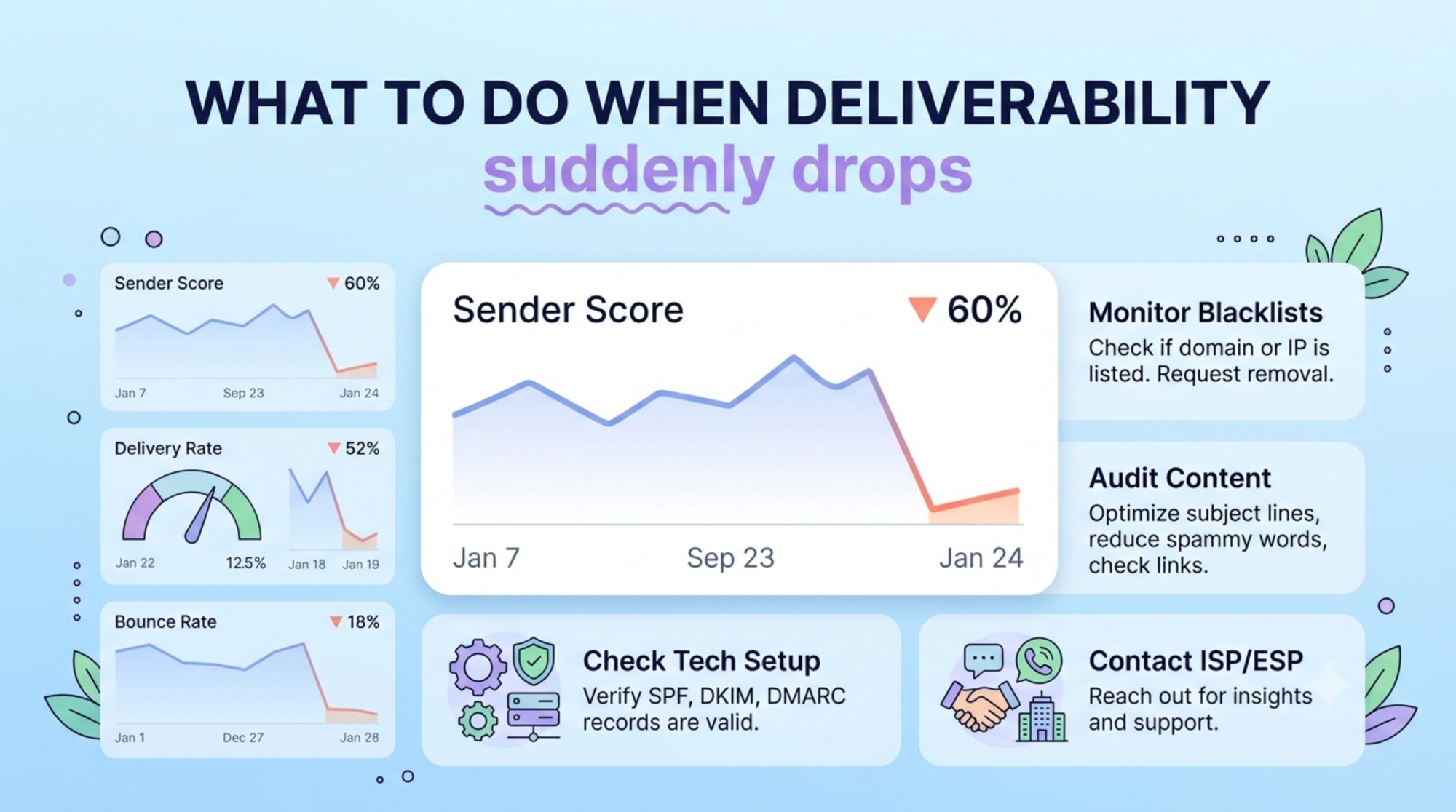
Open rates fall off a cliff. Bounce reports spike. A campaign that would normally perform well barely gets any engagement. Survey response rates can collapse just as quickly, especially when research communities depend on email for participation. When deliverability suddenly drops, the instinct is to act immediately, often by changing everything at once: new subject lines, a different sending time, maybe even a new ESP. That instinct, while understandable, is usually counterproductive. A sudden drop calls for a calm, structured investigation, not a flurry of simultaneous changes that make it impossible to tell what actually helped—or whether messages are simply landing in spam folders.
Don't Panic or Change Everything
The single most common mistake teams make when deliverability suddenly drops is changing multiple variables at once. A new subject line format, a reduced sending frequency, a switch to plain text, and a hurried list cleanup, all implemented in the same week, might genuinely improve things. But if they do, there's no way to know which change mattered, and if the same problem happens again later, that knowledge gap makes it harder to respond quickly a second time.
There's also a real risk that some of these hurried changes make things worse. A sudden shift in sending patterns can itself look suspicious to mailbox providers, since consistency is one of the signals filtering systems use to build trust in a sender over time. The better first move is to pause and gather information before making changes. One reason investigations often take longer than they should is that teams rely on outdated email deliverability advice that no longer reflects how modern mailbox providers evaluate senders, making it harder to identify the real cause of the drop. A day or two spent understanding what actually happened is almost always worth more than a day or two spent making uncoordinated fixes, especially during what may feel like an infrastructure crisis.
Identify What Changed Before Deliverability Suddenly Drops
Sudden deliverability drops are rarely random. Something changed, even if it's not immediately obvious what. The investigation should start by reviewing recent history across a few dimensions:
- Campaign changes: Was there a shift in subject line style, sending frequency, content format, or the segments being targeted? Did a product email misfire or a transactional-style email suddenly resemble promotional content?
- Infrastructure changes: Was there a recent domain migration, a new sending IP, an ESP switch, or any update to DNS records, including SPF, DKIM, or DMARC configuration? Could broken email infrastructure be affecting authentication or inbox delivery rates?
- Audience changes: Was a new list imported recently? Did list growth rely on a new acquisition channel? Are inactive subscribers increasing, or did audience fatigue lead to low interaction rates?
- Sending pattern changes: Did volume spike or drop significantly compared to recent history? Did bulk email senders, established senders, or a B2B outreach agency change their normal cadence?
Reviewing these four areas usually surfaces a likely starting point, even before any deeper technical investigation begins. It also helps survey researchers and research teams separate a survey design issue from an email delivery issue.
Technical vs Reputation: What Kind of Drop Are You Looking At?
Once a likely starting point emerges, the next step is determining whether the issue is primarily technical or primarily reputation-driven, since the two require different responses and tend to leave different signatures.
| Signal | Technical (Infrastructure) Cause | Reputation Cause |
|---|---|---|
| Speed of onset | Sudden, often within hours | Gradual, building over days or weeks |
| What to check first | SPF, DKIM, DMARC status; DNS records | Complaint rate, engagement trend, bounce trend |
| Typical trigger | Domain migration, DNS change, new IP | List decay, rising complaints, spam trap hits |
| Confirmation method | Authentication checker, bounce message codes | Trend review across several recent sends |
Technical problems tend to be confirmable quickly. Checking SPF, DKIM, and DMARC status directly will reveal whether authentication is passing as expected. Reviewing bounce messages can reveal specific rejection reasons, which mail servers often include in their response codes. Email health tools can also help identify issues affecting recipients' inboxes.
Reputation problems require looking at trends rather than a single check. Has complaint rate been climbing over the past several campaigns, not just the most recent one? Has engagement been declining gradually in the weeks leading up to the sudden drop, suggesting the "sudden" drop was actually the final, visible stage of a slower decline? Track engagement trends alongside bounce rates, inbox placement rates, and spam complaints.
It's possible, and fairly common, for both to be involved at once. A technical misstep, like a botched domain migration, can also introduce a reputation problem if it results in a spike of bounces or an unfamiliar new sending domain with no established history. The root cause may be a combination of infrastructure and sender reputation problems across major email service providers and inbox providers.
Recovery Plan for When Deliverability Suddenly Drops
Once the cause, or causes, are reasonably well understood, recovery should be approached deliberately rather than aggressively. A practical sequence looks like this:
- Prioritize engaged recipients. Send initial recovery campaigns to the most consistently engaged segment of a list, rather than the full list at once, to rebuild positive engagement signals without risking further complaints.
- Reduce unnecessary sending volume. Pause lower-priority campaigns or scale back frequency temporarily, giving reputation room to stabilize. This is especially important for cold outreach and traditional email channels, where cold email open rates may already be limited.
- Monitor closely during recovery. Watch engagement, complaint rate, and inbox placement trends daily rather than checking in only occasionally. Compare key metrics such as inbox delivery rates, inbox placement rates, bounce rates, and complaint rates.
- Fix and confirm technical issues precisely. If a technical issue was identified, correct it exactly and confirm the fix, rather than making broader speculative changes.
Recovery isn't instant, and reputation tends to rebuild gradually as mailbox providers observe consistent, positive sending behavior over time. Any reputation damage that occurred while a technical issue was live may still take longer to recover from, even after the underlying cause is fixed. Good sender scores and stronger research team performance usually follow consistent improvement rather than a single quick fix.
Preventing Future Drops
The most effective long-term response to a moment when deliverability suddenly drops is building the kind of visibility that would catch a similar issue earlier next time, before it becomes sudden and severe. That includes:
- Ongoing monitoring of authentication status, reputation trends, and engagement metrics, so a gradual decline gets caught while it's still small. Monitor promotional tabs, spam folders, and provider-specific inbox placement to identify problems early.
- Regular audits of list hygiene, sending infrastructure, and content practices, even a simple monthly review compared against historical trends. Include regular re-engagement efforts for inactive subscribers and remove contacts who remain unresponsive.
- Documentation of infrastructure changes, campaign strategy shifts, and list growth initiatives, so the next investigation starts with a clear record instead of guesswork. This should cover email content strategy, digital marketing campaigns, niche newsletters, and any pipeline or cold outreach activity.
Ultimately, a moment when deliverability suddenly drops is stressful, but it's rarely as mysterious as it feels at the time. A calm, structured investigation, followed by a deliberate rather than reactive recovery plan, tends to resolve it faster and more sustainably than an immediate scramble to change everything at once.
Frequently Asked Questions
What's the first thing to do when deliverability suddenly drops?
Pause before making changes, and review what changed recently across campaigns, infrastructure, audience, and sending patterns. Acting on the first guess, rather than a quick investigation, is the most common way teams waste the first 24 hours of a recovery window.
How long does it usually take to recover once deliverability suddenly drops?
It varies significantly depending on the cause and severity. Technical issues, once fixed, often show improvement within days. Reputation-related drops typically take longer, often several weeks of consistent, positive sending behavior.
Should I pause sending entirely when deliverability suddenly drops?
Not necessarily. A complete pause can sometimes make recovery harder, since it removes the positive engagement signals needed to rebuild reputation. Reducing volume and focusing on engaged recipients is generally more effective than stopping altogether.
How can I tell if a drop is due to a mailbox provider-specific issue rather than a broader problem?
Segmenting performance data by mailbox provider, comparing Gmail, Outlook, and Yahoo separately, will usually reveal whether the drop is isolated to one provider or affecting all of them. Comparing recipients' inboxes across providers can also expose differences in inbox placement rates and promotional tab filtering.
Learn how Mailora helps you monitor deliverability continuously, so the next time deliverability suddenly drops, it's a manageable early warning instead of a scramble.
Stay in the loop
Deliverability insights, product updates, and early access to new features. No spam, unsubscribe anytime.
By subscribing, you agree to our Privacy Policy. Unsubscribe anytime.