SPF Record vs. ‘a’ Record: What the ‘a’ Mechanism Does
Key Takeaways
|
Your SPF record has an ‘a’ mechanism in it, and your DNS has an ‘a’ record too. They share a letter, live in the same DNS zone, and are often mentioned together in deliverability documentation. It's easy to assume they're related versions of the same mechanism, but they are not.
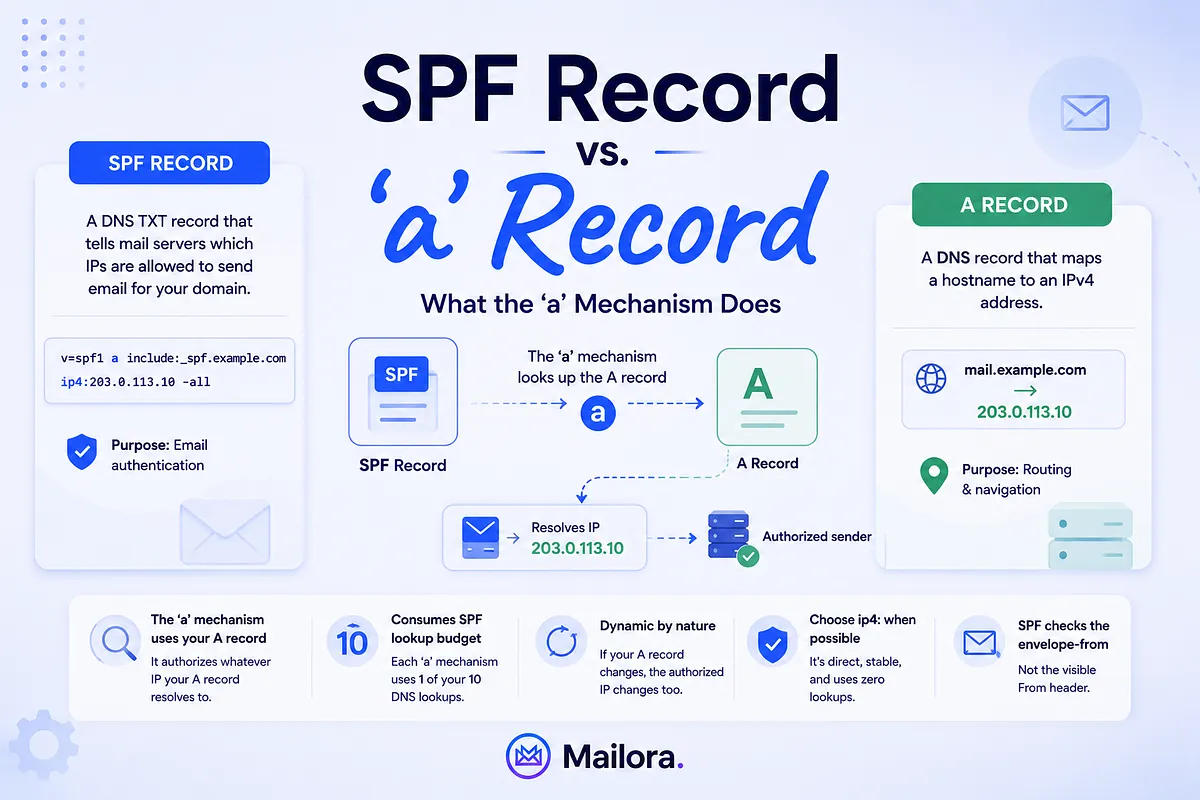
An ‘a’ record exists to route traffic, and maps a hostname to an IP address so systems know where to connect. An SPF record exists to establish sending authorization. It tells receiving mail servers which IP addresses are allowed to send email on behalf of your domain.
When you add ‘a’ to an SPF record, you're effectively telling receiving servers: "Look up this domain's ‘a’ record and authorize whatever IP address it resolves to."
However, every ‘a’ mechanism consumes SPF lookup budget, introduces a dependency on DNS records that may change over time, and can create authentication issues that are difficult to spot until deliverability starts to decline.
In this guide, we'll break down the difference between SPF records and ‘a’ records, explain exactly how the SPF ‘a’ mechanism works, and how to verify that your SPF configuration supports reliable email authentication and inbox placement.
SPF Record vs. ‘a’ Record
The only reason SPF Record and ‘a’ record appear together is because of the ‘a’ mechanism, a shorthand inside SPF that references the ‘a’ record to pull an IP address. Connected by that mechanism, but fundamentally different in what they are and what they do.
An ‘a’ record maps a hostname to an IPv4 address:
An ‘a’ record maps a hostname to an IPv4 address, for example: mail.example.com → 203.0.113.10.
When a mail client, browser, or server needs to reach a hostname, the ‘a’ record is what resolves that name to a routable IP. It plays no role in determining whether an email is trusted, and it has no knowledge of what the SPF record does with the IP it exposes.
An SPF record handles email trust:
An SPF record is published as a DNS TXT record. It contains a list of mechanisms, specifying which servers and IP addresses are authorized to send email for a domain. When a receiving mail server processes an incoming message, it looks up the sender's SPF record, checks the sending IP against those mechanisms, and passes or fails the check accordingly.
The connection between them is the ‘a’ mechanism. Inside an SPF record, ‘a’ instructs receiving servers to look up the domain's ‘a’ record, retrieve the IP it resolves to, and treat that IP as an authorized sender. The SPF record references the ‘a’ record, but the dependency is one-way. The ‘a’ record has no knowledge of SPF.
| SPF Record | A Record | |
| What it is | A DNS TXT record | A DNS record type of its own |
| What it does | Lists servers/IPs authorized to send email for a domain | Maps a hostname to an IPv4 address |
| Purpose | Email authentication | Routing/navigation |
| Record type | TXT | ‘a’ |
| Who reads it | Receiving mail servers | Anyone resolving a hostname to an IP |
| Example | v=spf1 ip4:203.0.113.10 -all | mail.example.com → 203.0.113.10 |
| Relationship to each other | Can reference the ‘a’ record via the ‘a’ mechanism | Has no awareness of SPF |
| Can it change email trust? | Yes | No |
[Table: A quick comparison between SPF record and ‘a’ record]
What is SPF?
An SPF record is a DNS TXT record that specifies which mail servers and IP addresses are authorized to send email on behalf of a domain. Published in the domain's DNS as a TXT entry, it contains a list of mechanisms, such as ip4:, include:, mx, and a, each defining a permitted sending source.
When a receiving mail server processes an incoming message, it looks up the sender's SPF record and checks the sending IP against those mechanisms. If the IP matches an authorized entry, SPF passes, if not, it fails or soft-fails depending on the record's terminator.
SPF exists because SMTP does not authenticate senders by default, making domains vulnerable to spoofing without it.
What is “a” Mechanism?
The ‘a’ mechanism is an SPF directive that authorizes a domain's sending IP by referencing its DNS ‘a’ record rather than specifying the IP directly. When an SPF record contains ‘a’, receiving mail servers resolve the sending domain's ‘a’ record, retrieve the IPv4 address it points to, and treat that address as an authorized sender for the domain.
A match passes SPF, and no match fails it. The mechanism can also reference a specific hostname, a:mail.example.com, or apply a CIDR prefix to authorize a subnet. Since it resolves dynamically at delivery time, the authorization it grants is only as stable as the ‘a’ record it references.
Syntax variants you'll encounter
These are the four forms you'll see in real SPF records:
- a - Look up the current domain's ‘a’ record and authorize those IPs.
- a:mail.example.com - Look up a different hostname's ‘a’ record (useful when your mail server is on a subdomain or a separate host).
- a/24 - Look up the ‘a’ record, then apply a CIDR prefix, authorizing the entire /24 subnet that the resolved IP belongs to. a:example.com/24 does the same for a named host.
- Qualifiers: If there's no explicit qualifier in front of the mechanism, + (Pass) is assumed, so ‘a’ is shorthand for +a. The other qualifiers are - (Fail), ~ (SoftFail), and ? (Neutral), giving you forms like -a or ~a:mail.example.com.
When ‘a’ is the right tool
The ‘a’ mechanism is the right choice when your email is sent from the same server your domain's ‘a’ record already points at, typical for self-hosted mail or a single-box setup. It's clean and requires no manual IP entry.
It ties your email authorization to whatever that ‘a’ record resolves to on the day a message is delivered. However, if the IP changes, everything breaks silently, with no error message and no syntax violation.
The ‘a’ Mechanism's Two Hidden Costs
Using ‘a’ looks straightforward, with one mechanism, no IP to hardcode, no manual entry to maintain. However, it carries two costs that don't surface as syntax errors and don't produce immediate warnings. They show up later, quietly, in the form of failed authentication and degraded delivery.
1. It counts toward the 10-lookup limit
RFC 7208, the standard that governs SPF, caps SPF evaluation at 10 DNS-querying mechanism lookups. Exceeding that limit doesn't produce a soft error or a warning. It produces a PermError, which causes the SPF evaluation to fail for every message from that domain.
The mechanisms that each consume one lookup: a, mx, include, ptr, and exists. The mechanisms that cost zero lookups: ip4: and ip6:, which resolve to literal addresses.
If you're already running include:_spf.google.com, include:_spf.mailgun.org, and include:sendgrid.net, three includes that collectively fan out into more nested lookups, adding ‘a’ "just to be safe" can be the mechanism that tips you over the limit. If you already know your sending IP, ip4:203.0.113.10 authorizes it with zero lookup cost. ‘a’ costs you one.
Quick decision guide:
- You know your server's IP → use ip4: (free, stable, precise)
- Your IP changes regularly and you control the ‘a’ record → ‘a’ is reasonable, but track your lookup count
- You're already at 8+ lookups → use ip4: regardless; do not add ‘a’
There's also a secondary cap worth knowing: 2 void lookups (DNS queries that return empty results) trigger an automatic PermError. ptr lookups are particularly prone to this, which is part of why the ptr mechanism is deprecated and strongly discouraged.
2. It silently inherits whatever your ‘a’ record resolves to
When you write ‘a’ in your SPF record, you're not authorizing a fixed IP, you're authorizing "whatever example.com resolves to today."
Common failure modes:
- Your web host changes your server's IP during a migration. Your ‘a’ record updates. Your SPF record now authorizes the new IP, which might not be your mail server.
- You're on shared hosting. The ‘a’ record points at a shared IP used by hundreds of other domains. Whoever else is on that IP may be sending mail; ‘a’ in your record gives them a pass.
- You updated the ‘a’ record deliberately for a website change and forgot the SPF dependency entirely.
None of these produce a syntax error, and your SPF record looks valid. The only signal that something's wrong is deliverability degrading, which is easy to attribute to the wrong cause.
This is the "it worked last month" failure mode. The ‘a’ mechanism is only as stable as the ‘a’ record underneath it.
SPF Mechanism Reference + Real Examples
SPF gives you eight mechanisms to work with. Each one defines a different way to authorize a sending source, carries a different lookup cost, and fits a different use case.
Here's the full reference, what each mechanism authorizes, whether it consumes one of your ten permitted DNS lookups, and what it looks like in a real record.
Mechanism reference table
The lookup cost column is the one most SPF records ignore until they hit a PermError. Read it alongside the mechanism, not after.
Mechanism | What it authorizes | Costs a DNS lookup? | Example |
| a | The domain's A/AAAA record IPs | Yes | v=spf1 a -all |
| mx | IPs of the domain's MX hosts | Yes | v=spf1 mx -all |
| ip4 | A specific IPv4 address or CIDR range | No | ip4:203.0.113.0/24 |
| ip6 | A specific IPv6 address or CIDR range | No | ip6:2001:db8::/32 |
| include | Another domain's full SPF policy | Yes | include:_spf.google.com |
| ptr | Reverse DNS match (deprecated) | Yes | (avoid entirely) |
| exists | Macro-based DNS existence check | Yes | exists:%{i}._spf.example.com |
| all | Everything (used only as terminator) | No | -all, ~all |
[Table: Table: SPF mechanisms explained, what each mechanism authorizes, whether it consumes DNS lookups, and when to use it.]
On ptr: This mechanism is deprecated and strongly discouraged by the SPF standard. It's slow, unreliable, and explicitly advised against using it. If you see ptr in an existing record, remove it.
Real SPF records, read plainly
Record | What it authorizes | Lookup cost | Notes |
| v=spf1 a -all | IPs in the domain's ‘a’ record only; hard-fails everyone else | 1 | Simple single-server setup |
| v=spf1 a mx include:_spf.google.com ~all | ‘a’ record host + MX hosts + Google Workspace IPs; soft-fails everyone else | 3+ | Google's include fans out into nested lookups. Verify the real count with an SPF checker before publishing |
| v=spf1 ip4:203.0.113.10 -all | One specific IP; hard-fails everyone else | 0 | The lookup-free equivalent of v=spf1 a -all when the IP is known; no inherited A-record fragility |
| v=spf1 include:_spf.google.com include:sendgrid.net ip4:198.51.100.5 -all | Google Workspace + Sendgrid + one internal SMTP server; hard-fails everyone else | 2+ | No a or mx, deliberate, to conserve lookups |
[Table: Real SPF records and what each one authorizes, costs, and is suited for]
Terminator and structural rules
Always close your SPF record with a terminator:
Terminator | What it does | Use in production? |
| -all | Hard fail .Every sender not explicitly authorized in the record fails | Yes. Correct for production |
| ~all | Soft fail. Unauthorized senders are flagged but not rejected | Transitional only. Tighten to -all once your sending inventory is stable |
| +all | Authorizes the entire internet | Neve. Defeats the purpose of SPF entirely |
[Table: SPF record terminators and when to use them]
Each domain should have only one SPF TXT record. Multiple v=spf1 records on the same domain cause a PermError. If your record is getting too long or hitting the lookup limit, the fix is consolidating ip4:/ip6: ranges where possible, or publishing separate SPF records on subdomains. Each subdomain gets its own independent 10-lookup budget, which is the most practical path when a root-domain record is overflowing.
How to Verify Your SPF (and the ‘a’ Mechanism) Is Actually Working
A technically valid SPF record does not guarantee ‘a’ working one. Syntax that parses cleanly can still fail authentication, through a lookup count that crossed 10, an ‘a’ mechanism pointing at the wrong IP, or an alignment gap that SPF alone will never surface. The verification workflow below covers all three.
1. Validate syntax and count your lookups.
Run your record through an SPF checker and confirm the total DNS-querying lookup count, including all nested include lookups, sits under 10. MxToolbox's DNS lookup tool will show you the flattened count. Every a, mx, and include in the record costs one lookup. If the count is at 8 or more, replace any ‘a’ or mx mechanisms with explicit ip4: entries where the IP is known.
2. Confirm the ‘a’ mechanism resolves to what you think.
If your record uses ‘a’, look up what your domain's ‘a’ record actually points to today, not when the record was written because DNS changes. If the IP your ‘a’ record returns isn't your mail server, the ‘a’ mechanism is authorizing the wrong thing, without producing any error.
3. Check alignment, not just pass/fail
SPF passing on the envelope-from is not the full picture. Confirm that the envelope-from domain matches or is a subdomain of the header-from domain, that's the alignment DMARC requires. Confirm DKIM is signing correctly. Both need to pass for DMARC to authenticate.
How to test email deliverability covers the end-to-end verification workflow beyond the DNS layer.
4. Monitor for drift over time
Point-in-time checks confirm the record is correct at the moment of the check. They don't catch what happens when a web host changes a server IP, a new ESP gets added without an SPF update, or the lookup count creeps past 10 between audits.
Mailora's authentication monitoring watches SPF, DKIM, and DMARC continuously, flagging lookup-limit breaches, alignment failures, and configuration drift before they reach inbox placement.
Try Mailora to confirm your full authentication stack, SPF lookup count, alignment, and DKIM signing, is functioning as intended, not just syntactically correct.
A Valid ‘a’ Mechanism Isn't the Same as Deliverable Mail
Getting the ‘a’ mechanism syntactically right means SPF can pass. However, it doesn't tell you whether that pass translates into trusted, delivered mail, because SPF is one part of a three-signal authentication system, and it's checking an address your recipient never sees.
SPF Authenticates the Return-Path, Not the From Address People See
SPF authenticates the domain used in the SMTP envelope, the 5321.MailFrom or Return-Path address used during message delivery. It does not authenticate the visible From: address your recipient sees in their inbox.
People don't make trust decisions based on the Return-Path. They make them based on the From address.
A message can pass SPF successfully because the sending server is authorized to use the envelope domain, while displaying a completely different From: address to the recipient.
From the receiving server's perspective, SPF passed. From the recipient's perspective, the message can still appear to come from a trusted brand, company, or colleague.
SPF Is One Part of an Authentication System
SPF works alongside DKIM and DMARC, and verifies that the sending server is authorized to send mail. DKIM verifies that the message hasn't been altered in transit. DMARC connects those authentication results to the visible From: domain and tells mailbox providers how to handle messages that fail authentication.
You can have a valid SPF record, a correctly configured ‘a’ mechanism, and zero SPF errors, while still failing DKIM alignment or running a DMARC policy set to p=none that takes no enforcement action. In practice, mailbox providers evaluate the combined result, instead of SPF in isolation.
Authentication Changes Faster Than Most Teams Realize
- IP addresses change.
- Mail infrastructure changes.
- New ESPs get added.
- Old sending platforms stay in records long after they're retired.
SPF lookups gradually accumulate until ‘a’ record approaches the ten-lookup limit. A configuration that worked perfectly during setup can become problematic months later. Unfortunately, these failures do not generate immediate and obvious warnings.
Most teams discover an SPF problem because inbox placement starts slipping, authentication results become inconsistent, or deliverability suddenly becomes harder to explain.
Getting the ‘a’ mechanism right is an important first step. Making sure SPF, DKIM, and DMARC continue working together as your sending infrastructure evolves is the part that requires ongoing visibility.
Keeping SPF Aligned with your Sending Infrastructure
Most deliverability issues are not caused by a missing ‘a’ record or a broken SPF record alone. They happen when small DNS decisions accumulate over time, such as
- A new sending platform gets added but never authorized in SPF
- An old service remains included long after it's retired
- A mail host changes IP addresses, or
- A record that worked perfectly a year ago no longer reflects how mail is actually being sent today.
Treating SPF as a one-time setup task is risky because authentication is not static infrastructure. Every new ESP, CRM, outbound platform, marketing tool, or transactional mail service changes the sending environment and potentially changes what should be authorized.
Understanding how SPF references ‘a’ records helps you troubleshoot failures. Continuously validating that those references still match active domains protects deliverability.
Mailora monitors your SPF record, DKIM signing, and DMARC alignment continuously, flagging authorization gaps, lookup-limit breaches, and configuration drift before they reach inbox placement.
FAQs
Is an SPF record an ‘a’ record or a TXT record?
An SPF record is a TXT record, the dedicated SPF resource-record type was deprecated, so TXT is the only valid format today. An ‘a’ record maps a hostname to an IPv4 address and has no authentication role. The SPF ‘a’ mechanism references it, but the two record types are entirely separate.
What does the ‘a’ mechanism do in an SPF record?
The ‘a’ mechanism tells receiving servers to look up the ‘a’ record of your sending domain and authorize any IP addresses found there. If your domain's ‘a’ record points to 203.0.113.10, then v=spf1 a -all authorizes that IP to send mail for your domain.
Does the ‘a’ mechanism count toward the SPF 10-lookup limit?
Yes. The ‘a’ mechanism requires a DNS lookup and counts as one of the ten permitted lookups per RFC 7208. Exceeding the 10-lookup ceiling causes a PermError, failing SPF for every message from the domain.
Do I actually need the ‘a’ mechanism in my SPF record?
Not usually. The ‘a’ mechanism is appropriate when your mail server and your domain's ‘a’ record resolve to the same IP. If you know that IP and it's stable, ip4: is simpler, cheaper (no lookup), and less fragile because it won't silently inherit a changed ‘a’ record.
What's the difference between ‘a’ and "mx" in an SPF record?
Both a and mx cost one DNS lookup and authorize IPs based on DNS lookups. The difference is what they resolve: ‘a’ resolves the domain's ‘a’ record and authorizes those IPs; mx resolves the domain's MX records and then resolves the ‘a’ records of each MX host, authorizing the IPs found there.
Stay in the loop
Deliverability insights, product updates, and early access to new features. No spam, unsubscribe anytime.
By subscribing, you agree to our Privacy Policy. Unsubscribe anytime.