What Are DMARC Digests and Why They're Easier to Act On
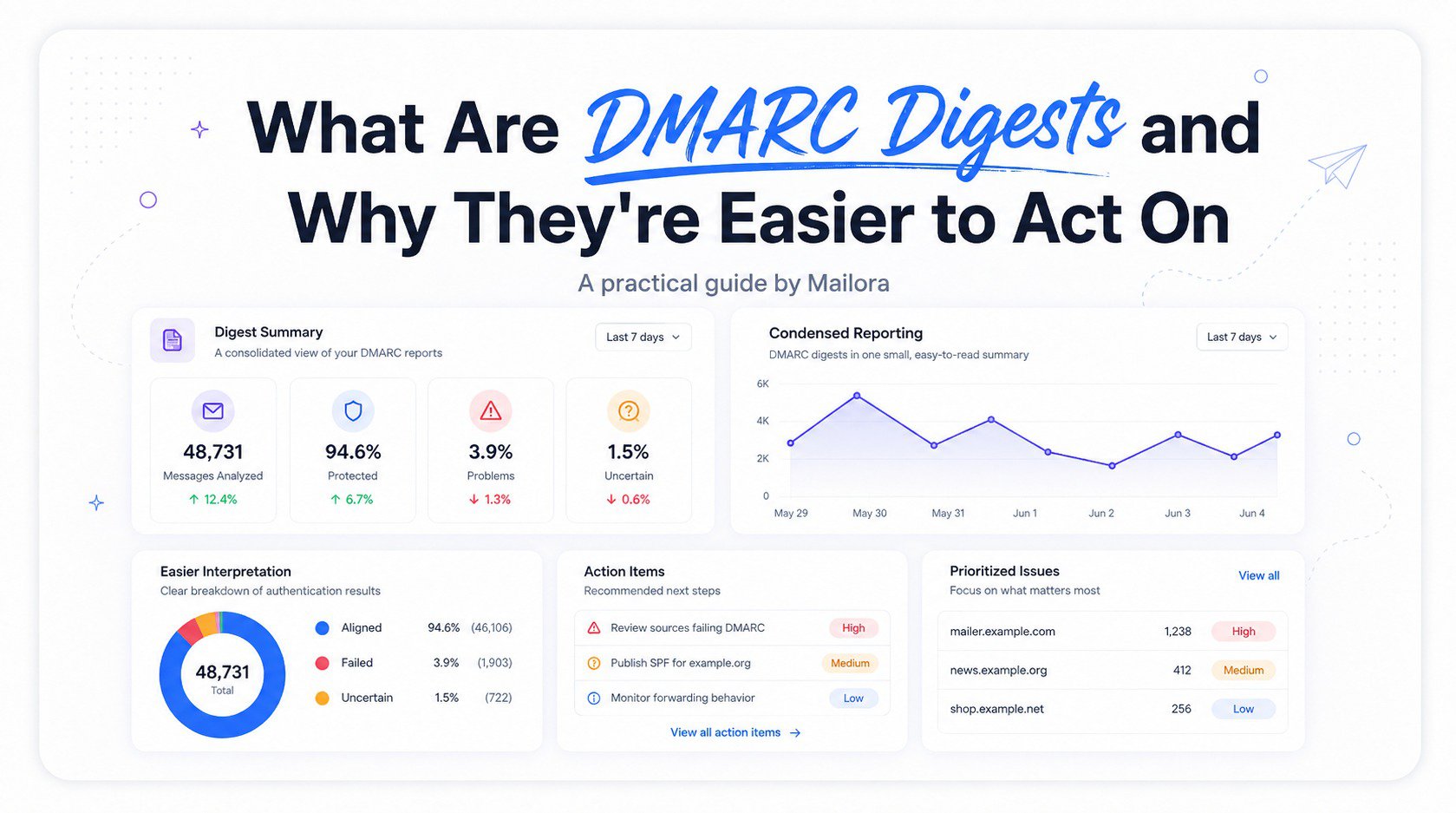
Publish a DMARC record with reporting enabled, and within a day or two, an inbox starts filling up with compressed XML attachments from Google, Microsoft, Yahoo, and dozens of smaller providers. Each one is technically useful. Together, they're close to unusable without help, which is exactly the gap DMARC digests are built to close. A digest takes that raw, fragmented reporting data and turns it into something a person can actually read and act on in a few minutes rather than an afternoon, helping domain owners address email authentication issues and improve email deliverability.
Why Raw DMARC Reports Are Hard to Use
The core problem with raw DMARC aggregate reports isn't that the data is bad. It's that it arrives in a format designed for machines, not people, and it arrives in pieces. A domain sending even a moderate volume of mail can receive reports from a dozen or more mailbox providers daily, each covering only that provider's view of the last 24 hours. Understanding the full picture means manually collecting, unzipping, and cross-referencing all of these separate files, a process that doesn't scale past the first week or two of curiosity for most teams. This is the exact gap DMARC digests are designed to fill.
The result, in practice, is that most domains with DMARC reporting enabled simply let the reports accumulate unread in an inbox, which defeats the entire purpose of setting up reporting in the first place. Without a dmarc analyzer, even organizations that want to combat spoofing can struggle to identify unauthenticated email from unknown sources.
What a DMARC Digest Actually Summarizes
A digest takes the raw aggregate data collected over a period, whether a day or a week, and condenses it into a format built for quick human review rather than machine parsing. DMARC digests typically present:
| Element | What It Shows |
|---|---|
| Total volume | Mail evaluated across all reporting providers |
| Pass/fail rate | Overall SPF and DKIM alignment outcome, including the dmarc compliance ratio |
| Source breakdown | Which systems are sending mail on the domain's behalf |
| What changed | New sources, rising failure rates, volume shifts since the last period |
Good DMARC digests go further than simple totals. They highlight what changed since the last period, flagging new sending sources that weren't present before, sources with rising failure rates, and any significant shifts in overall sending volume. This "what's different" framing is often more valuable than the raw totals themselves. It can also reveal failed SPF alignment, dmarc failures, and problems with dmarc alignment before they affect more email messages.
Daily vs Weekly Digest Cadence
The right cadence for DMARC digests depends largely on where a domain is in its DMARC rollout and how much sending volume it handles. During the early stages of implementation, particularly while a domain is still at a policy of p=none and actively identifying every legitimate sending source, daily digests are usually worth the extra attention.
Once a domain has reached a stable, well-understood sending pattern and moved to enforcement, weekly digests are often sufficient for ongoing monitoring, since the goal shifts from active discovery to catching meaningful changes. A reasonable middle ground many teams settle on is a hybrid approach: automated alerts for high-priority findings, paired with a standard weekly digest for routine review. This helps domain owners act in a timely manner while maintaining control over outbound email traffic.
What to Look For in a Digest
A handful of patterns are worth specifically watching for whenever reviewing DMARC digests, regardless of cadence:
- New sending sources, which deserve the fastest attention, since a source that wasn't present in previous digests is either a newly added legitimate tool that needs authentication, or something less benign, such as email scammers sending spoofed email.
- Rising failure rates from an otherwise established, known source, often pointing to a configuration change on that platform's end or incorrect email verification settings.
- Volume shifts, especially unexplained increases from a specific source, which can indicate anything from a testing environment to a compromised system.
- Consistent low-level failures from a small, unfamiliar set of IPs, which sometimes indicate a slower, ongoing spoofing attempt or fake emails sent from unknown sources.
Digests that track trend direction over multiple periods, rather than presenting each period in isolation, make this kind of pattern recognition considerably easier. A useful dmarc report history also helps distinguish genuine dmarc failures from temporary reporting anomalies.
Moving From Digests to Ongoing Monitoring
DMARC digests solve the immediate readability problem, but they work best as part of a broader, ongoing monitoring habit rather than an occasional check-in. The value of DMARC reporting compounds over time. A digest reviewed once and then ignored provides a snapshot. A digest reviewed consistently, week after week, builds a working understanding of a domain's sending ecosystem that makes anomalies far easier to spot the moment they appear.
This is part of a broader pattern in deliverability management: point-in-time checks are useful, but they're consistently outperformed by continuous visibility. DMARC digests are, in effect, a monitoring tool applied specifically to authentication and sender identity. Leading brands trust dmarc digests to maintain visibility across domain groups and monitor email volume without manually reviewing raw dmarc reports.
Frequently Asked Questions
Are DMARC digests the same as DMARC reports?
Not exactly. DMARC reports are the raw aggregate (RUA) or forensic (RUF) data sent directly by mailbox providers. DMARC digests are a processed summary built from that raw data, designed to be readable and actionable rather than requiring manual XML parsing. They turn an email authentication protocol into practical insight for email receivers and domain owners.
Do I need a tool to generate DMARC digests, or can I build one manually?
It's technically possible to build a manual process, especially for a domain with very low sending volume and few sources, but it becomes impractical quickly. Most teams use a dedicated DMARC monitoring tool or free DMARC monitoring tool that automatically parses incoming reports and generates digests on a set schedule, with on-demand access when a deeper review is needed.
What should I do if a digest shows a sending source I don't recognize?
Investigate before assuming the worst. Check whether it corresponds to a tool someone on the team recently added that hasn't been properly authenticated yet. If it can't be traced to a known source, treat it as a potential spoofing concern and review the affected email domain, domain name, and any related domain transfer or vendor changes.
How does digest review fit into moving from a DMARC policy of none to reject?
DMARC digests make it possible to confirm every legitimate sending source is authenticating correctly before tightening enforcement, making a safe, confident move to quarantine and eventually reject possible without risking legitimate mail. They also provide a clear digest report for monitoring email authentication issues across major ISPs.
Learn how Mailora turns raw DMARC data into clear, regular DMARC digests, so authentication monitoring becomes a five-minute habit instead of an afternoon project.
Stay in the loop
Deliverability insights, product updates, and early access to new features. No spam, unsubscribe anytime.
By subscribing, you agree to our Privacy Policy. Unsubscribe anytime.