Deliverability Incident Response Playbook: How to Detect, Contain, and Recover from Email Delivery Failures
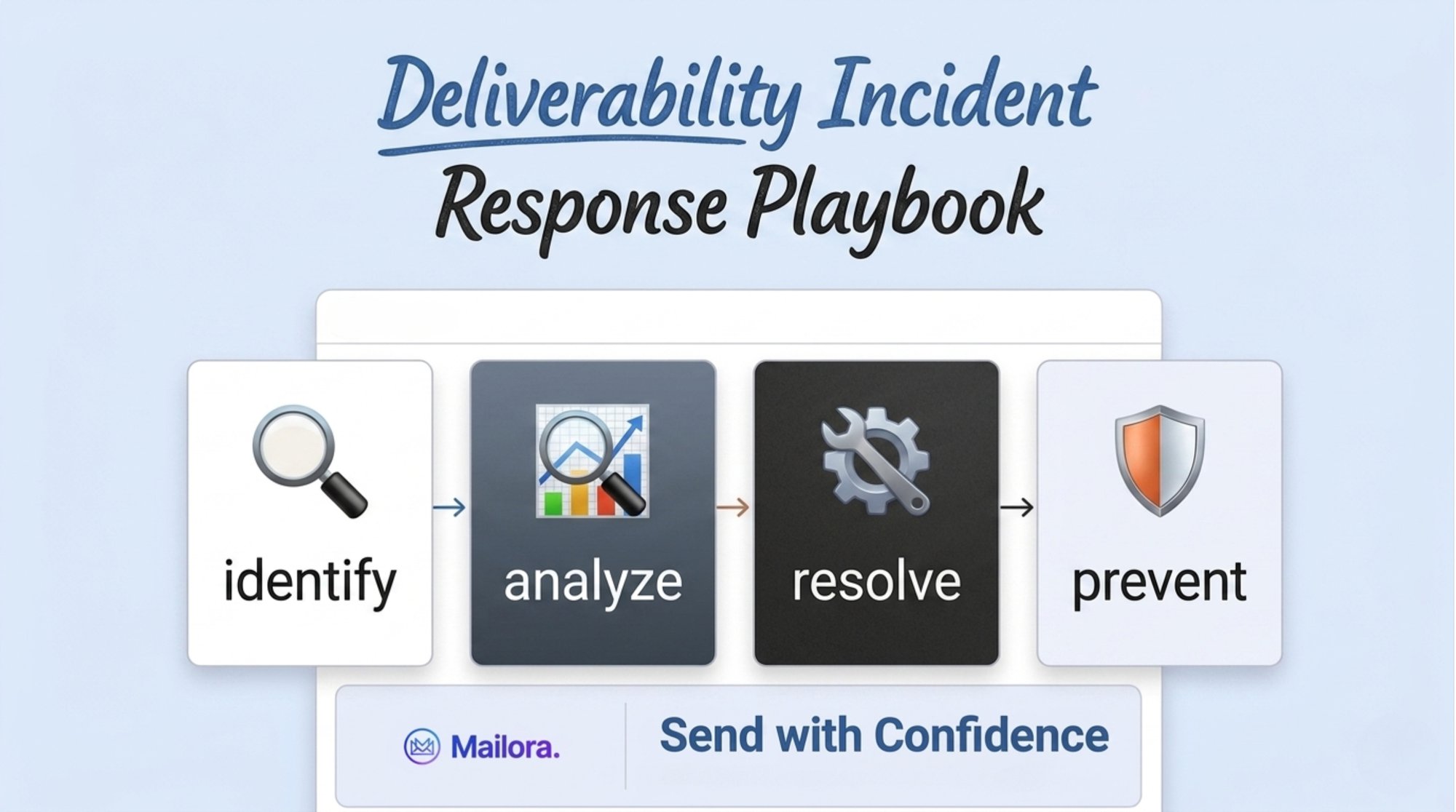
A deliverability incident response playbook becomes essential when email deliverability incidents start showing subtle warning signs rather than obvious failures. A small dip in inbox placement. A few “not receiving emails” tickets. One domain suddenly failing DMARC alignment.
Then revenue alerts start firing, lifecycle programs stall, and support queues fill with password reset issues.
That pattern is exactly why deliverability deserves the same structured discipline as security incident response: clear phases, defined roles, prebuilt run books, and a repeatable way to learn. Not because deliverability is “just like security,” but because both are operational risk problems where minutes matter, signals are noisy, and uncoordinated changes can make things worse, especially in critical moments where you need effective action, not guesswork.
Why treat deliverability like incident response
Security teams don’t improvise during an outage. They follow a playbook because:
- The blast radius can expand fast
- Root cause is unclear early on
- Multiple teams must act in parallel
- Communication needs to be consistent and auditable
Deliverability has the same characteristics. Inbox placement depends on reputation, authentication, infrastructure, content, list quality, and recipient behavior, so “quick fixes” can accidentally create bigger problems (for example, pausing one stream while a compromised subdomain keeps sending, or ramping volume to “catch up” and triggering throttling).
If your organization already runs cybersecurity incident management with formal procedures, a deliverability incident response playbook provides the same operational discipline for email programs while protecting revenue and customer trust. Think of it as a deliverability cyber incident response plan for email operations: the same overall strategy, adapted to inbox realities (and yes, you may end up with multiple incident response playbooks for different systems).
A deliverability incident response (IR) playbook gives you a shared operating model: how you detect issues, who decides what, what actions are allowed, and how you recover without guessing, so the right people can act fast, including customer-facing teams.
A well-designed deliverability incident response playbook starts by clearly defining what constitutes an incident and when escalation is required.
What qualifies as a deliverability incident
A deliverability incident is any unexpected change that materially impacts your ability to reach the inbox or deliver critical messages. Common triggers include:
- Inbox placement drops (or spam placement spikes) for key mailbox providers
- Authentication failures (SPF/DKIM/DMARC alignment, sudden fail rates)
- Reputation shifts (domain/IP reputation falling quickly, blocks, throttling)
- Infrastructure anomalies (new sending sources, DNS changes, expired certs, vendor misroutes)
- Complaint spikes (user reports, feedback loops, “this is spam” rate increases)
- Critical message failure (password resets, MFA, receipts, onboarding not landing)
A “serious incident” in deliverability is often the one that breaks the customer relationship: users can’t log in, trials can’t verify, or invoices don’t arrive, especially painful for b2b teams managing high-value accounts.
Once incident criteria are defined, the next component of a deliverability incident response playbook is a structured lifecycle that guides teams from detection through recovery.
The deliverability incident lifecycle (detection → response → recovery)
A practical playbook mirrors classic incident response phases (the traditional cybersecurity playbook), but maps them to deliverability-specific signals and decisions. The core components are the same: detection, containment, eradication, recovery, and a post-incident review.
Phase 1: Detection and triage
Detection should be multi-signal. Relying on one dashboard metric (like open rates) is fragile.
Core detection inputs
- Inbox placement monitoring (seed tests, panel data, or provider-level indicators)
- DMARC aggregate reports and authentication pass/fail trends
- Provider signals (deferrals, throttling patterns, block notifications when available)
- Internal telemetry (bounce classifications, latency, queue growth, delivery rates)
- Support signals (“not receiving” tickets, user complaints, resets failing)
- Change logs (DNS changes, new streams, vendor configuration updates)
Triage questions to answer in 15–30 minutes
- Is this global or isolated to a provider (Gmail, Microsoft, Yahoo/AOL)?
- Is it transactional, marketing, or both?
- Is it isolated to a domain, subdomain, IP pool, or new sending source?
- Is authentication failing (SPF, DKIM, DMARC alignment), or is reputation shifting?
- What changed in the last 24–72 hours (volume, list source, template, DNS, infrastructure)?
Deliverability intelligence platforms help here because they pull together authentication, infrastructure, and sending signals into one view. That’s the point of moving beyond pass/fail checks: you want early detection and faster scoping based on correlated evidence. If you’re centralizing these signals, tools like Mailora are designed to make that triage step faster and less ambiguous.
Phase 2: Containment and response
In security IR, containment is about limiting damage. In deliverability IR, containment is about limiting reputation harm and restoring reliable delivery for critical mail.
Typical containment actions include:
- Protect critical streams first
- Prioritize password resets, MFA, receipts, and legal notices
- Shift critical mail to the most trusted, stable sending path (where appropriate)
- Freeze risky change
- Pause template edits, list expansion, and volume ramp-ups until scoping is complete
- Stop the bleeding
- If a specific stream is causing complaints, pause it and isolate root cause
- If an unknown sender appears, remove or quarantine it immediately
- Reduce pressure intelligently
- Throttle or temporarily reduce volume rather than “blast to catch up”
- Segment to engaged recipients for non-critical campaigns during recovery
- Validate authentication and DNS
- Confirm SPF includes are correct, DKIM signing is active, DMARC alignment is intact
- Check for expired DKIM keys, missing records, or unintended DNS edits
Good response is conservative and measurable: one change at a time where possible, with a clear hypothesis and success metric. Treat these as clear steps with both technical steps (DNS/authentication validation) and mitigation tactics (throttling, pausing, segmentation).
Phase 3: Eradication and recovery
Recovery is not “we’re done when sends resume.” Recovery means you’ve restored stable inboxing and reduced the chance of recurrence.
Deliverability recovery actions often include:
- Reputation rebuild
- Gradual volume ramp (especially after blocks or spam placement)
- Engagement-based sending (suppress unengaged users temporarily)
- List and acquisition cleanup
- Audit recent acquisition sources, remove risky segments, confirm consent capture
- Tighten suppression rules for chronic bounces and complainers
- Content and UX fixes
- Align subject/body expectations, reduce “surprise,” improve preference controls
- Ensure unsubscribe works reliably and is easy to find
- Infrastructure hardening
- Separate streams (marketing vs transactional) via subdomains/IP pools if needed
- Lock down DNS change processes and key rotation schedules
- Review resilience risks like vendor routing mistakes, database failures in event pipelines, and config drift that can mimic “deliverability problems”
Recovery should end with a clear “back to baseline” definition: not only deliver rates, but inbox placement, complaint rate, and provider-specific behavior stabilizing over multiple days.
Define severity levels and response targets
Deliverability incidents benefit from a shared severity model so you don’t debate urgency mid-crisis, and so everyone understands different severity and escalation rules.
| Severity | Typical symptoms | Business impact | Initial target response |
|---|---|---|---|
| Sev 1 (critical) | Transactional mail failing or landing in spam; widespread blocks | Revenue, account access, support surge | Triage in 15 min, containment in 60 min |
| Sev 2 (major) | Major provider spam placement; sharp reputation drop for a primary domain | Campaign performance and pipeline risk | Triage in 30 min, containment same day |
| Sev 3 (moderate) | Localized issues (one stream, one region, one template) | Manageable degradation | Triage in 4 hours, fix in 1–3 days |
| Sev 4 (minor) | Metric anomaly without user impact | Low | Investigate during business hours |
Security IR works because roles are predefined. Deliverability should be the same, especially when customer-facing teams need a consistent message, and when compliance issues (like consent records or unsubscribe handling) might be part of the root cause.
Recommended roles
- Incident commander (IC): runs the process, assigns owners, keeps timeline, approves major changes
- Deliverability lead: scopes provider signals, reputation/authentication hypotheses, recommends actions
- Messaging owner: owns templates and program logic, helps isolate which streams changed
- Infrastructure/DNS owner: verifies SPF/DKIM/DMARC, sending routes, IP pools, vendor settings
- Data/analytics partner: validates impact and recovery with clean measurement
- Customer support liaison: tracks user-reported impact, aligns messaging, confirms resolution (often partnering closely with the customer support team)
- Comms owner: internal updates and (if needed) customer-facing incident communication
- Dev team representative (when needed): helps validate application-triggered sends, event timing, and upstream failures
- Relevant leadership teammates (as escalation requires): unblock decisions, tradeoffs, and customer messaging
One person can hold multiple roles in smaller teams. What matters is that each responsibility is explicitly covered.
Runbooks: turn “what we should do” into “what we do next”
A deliverability playbook should include short, provider-agnostic runbooks that remove ambiguity under stress. Keep them action-oriented and step-based, these are important elements of a trust-building incident response playbook, and they often look like customer support-focused incident response playbooks when password resets and onboarding are impacted.
Runbook 1: sudden DMARC failure spike
Goal: restore authentication alignment and stop unauthenticated mail from harming reputation.
- Confirm the failing domain(s) and selectors (which DKIM keys, which subdomains).
- Identify source(s) generating failures (new vendor, new IP range, unknown system).
- Validate DNS records:
- SPF includes and lookup limits
- DKIM public keys published and correct
- DMARC policy and alignment mode
- If an unknown sender is present:
- Contain: stop sending, block at source, and remove from DNS includes
- Re-test and monitor pass rates until stable for 24–48 hours.
- Document root cause and preventive controls (change management, vendor onboarding checklist).
Runbook 2: inbox placement drop at a major provider
Goal: stabilize reputation and restore inboxing without introducing new risk.
- Verify scope: provider-specific or global; marketing vs transactional.
- Check recent changes: volume, list source, creative, cadence, new subdomain/IP.
- Contain:
- Pause or reduce non-critical volume
- Prioritize engaged audiences
- Protect transactional delivery paths
- Investigate leading indicators:
- Complaint rates and unsubscribe rates
- Bounce/deferral patterns (throttling vs blocks)
- Spam placement by stream/template
- Remediate:
- Remove risky segments
- Adjust cadence/ramp plan
- Fix misleading content or broken unsubscribe flows
- Recovery: gradual ramp with checkpoints; confirm stability over multiple send cycles.
Runbook 3: unexpected new sending source appears
Goal: prevent rogue mail from damaging domain reputation.
- Identify the sender (IP, domain, envelope, DKIM signature) and when it started.
- Confirm whether it is authorized.
- If unauthorized:
- Disable credentials and routes
- Remove from SPF includes / vendor configs
- Consider tightening DMARC policy if appropriate
- Monitor authentication and reputation signals for after-effects.
- Post-incident: vendor and internal system access audit.
This runbook is also where you sanity-check whether the “new source” is a legitimate integration, a compromised credential, or something that behaves like a phishing attack (spoofing or lookalike sending). It’s a textbook example of how a small anomaly can become a real-world incident if you don’t contain it quickly.
Communication templates that keep everyone aligned
Deliverability incidents fail when updates are vague (“opens are down”) or overly technical (“SPF alignment drift”). The best updates translate signals into impact and next steps, especially for customer-facing teams working live queues.
Internal update template (Slack / Teams)
- Status: Investigating / Contained / Recovering / Resolved
- Severity: Sev X
- Impact: What users/business flows are affected (and where)
- Scope: Providers, domains, streams involved
- Current hypothesis: One sentence
- Actions taken: Bullet list
- Next actions + owner + ETA: Bullet list
- Next update: Time
Executive summary template (email)
- What happened (plain language)
- Customer/business impact
- What we did to contain
- What’s next (recovery plan and timeline)
- Risk of recurrence (low/medium/high) and what reduces it
Customer-facing note (if needed)
Keep it calm and specific: which messages, what timeframe, what the customer should do (if anything), and when you’ll update again. This is especially important if the incident touches high-value accounts or regulated workflows where compliance issues may arise.
Post-incident review (PIR): make it measurable, not blameful
A good PIR produces two things: clarity and change.
What to include
- Timeline (detection → triage → containment → recovery → resolution)
- Root cause and contributing factors (technical + process)
- What signals worked, what signals were missing
- What we changed during the incident (with outcomes)
- Preventive actions with owners and due dates
Deliverability-specific metrics to capture
- Time to detection (TTD)
- Time to containment (TTC)
- Inbox placement by provider over time (where available)
- Authentication pass rates and changes (SPF/DKIM/DMARC)
- Complaint rate, unsubscribe rate, bounce/deferral trends
- Estimated business impact (e.g., reset failures, conversion drops)
This is where an intelligence layer pays off: when deliverability signals, DMARC data, and infrastructure context are already consolidated, your PIR becomes faster and more factual, not a debate over whose dashboard is “right.”
Tabletop exercises and simulations (before the real crisis)
The best time to discover gaps is when nothing is on fire.
How to run a deliverability tabletop in 60–90 minutes
- Pick one scenario
- “DMARC failures spike after a vendor launch”
- “Microsoft starts throttling transactional mail”
- “Spam placement jumps after a list import”
- Assign roles
- Incident commander, deliverability lead, infra/DNS, messaging owner, comms
- Provide a timed injects
- Minute 0: open rate drops / support tickets appear
- Minute 15: DMARC fail rate increases
- Minute 30: provider deferrals spike
- Minute 45: leadership asks for ETA and customer impact
- Force decisions
- What do you pause? What do you protect? What do you measure next?
- Debrief
- What was unclear, missing, or too slow?
What to test for (and fix immediately)
- Can you identify all active sending sources within 15 minutes?
- Do you have a clean owner for DNS and authentication changes?
- Can you segment critical vs non-critical streams quickly?
- Are there pre-approved containment actions (pause, throttle, suppress segments)?
- Do you have a single “source of truth” for deliverability signals?
If the answer is “not reliably,” that’s the work. Build the muscle memory before you need it.
A practical starting checklist
If you want a simple path to a first version of the playbook, start here:
- Define severity levels and what “critical” means for your business
- List roles and a primary + backup for each
- Create three runbooks (DMARC failure, provider spam placement, rogue sender)
- Add two comms templates (internal + exec)
- Define recovery criteria (what metrics must stabilize, and for how long)
- Run one tabletop exercise this month, then update the playbook within 48 hours
Deliverability incidents are inevitable. Chaos isn’t. A structured incident response playbook turns inbox crises into manageable operational events, and helps you protect sender reputation, customer trust, and revenue when it matters most.
If you’re already mature on security playbooks (whether that’s a traditional cybersecurity playbook, something vendor-led like Palo Alto Networks guidance, or even an industry-specific public power cyber incident response playbook), this deliverability approach will feel familiar: same discipline, same post-incident learning loop, tailored to the systems that keep your customers informed and your business running.
Stay in the loop
Deliverability insights, product updates, and early access to new features. No spam, unsubscribe anytime.
By subscribing, you agree to our Privacy Policy. Unsubscribe anytime.