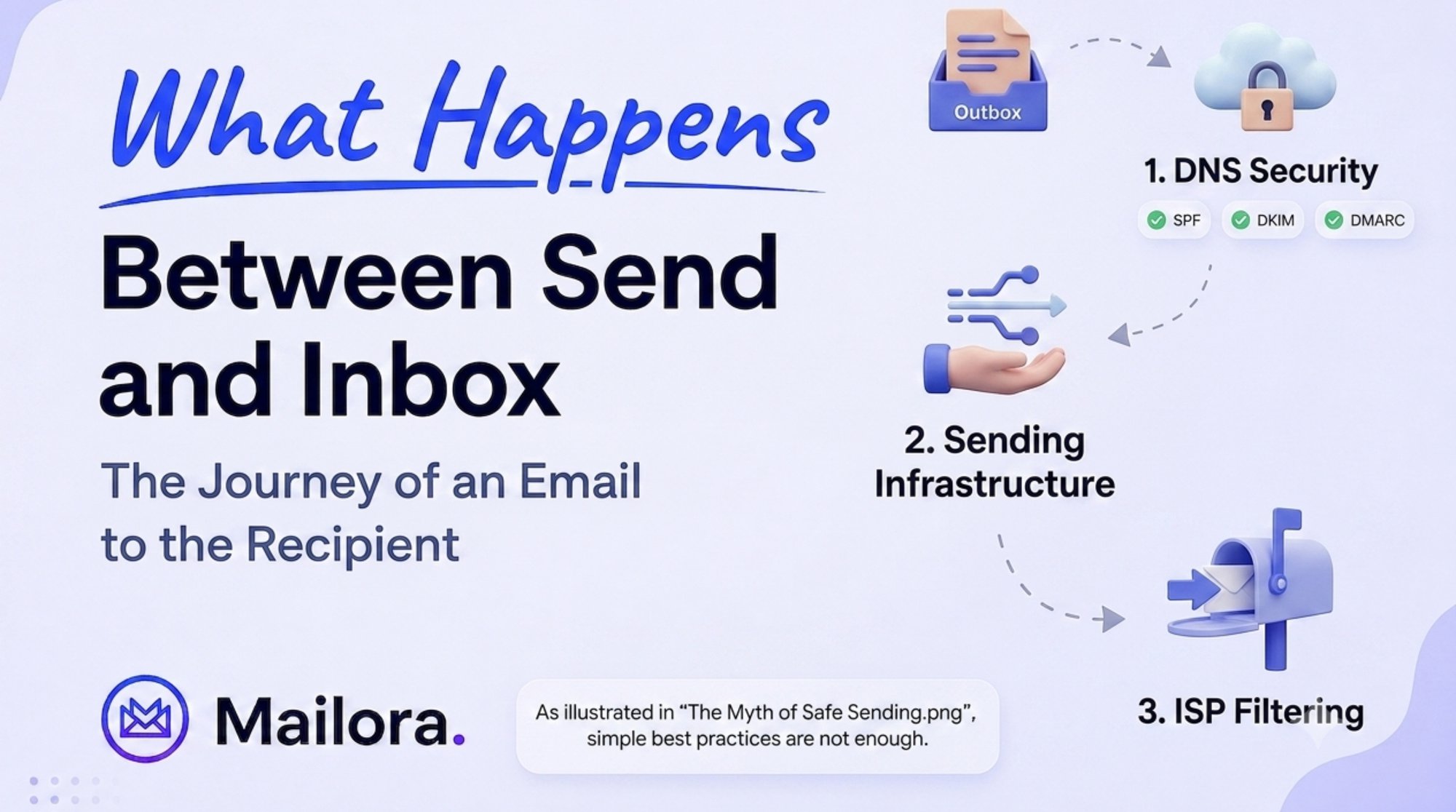
Two recipients on the same list, subscribed to the same campaign, sent from the same domain at the same moment, can end up with very different experiences. One finds the message sitting in their primary email inbox. The other never sees it, because it landed quietly in spam. Understanding what happens between send and inbox requires looking at the anatomy of a sequence most marketers never see but that determines the outcome of every campaign they send.
The Journey Every Email Takes
Every email travels through a series of distinct stages before a mailbox provider makes a final placement decision. Here is what happens between send and inbox, stage by stage:
| Stage | What Happens | What It Determines |
|---|---|---|
| Connection | Sending server contacts the receiving server | Whether the message is even accepted for evaluation |
| Authentication | SPF, DKIM, and DMARC are checked | Whether the message's identity can be trusted |
| Reputation | Sender and domain history are assessed | How much baseline trust the message starts with |
| Contextual evaluation | Content and recipient-specific history are analyzed | How relevant and wanted the message appears |
| Placement decision | Inbox, tab, spam, or rejection | Where the recipient actually finds the message |
This sequence happens in a fraction of a second from the sender's perspective, but each stage represents a genuine checkpoint, and a message has to pass through all of them favorably to land where the sender intends. The messages a sender sees in sent items or sent mail only confirm that the sending system processed them; they do not guarantee inbox delivery.
Authentication and Reputation Checks
Once a connection is established, the receiving server verifies the message's authentication. SPF confirms the sending IP is authorized to send on behalf of the domain. DKIM confirms the message hasn't been altered and genuinely originated from the claimed sender. DMARC ties these together, instructing the receiving server on how to handle messages that fail either check.
Authentication establishes identity, but identity alone doesn't determine trust. Immediately following authentication, receiving servers evaluate reputation, drawing on the sending IP's history, the domain's history, recent complaint rates, bounce patterns, and whether recent sends have hit spam trap addresses. This reputation data is cumulative, built from weeks or months of sending behavior rather than assessed fresh with each message.
Contextual Evaluation
With identity and reputation established, filtering systems move to a more nuanced evaluation of context. This includes the content of the message itself, its formatting, link patterns, and structure, but it also increasingly includes behavioral context: how similar messages from this sender have historically performed, and how this specific recipient has interacted with this sender in the past.
This is where things become recipient-specific rather than purely sender-specific. Gmail, in particular, uses machine learning models that weigh an individual user's engagement history heavily. A recipient who has consistently opened and engaged with a sender's previous messages sends a different signal than one who has ignored or deleted them without opening, even when both received the exact same campaign. In some cases, conversation view can also make a message appear alongside previous replies rather than as a separate item, so the visible result is not always evidence of actual duplicates or missing messages.
The Placement Decision
All of these signals converge into a final placement decision, made independently by each receiving mail server and, in some cases, refined further at the individual recipient level. The possible outcomes are:
- Primary inbox: reflects a high level of trust and relevance.
- Secondary tab, like Gmail's Promotions category: still delivered and accessible, but with meaningfully lower visibility.
- Spam folder: the combined signals fell short of the trust threshold required for inbox placement.
- Rejection: in cases involving serious authentication failures or severely damaged reputation, the message never reaches any folder at all.
It's worth emphasizing that this isn't a single global decision applied uniformly to an entire campaign. Gmail, Outlook, and Yahoo each apply their own filtering logic and weighting, which is why placement can vary noticeably across providers even for the exact same message sent under identical conditions. Recipient-side settings, such as forwarding rules and automatic replies, can also affect how a delivered message is displayed or handled after it reaches the mailbox.
Why Every Recipient May Experience Something Different
This is perhaps the most counterintuitive part of what happens between send and inbox for marketers used to thinking of a campaign as a single, uniform event: two recipients on the same email service provider can receive different placement outcomes for the identical message, based on their individual engagement history with the sender.
A recipient who regularly opens and clicks through a sender's emails builds up a kind of personal trust signal that can improve placement specifically for that recipient, even during a period when the sender's aggregate reputation is under some strain. Conversely, a recipient who hasn't engaged with a sender in a long time may see that sender's messages routed to spam specifically for them, even while the campaign performs reasonably well in aggregate.
This personalization reflects how mailbox providers, particularly Gmail, have moved deliverability decisions away from being purely sender-based toward being a blend of sender reputation and recipient-specific relationship signals. It's part of why deliverability is genuinely a spectrum rather than a binary outcome. The same principle can apply when messages pass through a delegated mailbox or an exchange account, where mailbox configuration and user behavior may influence what the recipient ultimately sees.
Why This Matters for How You Think About Deliverability
Understanding what happens between send and inbox reframes what "deliverability" actually means. It isn't a single property of a domain that's either good or bad. It's the outcome of a layered process, authentication, reputation, contextual evaluation, and recipient-specific history, that plays out slightly differently for every message and every recipient.
For marketing teams, the practical implication is that improving outcomes isn't about finding a single lever to pull. It requires attention across each layer: confirming authentication stays correctly configured, monitoring reputation trends over time, maintaining list hygiene to protect engagement quality, and being thoughtful about content and sending consistency.
Frequently Asked Questions
What happens between send and inbox, in the simplest terms?
A message moves through connection, authentication, reputation evaluation, contextual analysis, and finally a placement decision, all within seconds of being sent.
Why would the same email be filtered differently for two people at the same company, both using the same email provider?
Individual engagement history plays a real role in placement decisions, particularly with providers like Gmail. Even within the same organization, one recipient's past interactions with a sender can differ from a colleague's, leading to different placement outcomes for identical messages.
Does a strong sender reputation guarantee inbox placement for every recipient?
No. Strong aggregate reputation improves the odds significantly, but recipient-specific signals can still shift placement for individuals, particularly those who haven't engaged with a sender in a long time.
How much of what happens between send and inbox is actually visible to a sender?
Very little of it is directly visible. Senders can monitor authentication status, aggregate reputation signals, and engagement metrics, but the specific weighting and logic mailbox providers use internally isn't publicly disclosed. Reviewing sent items or sent mail can help confirm that a campaign was dispatched, but only recipient-side testing and monitoring can reveal where messages actually landed.
Learn how Mailora helps you monitor what happens between send and inbox, so you understand not just whether a campaign was delivered, but where it actually landed.
Stay in the loop
Deliverability insights, product updates, and early access to new features. No spam, unsubscribe anytime.
By subscribing, you agree to our Privacy Policy. Unsubscribe anytime.